
CAT4 Level A practice questions help Year 4 students become familiar with the reasoning skills they may need for the assessment. At this stage, children are building stronger vocabulary, better number confidence, more accurate visual thinking andhjkh problem-solving habits. With the right practice, students can learn how to approach unfamiliar questions calmly instead of rushing or guessing.
The CAT4 Level A assessment is different from an ordinary school test. It is not mainly about memorising facts or repeating classroom methods. Instead, it focuses on how a child thinks. A Year 4 student may need to compare words, identify a pattern, spot a number rule, recognise a figure, complete a visual puzzle or imagine how a shape changes when folded or turned.
For many children, CAT4-style questions feel unusual at first. They may look like puzzles, diagrams or short reasoning challenges. This is why practice questions are so useful. They help students understand the format, build confidence and learn how to explain their answers step by step.
This blog is written for CAT4 Level A Year 4 students and parents. It includes 20 sample question placeholders with answer and explanation spaces, so final question images, options, correct answers and child-friendly explanations can be added later.
CAT4 Level A preparation should cover four main reasoning areas:
- Verbal Reasoning
- Non-Verbal Reasoning
- Quantitative Reasoning
- Spatial Reasoning
These areas help students practise thinking with words, figures, numbers and shapes.
1. What Are CAT4 Level A Practice Questions?
CAT4 Level A practice questions are reasoning-style questions designed for Year 4 students. They help children practise the types of thinking needed in the assessment.
These questions may include:
- Word groups
- Word relationships
- Figure groups
- Matrix patterns
- Number relationships
- Number sequences
- Folded-paper tasks
- Shape recognition
- Multiple-choice answers
- Step-by-step explanations
The purpose of practice questions is not only to get answers right. The real goal is to help students understand the method behind each question.
1.1 Why Practice Questions Matter for Year 4 Students
Year 4 is an important stage for developing independent thinking. Children are becoming more confident readers, stronger problem-solvers and more aware of how to explain their ideas.
CAT4 Level A practice questions can help students improve:
- Vocabulary confidence
- Number reasoning
- Visual comparison
- Pattern recognition
- Shape awareness
- Careful observation
- Logical thinking
- Focus and concentration
- Mock test confidence
- Ability to learn from mistakes
When students practise regularly, the question style becomes more familiar and less intimidating.
1.2 How CAT4 Practice Questions Are Different from Normal Homework
Normal homework often checks what a child has recently learned in class. CAT4 practice questions are different because they ask students to use reasoning skills in unfamiliar situations.
A student may need to ask:
- What do I notice?
- What is the rule?
- Which answer belongs?
- Which option is different?
- How are these words connected?
- What number comes next?
- Has the shape moved or turned?
- What happens when the paper is unfolded?
This makes CAT4 practice more like structured problem-solving than ordinary revision.
2. Main CAT4 Level A Question Types
CAT4 Level A practice usually includes different question types across verbal, non-verbal, quantitative and spatial reasoning. Each type checks a different thinking skill.
2.1 Verbal Reasoning Question Types
Verbal Reasoning checks how students think with words.
The main question types are:
- Verbal Classification
- Verbal Analogies
Verbal Classification asks students to recognise words that belong together.
Verbal Analogies ask students to find a relationship between words and apply the same relationship to another pair.
Students should ask:
- What do these words mean?
- Which words belong together?
- Which word is different?
- How are the words connected?
- Which answer follows the same relationship?
2.2 Non-Verbal Reasoning Question Types
Non-Verbal Reasoning checks how students think with pictures, figures and visual patterns.
The main question types are:
- Figure Classification
- Figure Matrices
Figure Classification asks students to identify which figure belongs with a group.
Figure Matrices ask students to work out the missing figure in a pattern.
Students should ask:
- What is the same?
- What is different?
- What changed?
- Is the rule about shape, colour, size, direction or position?
- Which answer follows the visual rule?
2.3 Quantitative Reasoning Question Types
Quantitative Reasoning checks how students think with numbers.
The main question types are:
- Number Analogies
- Number Series
Number Analogies ask students to identify a number relationship and apply the same rule.
Number Series ask students to continue or complete a number pattern.
Students should ask:
- Are the numbers going up or down?
- What is added or subtracted?
- Is there a multiplication or division rule?
- Does the rule repeat?
- Which answer follows the pattern?
2.4 Spatial Reasoning Question Types
Spatial Reasoning checks how students think about shape movement, folding, unfolding and visual recognition.
The main question types are:
- Figure Analysis
- Figure Recognition
Figure Analysis may involve folded paper, holes, marks or unfolded patterns.
Figure Recognition asks students to identify the same figure when it has moved, turned or appeared in a different position.
Students should ask:
- Has the shape moved?
- Has it turned?
- What happens when it unfolds?
- Which option matches exactly?
- Which answer is only similar?
3. CAT4 Level A Practice Questions: 20 Sample Spaces
Use this section to insert 20 CAT4 Level A sample questions. These placeholders can be replaced later with final question images, answer options, correct answers and explanations.
Each practice space includes:
- Question number
- Placeholder for the question
- Answer space
- Explanation space
Students should try each question first, then review the answer and explanation carefully.
3.1 Verbal Reasoning Sample Questions
Question 1. The words in the first pair are related in a certain way. Choose the word that completes the second pair so that the words are related in the same way: easy → simple : withstand →
Choice A: yield
Choice B: waste
Choice C: bear
Choice D: ignore
Correct Answer: C
Explanation: “Easy” and “simple” mean nearly the same thing (both mean not hard to do). Similarly, “withstand” and “bear” both mean to hold out against. Choices A, B, and D are not similar in meaning to withstand.
Question 2. The words in the first pair are related in a certain way. Choose the word that completes the second pair so that the words are related in the same way: funny → amusing : adapt →
Choice A: oppose
Choice B: abandon
Choice C: neglect
Choice D: accommodate
Correct Answer: D
Explanation: “Funny” and “amusing” mean nearly the same thing (both mean causing laughter). Similarly, “adapt” and “accommodate” both mean to adjust to change. Choices A, B, and C are not similar in meaning to adapt.
Question 3. The words in the first pair are related in a certain way. Choose the word that completes the second pair so that the words are related in the same way: quiet → silent : allocate →
Choice A: assign
Choice B: hoard
Choice C: ruin
Choice D: scatter
Correct Answer: A
Explanation: “Quiet” and “silent” mean nearly the same thing (both mean making no sound). Similarly, “allocate” and “assign” both mean to give out shares. Choices B, C, and D are not similar in meaning to allocate.
Question 4. Choose the word that belongs in the same group as the first three words: double bass, violin, cello
Choice A. trumpet
Choice B. recorder
Choice C. drum
Choice D. clarinet
Choice E. guitar
Correct Answer: E
Explanation: Double bass, violin, and cello are string instruments. Choice E is correct because a guitar is also a string instrument. Choice A is a brass instrument. Choice B and Choice D are woodwind instruments. Choice C is a percussion instrument.
Question 5. Choose the word that belongs in the same group as the first three words: yuzu, lemon, calamansi
Choice A. mango
Choice B. pear
Choice C. peach
Choice D. lime
Choice E. plum
Correct Answer: D
Explanation: Yuzu, lemon, and calamansi are citrus fruits. Choice D is correct because lime is also a citrus fruit. Choice A, Choice B, Choice C, and Choice E are fruits but are not citrus fruits.
3.2 Non-Verbal Reasoning Sample Questions
Question 1
Choose the option that follows the same pattern as the three given figures:
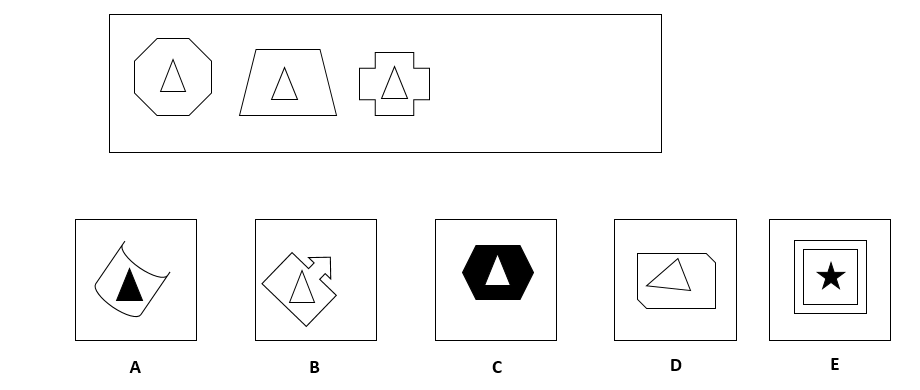
Correct Answer: B
Explanation: The three given figures have triangle inside the outer shape which is made of straight lines, B is the only figure that preserves both characteristics.
Question 2
Choose the option that follows the same pattern as the three given figures:
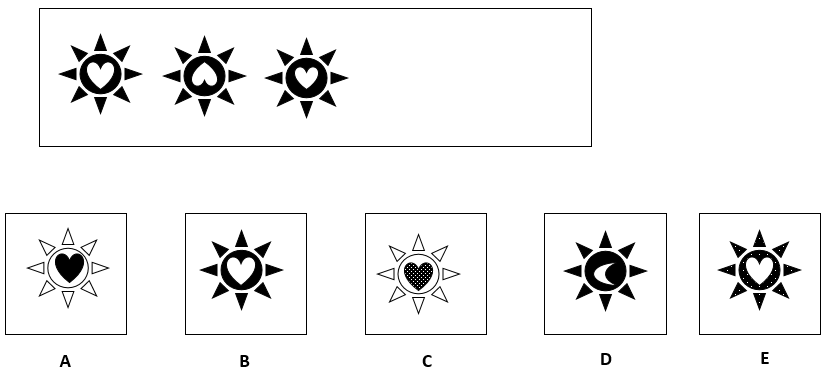
Correct Answer: B
Explanation: The three given figures are black sun having white heart in centre, B is the only figure that preserves both characteristics.
Question 3
Observe how the first pair of pictures are related. Then choose the picture that completes the second pair using the same rule:
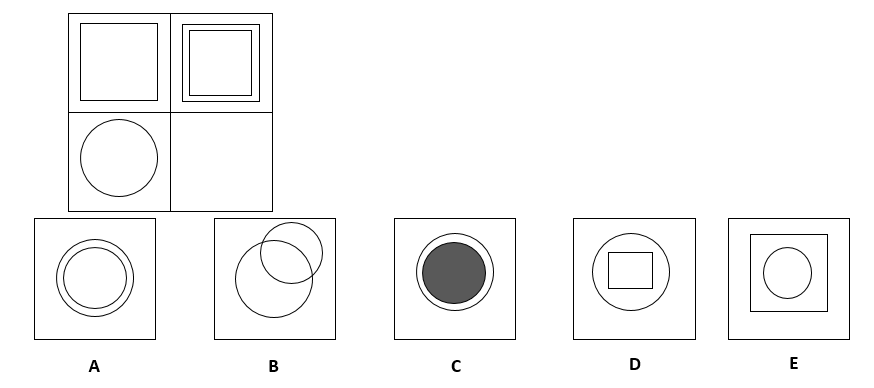
Correct Answer: A
Explanation: In the first pair, a smaller square is added inside the larger square, forming two concentric squares. Applying the same rule to the circle, we need to add a smaller circle inside the larger circle. Therefore, Option A is the correct answer because it shows two concentric circles, just like the first pair shows two concentric squares.
Question 4
Choose the answer choice that follows the pattern and complete the matrix.
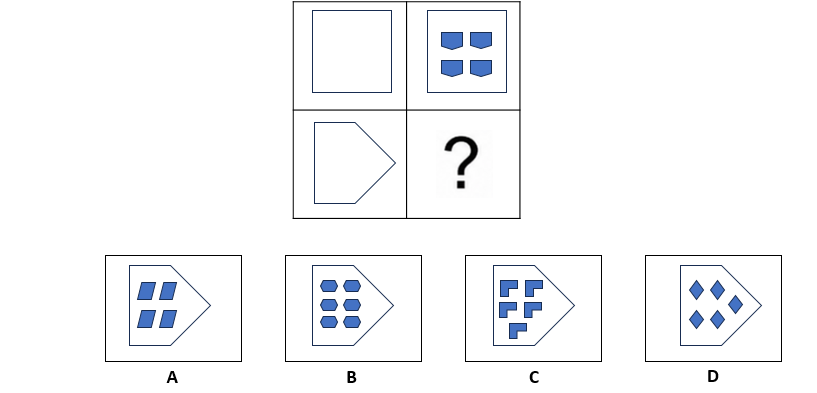
Correct Answer: C
Explanation: In the top row, the inner shapes are placed inside the outer shape. The number of inner shapes is equal to the number of sides of the outer shape. Also, each newly introduced inner shape has one more side than the outer shape, and all the inner shapes are blue in colour. Applying the same pattern to the bottom row, the outer shape has 5 sides. Therefore, there should be 5 inner shapes, and each inner shape should have 6 sides. The only answer that meets this criteria is answer C.
Question 5
Choose the answer choice that follows the pattern and complete the matrix.
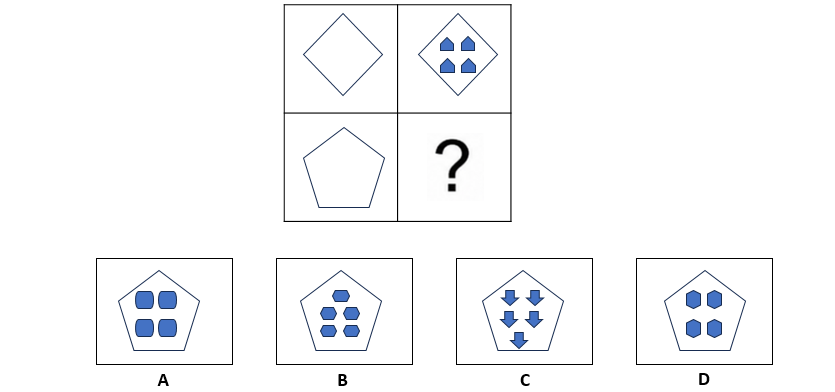
Correct Answer: B
Explanation: In the top row, the inner shapes are placed inside the outer shape. The number of inner shapes is equal to the number of sides of the outer shape. Also, each newly introduced inner shape has one more side than the outer shape, and all the inner shapes are blue in colour. Applying the same pattern to the bottom row, the outer shape has 5 sides. Therefore, there should be 5 inner shapes, and each inner shape should have 6 sides. The only answer that meets this criteria is answer B.
3.3 Quantitative Reasoning Sample Questions
Question 1. Choose the number that completes the third pair so that it demonstrates the same relationship as the first two pairs. [5 → 8] [14 → 17] [21 → ?]
Choice A. 24
Choice B. 25
Choice C. 18
Choice D. 28
Choice E. 30
Answer: A
Explanation: In each pair, 3 is added to the first number to obtain the second number. 5 + 3 = 8 and 14 + 3 = 17. Applying the same rule to the final pair, 21 + 3 = 24. Therefore, the missing number is 24.
Question Topic: Number Relationships
Question SubTopic: Pair Rules
Question 2. Choose the number that completes the third pair so that it demonstrates the same relationship as the first two pairs. [18 → 12] [35 → 29] [9 → ?]
Choice A. 15
Choice B. 2
Choice C. 3
Choice D. 4
Choice E. 14
Answer: C
Explanation: In each pair, 6 is subtracted from the first number to obtain the second number. 18 – 6 = 12 and 35 – 29 = 6. Applying the same rule to the final pair, 9 – 6 = 3. Therefore, the missing number is 3.
Question Topic: Number Relationships
Question SubTopic: Pair Rules
Question 3. Choose the number that completes the third pair so that it demonstrates the same relationship as the first two pairs. [2 → 14] [5 → 35] [9 → ?]
Choice A. 16
Choice B. 54
Choice C. 72
Choice D. 45
Choice E. 63
Answer: E
Explanation: In each pair, the first number is multiplied by 7 to obtain the second number. 2 × 7 = 14 and 5 × 7 = 35. Applying the same rule to the final pair, 9 × 7 = 63. Therefore, the missing number is 63.
Question Topic: Number Relationships
Question SubTopic: Pair Rules
Question 4. What number should replace the question mark in the sequence 5, 10, 20, 40, 80, 160, ?
Choice A. 300
Choice B. 310
Choice C. 280
Choice D. 320
Choice E. 240
Answer: D
Explanation: The sequence follows Rule 4 where each number is multiplied by 2 to get the next term. From 5 to 10 is x2, from 10 to 20 is x2, from 20 to 40 is x2, from 40 to 80 is x2, and from 80 to 160 is x2. Therefore, the next term is found by multiplying the last term by 2: 160 x 2 = 320.
Question Topic: Number Series
Question SubTopic: Series Rules
Question 5. What number should replace the question mark in the sequence 20, 22, 18, 20, 16, 18, ?
Choice A. 15
Choice B. 14
Choice C. 16
Choice D. 12
Choice E. 13
Answer: B
Explanation: The sequence follows Rule 5, which uses an alternating add/subtract rule of +2 and -4 repeating. From 20 to 22 is +2, from 22 to 18 is -4, from 18 to 20 is +2, from 20 to 16 is -4, and from 16 to 18 is +2. Following this alternating pattern, the next operation must be -4, so 18 – 4 = 14.
Question Topic: Number Series
Question SubTopic: Series Rules
3.4 Spatial Reasoning Sample Questions
Question 1
Choose the answer choice that shows the final product of the unfolded punched-in paper.
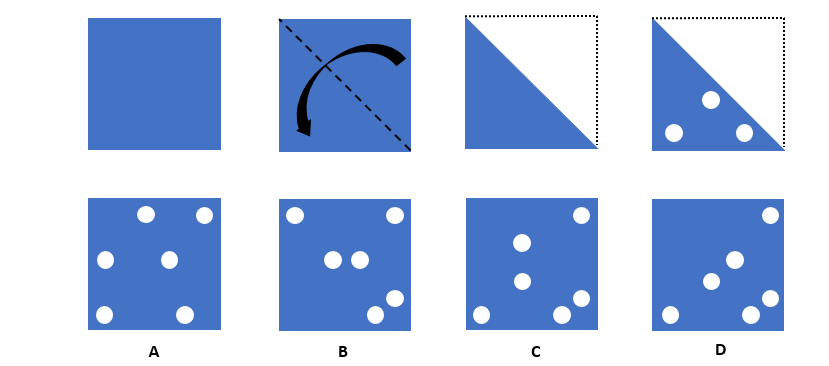
Correct Answer: D
Explanation. The square was folded diagonally in half from the top right corner to the bottom left corner. The white shapes were punched through two layers of paper. When the paper is unfolded, it will have six shapes.
Question 2
Choose the answer choice that shows the final product of the unfolded punched-in paper.
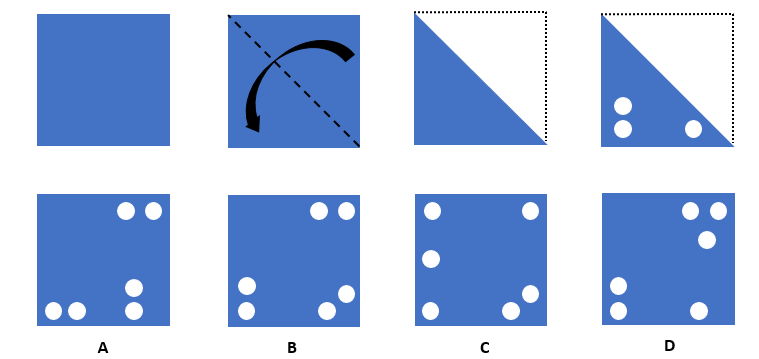
Correct Answer: B
Explanation. The square was folded diagonally in half from the top right corner to the bottom left corner. The white shapes were punched through two layers of paper. When the paper is unfolded, it will have six shapes.
Question 3
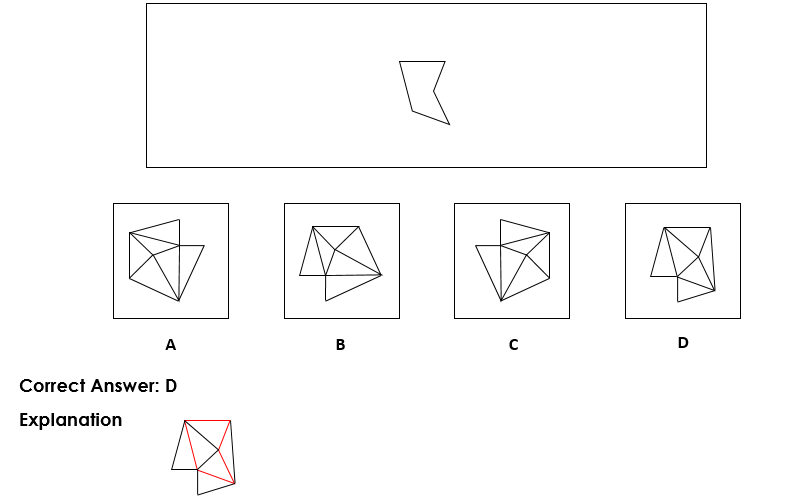
Choose the answer choice that contains the given shape. The shape must keep its size and orientation.
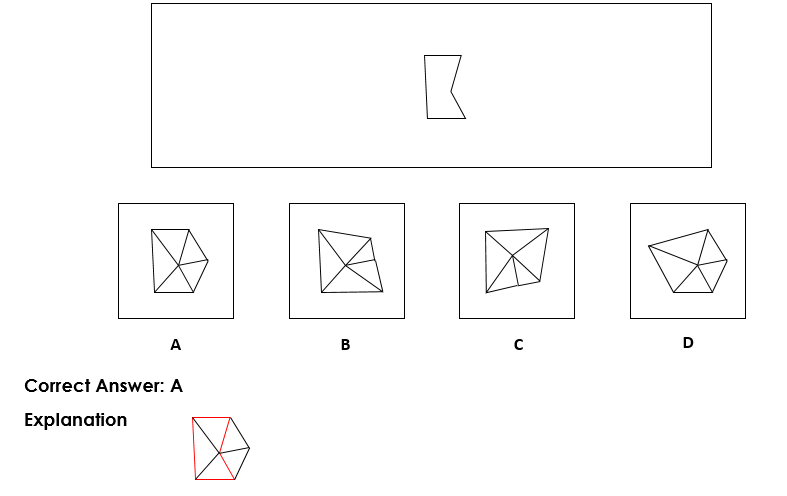
Question 4
Choose the answer choice that contains the given shape. The shape must keep its size and orientation.
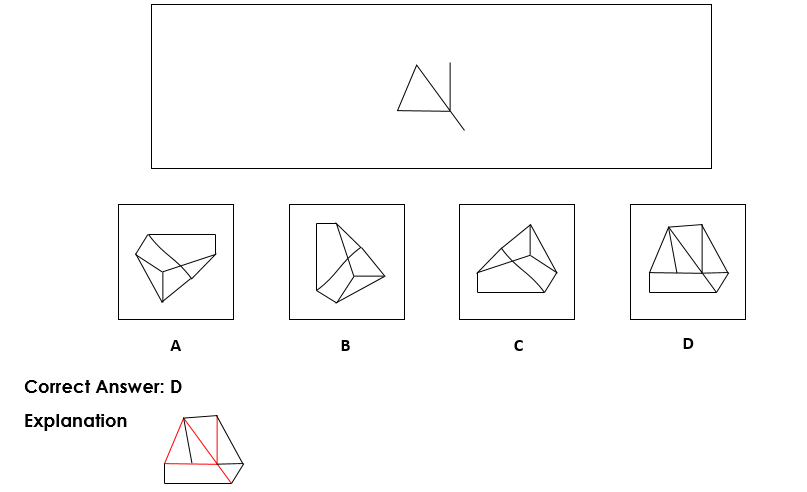
Question 5
Choose the answer choice that contains the given shape. The shape must keep its size and orientation.
4. How to Use These CAT4 Level A Sample Questions
Practice questions are most useful when students treat them as learning tools. The aim is not only to get a score. The aim is to understand how to solve each question type.
4.1 Try the Question First
Students should attempt each question before looking at the answer.
A good method is:
- Read or look carefully.
- Find the rule.
- Check all answer choices.
- Remove answers that do not fit.
- Choose the best answer.
- Review the explanation.
This helps students build independent reasoning.
4.2 Review the Explanation
The explanation is where real learning happens. A student may get the answer wrong, but still improve if they understand the method afterwards.
Students should ask:
- What was the rule?
- Why was the answer correct?
- Why were the other options wrong?
- Did I rush?
- Did I miss a detail?
- What should I check next time?
This helps students learn from mistakes.
4.3 Practise Similar Questions
After reviewing one question, students should try a similar question. This helps them apply the same method again.
For example:
- After a Verbal Classification question, practise another word group.
- After a Number Series question, practise another sequence.
- After a Figure Matrix question, practise another visual change.
- After a Figure Analysis question, practise another folding task.
Repeated practice builds confidence and accuracy.
5. Why CAT4 Level A Practice Questions Build Confidence
Confidence grows when students know what to expect. CAT4-style questions can feel unfamiliar at first, but regular practice helps children become more comfortable with the format.
5.1 Practice Reduces Uncertainty
When students understand the question types, they are less likely to panic or guess.
Practice helps children become familiar with:
- Question instructions
- Multiple-choice options
- Visual patterns
- Number rules
- Word relationships
- Folding and recognition tasks
- Mock test format
- Explanation review
Familiarity makes the assessment feel more manageable.
5.2 Practice Improves Accuracy
Accuracy improves when students slow down and check carefully.
Students should remember to check:
- The meaning of words
- The visual rule
- The number pattern
- The direction of a shape
- The position of marks or holes
- Every answer option
Small details can change the answer, so careful checking matters.
5.3 Practice Builds a Positive Mindset
A positive mindset helps students stay calm when a question feels difficult.
Parents can remind children:
- This is practice.
- Mistakes help us learn.
- Try to find the rule.
- Check before choosing.
- You are improving.
- One tricky question does not mean you cannot do it.
Confidence improves when practice feels supportive, not stressful.
6. How Parents Can Support CAT4 Level A Practice
Parents do not need to be test experts to support CAT4 preparation. The most useful support is calm encouragement, regular practice and careful review.
6.1 Create a Simple Practice Routine
A routine helps students practise without feeling overwhelmed.
A weekly routine may include:
- One short Verbal Reasoning session
- One short Non-Verbal Reasoning session
- One short Quantitative Reasoning session
- One short Spatial Reasoning session
- One mixed mini test
- One review session with explanations
This gives students balanced practice across all reasoning areas.
6.2 Ask Children to Explain Their Thinking
Students learn more when they explain how they found an answer.
Parents can ask:
- What did you notice?
- What was the rule?
- Why did you choose that answer?
- Which option did you rule out?
- What would you check next time?
This builds deeper reasoning skills and helps children become more confident.
6.3 Keep Practice Positive
Children learn better when they feel encouraged.
Parents can say:
- Good thinking.
- Let’s check again.
- That was a tricky one.
- You explained that well.
- You are improving.
- Let’s try another.
The goal is progress, not perfection.
7. Common Mistakes in CAT4 Level A Practice Questions
Many Year 4 students make mistakes because they rush, guess or miss small details. These mistakes are normal and can improve with practice.
7.1 Rushing Through Questions
Students sometimes choose the first answer that looks right. This can lead to mistakes because another answer may fit better.
A better method is:
- Look carefully.
- Think about the rule.
- Check every option.
- Remove wrong answers.
- Choose the best answer.
This helps improve accuracy.
7.2 Missing the Rule
CAT4 questions usually have a rule or relationship. Students need to find that rule before choosing the answer.
The rule may involve:
- A word category
- A word relationship
- A visual pattern
- A matrix change
- A number sequence
- A number relationship
- A folded-paper pattern
- A rotated figure
Finding the rule is more reliable than guessing.
7.3 Not Reviewing Mistakes
Some students only check whether they were right or wrong. However, explanations are more important than the score.
Students should review:
- Why the correct answer works
- Why the wrong options do not work
- What mistake was made
- What method to use next time
This turns mistakes into learning.
8. CAT4 Level A Mini Tests and Mock Tests
Practice questions are a strong starting point, but mini tests and mock tests help students prepare for longer assessment-style practice.
8.1 Start with Mini Tests
Mini tests are shorter and easier to manage than full mock tests.
Mini tests help students practise:
- Focus
- Timing
- Mixed question types
- Answer checking
- Confidence under light pressure
- Reviewing mistakes
Mini tests should always be followed by explanation review.
8.2 Move to Mock Tests When Ready
Full mock tests are useful once students understand the main question types.
A helpful preparation order is:
- Learn each question type
- Practise sample questions
- Review explanations
- Try short mini tests
- Complete mock tests
- Practise weaker areas again
This helps students build confidence gradually.
8.3 Use Mock Tests for Learning, Not Pressure
A mock test should not be used only to check a score. It should guide future practice.
After a mock test, parents can ask:
- Which section felt easiest?
- Which section felt hardest?
- Did you rush?
- Which question type needs more practice?
- What improved from last time?
This helps students prepare more effectively.
9. More About CAT4 Level A Year 4 Preparation
CAT4 Level A preparation works best when students practise regularly, review explanations and build confidence step by step.
Students should aim to:
- Understand all main question types
- Practise little and often
- Build word confidence
- Build visual reasoning confidence
- Build number confidence
- Build spatial reasoning confidence
- Review explanations carefully
- Try mini tests
- Complete mock tests when ready
9.1 CAT4 Level A Information Page
For more information about CAT4 Level A Year 4 preparation, visit:
CAT4 Level A Year 4 Information Page
10. Start Practising with the CAT4 Level A Year 4 Package
For students who want structured CAT4 Level A preparation, the CAT4 Level A Year 4 package can help them practise in a focused and organised way.
A structured practice package can support students with topic-by-topic practice, mini tests, mock tests, exam-style questions and step-by-step explanations.
10.1 CAT4 Level A Year 4 Practice Package Link
To start practising, use the link below:
Start CAT4 Level A Year 4 Practice Here
10.2 What Students Can Benefit From
This CAT4 Level A Year 4 package can support students with:
- Topic-by-topic practice
- Mini tests
- Mock test practice
- Verbal Reasoning
- Non-Verbal Reasoning
- Quantitative Reasoning
- Spatial Reasoning
- Verbal Classification
- Verbal Analogies
- Figure Classification
- Figure Matrices
- Number Analogies
- Number Series
- Figure Analysis
- Figure Recognition
- Step-by-step explanations
- Tutor Mode
- Exam Mode
- Confidence-building preparation
This structured approach helps students practise regularly, learn from explanations and build confidence before the assessment.
11. Final Thoughts
CAT4 Level A practice questions help Year 4 students become familiar with the reasoning skills needed for the assessment. They support confidence across words, figures, numbers and spatial thinking.
The best preparation is calm, structured and consistent. Students should not focus only on getting answers right. They should focus on understanding the rule, checking answer choices, reviewing explanations and learning from mistakes.
With regular practice, 20 sample question spaces, mini tests, mock tests, step-by-step explanations and parent support, Year 4 students can approach CAT4 Level A with stronger reasoning skills, better accuracy and a calmer mindset.