
CAT4 Level F questions can challenge even capable and hardworking Year 9 students. The assessment is different from an ordinary school test because students are not mainly asked to recall information from recent lessons. Instead, they must interpret unfamiliar material, recognise relationships and apply logical reasoning.
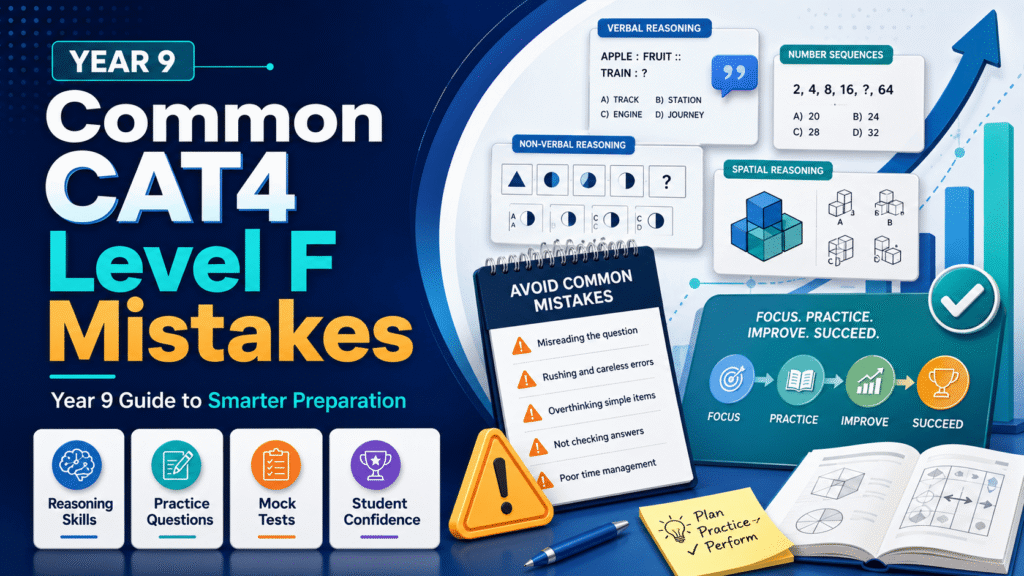
Students work with four broad forms of reasoning:
- Verbal Reasoning
- Non-Verbal Reasoning
- Quantitative Reasoning
- Spatial Reasoning
These areas can involve word classifications, verbal analogies, figure patterns, visual matrices, number relationships, sequences, folded-paper problems and hidden figures.
Many CAT4 Level F mistakes are avoidable. They often occur because students:
- Misread an instruction
- Rush under time pressure
- Use an incomplete rule
- Reverse an analogy
- Miss a small visual detail
- Select a number pattern that works only once
- Confuse rotation with reflection
- Unfold shapes in the wrong order
- Guess without eliminating options
- Lose confidence after one difficult question
A mistake does not automatically show that a student lacks reasoning ability. It may indicate unfamiliarity with the question style, an ineffective strategy, weak time management or anxiety.
The best preparation does not involve memorising individual answers. It helps students understand how to approach unfamiliar questions calmly and systematically.
This detailed guide explains the most common CAT4 Level F mistakes made by Year 9 students and provides practical ways to reduce them through reasoning activities, carefully selected practice questions, mock tests, mistake review and confidence-building strategies.
1. Why Year 9 Students Make CAT4 Level F Mistakes
CAT4 Level F requires students to switch between different kinds of reasoning.
A student may begin with shapes, move to words, work with numbers and then complete a spatial problem. Each change requires a different strategy.
1.1 Unfamiliarity Can Hide Strong Reasoning Skills
A student may be able to:
- Recognise patterns in everyday situations
- Categorise information
- Solve practical numerical problems
- Visualise objects from different angles
- Explain logical relationships
However, an unfamiliar test layout may make these skills harder to apply.
Understanding the question format reduces unnecessary confusion.
1.2 Time Pressure Can Change Student Behaviour
Students who normally work accurately may start to:
- Skip instructions
- Avoid rough working
- Select the first plausible option
- Miss important visual details
- Change correct answers
- Become stuck on one difficult item
Timing should therefore be introduced only after students understand the solving method.
1.3 Level F Questions May Contain Several Layers
Year 9 students may need to recognise:
- Precise vocabulary relationships
- Two-part or three-part visual rules
- Multi-step numerical operations
- Alternating sequences
- Diagonal folds
- Rotated hidden figures
- Distractors that follow only part of a rule
Students who stop after finding the first possible connection may choose an incomplete answer.
1.4 Confidence Influences Reasoning
When students expect to fail, they may:
- Give up too quickly
- Avoid difficult sections
- Guess without checking
- Overthink straightforward questions
- Change correct answers
- carry frustration into the next question
Confidence grows when students have a reliable process to follow.
2. Mistake One: Misreading the Instruction
Misreading the task is one of the most common CAT4 Level F mistakes.
A student may understand the figures, words or numbers but answer a different question from the one presented.
2.1 Similar Layouts May Ask Different Questions
Students may need to find:
- The figure that belongs
- The figure that does not belong
- The missing figure
- The next figure
- The matching word
- The missing number
- The hidden shape
- The pair with the same relationship
A familiar-looking layout does not guarantee that the task is identical.
2.2 Small Words Can Change the Meaning
Students should pay particular attention to words such as:
- Not
- Same
- Different
- Next
- Missing
- Completes
- Belongs
- Follows
Missing one of these words can lead to an incorrect response even when the reasoning is otherwise accurate.
2.3 Use a Three-Question Check
Before solving, students should ask:
- What information have I been given?
- What exactly must I find?
- What type of relationship am I looking for?
2.4 How Parents Can Help
During practice, parents can ask:
- What is the action word?
- Are you looking for a match or an exception?
- Are you completing a sequence or filling a gap?
- What would a correct answer need to show?
The goal is to make careful reading automatic.
3. Mistake Two: Ignoring the Practice Example
A practice example explains how a particular section works.
Some students rush past it because they believe it is not part of the real assessment.
3.1 The Example May Clarify the Exact Task
It can show:
- How the figures are related
- Which direction an analogy follows
- Whether rows or columns matter
- How answer options are selected
- Whether one or several operations are required
3.2 Familiar Question Types Can Still Vary
A student may have seen Figure Classification before, but the new section could require a different kind of comparison.
The same applies to:
- Verbal relationships
- Number patterns
- Visual matrices
- Spatial transformations
3.3 What Students Should Learn From the Example
Before starting, students should identify:
- What is being compared
- Which clue is most important
- How the example answer was reached
- Which method should be repeated
- Which answer format is required
3.4 A Better Habit
Students should treat every new section as a fresh task.
Even strong students benefit from checking the example carefully.
4. Mistake Three: Rushing Because the Assessment Is Timed
Some students believe that speed matters more than accuracy.
This can result in several avoidable errors.
4.1 Signs That a Student Is Rushing
The student may:
- Read only part of the question
- Choose an answer before viewing every option
- Miss a change in shading
- Reverse a verbal relationship
- Use the wrong numerical operation
- Click the wrong response
- Finish far earlier than usual
4.2 Fast Does Not Always Mean Efficient
An efficient student:
- Understands the task
- Applies a suitable strategy
- Checks the key details
- Makes a logical decision
- Moves forward
A rushed student often has to repeat work or makes mistakes that could have been prevented.
4.3 Build Speed After Accuracy
A sensible progression is:
- Learn the question format.
- Understand the strategy.
- Complete untimed examples.
- Improve accuracy.
- Attempt short timed sets.
- Complete mixed mini-tests.
- Use full mock tests when appropriate.
4.4 Use a Steady Pace
Students should avoid moving at the same speed on every question.
A simple item may require only a short check, while a complex matrix or sequence may need more attention.
5. Mistake Four: Spending Too Long on One Question
The opposite timing problem occurs when a student becomes trapped by one difficult item.
5.1 Why Students Become Stuck
They may:
- Want every answer to be perfect
- Keep repeating the same unsuccessful method
- Feel uncomfortable leaving a question unresolved
- Believe moving on means failure
- Forget that later questions may be easier
5.2 How One Question Can Affect the Whole Section
Spending too long may lead to:
- Unanswered later questions
- Rushed decisions
- Reduced concentration
- Frustration
- Panic
- Lower confidence
5.3 Use a Stuck-Question Routine
Students can:
- Re-read the instruction once.
- Identify the question type.
- Try one alternative strategy.
- Eliminate clearly incorrect options.
- Make the best reasoned choice available.
- Move forward calmly.
5.4 Moving Forward Is a Strength
Leaving a difficult question is not giving up.
It is a time-management decision that protects the student’s performance across the remaining section.
6. Mistake Five: Changing Correct Answers Without Evidence
Some Year 9 students correctly solve a question and then change their answer because they become uncertain.
6.1 Why Students Overcheck
They may think:
- The answer was too easy
- They solved it too quickly
- Another option looks more sophisticated
- A difficult test should not include a simple question
- They should use every second to reconsider
6.2 When an Answer Should Be Changed
A student should change an answer when they identify a specific error, such as:
- Misreading the instruction
- Reversing the relationship
- Missing a visual feature
- Counting incorrectly
- Using the wrong operation
- Discovering that the rule does not work throughout
6.3 When an Answer Should Usually Stay
A carefully reasoned answer should not be replaced because of unexplained doubt.
Students should check the rule, not restart the entire problem.
7. Mistake Six: Practising Only Favourite Reasoning Areas
Students often enjoy practising the question types they already find easy.
This can create an unbalanced preparation routine.
7.1 Why This Is a Problem
CAT4 Level F covers:
- Verbal Reasoning
- Non-Verbal Reasoning
- Quantitative Reasoning
- Spatial Reasoning
A student who practises only number questions may feel unprepared for verbal or spatial tasks.
7.2 Use a Balanced Weekly Routine
A preparation week might include:
- One Verbal Reasoning session
- One Non-Verbal Reasoning session
- One Quantitative Reasoning session
- One Spatial Reasoning session
- One mixed review or mini-test
7.3 Give Weaker Areas Extra Attention
Balanced preparation does not require equal time for every battery.
A student may need additional work on:
- Advanced vocabulary
- Figure Matrices
- Multi-step number analogies
- Alternating sequences
- Diagonal folds
- Hidden figures
- Timed decision-making
7.4 Watch for Avoidance
The question type a student repeatedly avoids may be the one that needs the most structured support.
8. Mistake Seven: Memorising Answers Rather Than Methods
Remembering that the answer to a practice question was option B does not show that the reasoning skill has been mastered.
8.1 Why Memorisation Does Not Transfer
A new question may use different:
- Words
- Numbers
- Shapes
- Positions
- Shading
- Fold directions
- Relationships
Students need to understand the process, not the option letter.
8.2 Ask Students to Explain the Rule
They should be able to say:
- “These words belong together because…”
- “The analogy follows this relationship…”
- “The figure changes by…”
- “The number rule is…”
- “The holes appear here because…”
- “The target shape has been rotated…”
8.3 Retry Questions After a Gap
Students should return to difficult questions after several days.
They should solve them using the method rather than relying on memory.
8.4 Use Parallel Questions
After correcting a mistake, students should attempt a new question that uses the same reasoning principle.
This confirms whether the method can be transferred.
9. Mistake Eight: Completing Practice Without Reviewing Errors
Answering many questions can appear productive, but improvement depends on understanding mistakes.
9.1 A Wrong Answer Can Have Different Causes
The student may have:
- Misread the task
- Misunderstood a word
- Missed a visual detail
- Used the wrong operation
- Lost track of a fold
- Rushed
- Guessed
- Changed a correct answer
9.2 Use a Structured Review
Students should ask:
- What was the question asking?
- Which method did I use?
- Where did my reasoning stop working?
- What is the correct rule?
- Which clue did I miss?
- How will I recognise this next time?
9.3 Review Correct Guesses
A correct guess may hide a misunderstanding.
Students should explain all uncertain answers, even when the selected option happens to be correct.
9.4 Quality Matters More Than Quantity
Ten carefully reviewed questions can teach more than fifty rushed questions.
10. Mistake Nine: Failing to Track Repeated Errors
Students may correct one question but continue making the same type of mistake later.
10.1 Create a Mistake Log
The log can record:
- Question type
- Mistake
- Correct strategy
- Cause
- Reminder for next time
10.2 Useful Error Categories
These may include:
- Misread instruction
- Category too broad
- Analogy reversed
- Shading missed
- Matrix column ignored
- Wrong operation
- Alternating sequence missed
- Fold reversed incorrectly
- Reflection confused with rotation
- Time spent too long
10.3 Review Patterns, Not Every Small Error
The most valuable entries are mistakes that:
- Happen repeatedly
- Affect several questions
- Continue under timing
- Reveal a misunderstanding
10.4 Use the Log Before Mock Tests
Reviewing repeated errors before a mock test gives students clear reminders without overwhelming them.
11. Common Verbal Classification Mistakes
Verbal Classification questions require students to identify the precise category linking several words.
11.1 Choosing a Category That Is Too Broad
Weak category descriptions include:
- Objects
- Actions
- Places
- Descriptions
- Things people use
Stronger descriptions might include:
- Tools used for measurement
- Words describing rapid movement
- Materials used for construction
- Emotions associated with fear
- Types of written communication
11.2 Ignoring One Word
A category must apply to every word in the group.
Students should not accept a connection that explains only two of the three words.
11.3 Choosing a Related Word Instead of a Group Member
Words may share a topic without belonging to the same category.
For example, “surgeon,” “hospital” and “operation” are connected, but they are not the same kind of thing.
11.4 Panicking Over an Unknown Word
Students can:
- Use the known words
- Identify a likely category
- Examine prefixes and suffixes
- Look for familiar word roots
- Eliminate unrelated options
11.5 How to Improve
Useful activities include:
- Sorting words into categories
- Learning synonyms and antonyms
- Explaining categories aloud
- Reading varied texts
- Building a vocabulary notebook
12. Common Verbal Analogy Mistakes
Verbal Analogies require students to transfer an exact relationship from one word pair to another.
12.1 Reversing the Relationship
Direction matters.
For example:
- A page is part of a book.
- A book is not part of a page.
The second pair must follow the same order as the first.
12.2 Selecting a Word That Is Only Associated
An option may belong to the same topic but not complete the relationship.
Students need the precise logical link.
12.3 Misidentifying the Relationship Type
Students may confuse:
- Synonyms with antonyms
- Part and whole with item and category
- Worker and workplace with tool and user
- Product and source with object and purpose
- Cause and effect with sequence
12.4 Using a Vague Description
Saying “the words go together” is not enough.
A clearer sentence might be:
- “A compass is used to find direction.”
- “A cub is a young bear.”
- “A chapter forms part of a book.”
- “A sculptor creates a statue.”
12.5 Use the Sentence Method
Students should:
- Turn the first pair into a sentence.
- Preserve the direction.
- Apply the same sentence to the second pair.
- Test every option.
- Reject answers that are only generally related.
13. Common Vocabulary Mistakes
Vocabulary gaps can affect CAT4 Level F Verbal Reasoning performance.
13.1 Learning Definitions Without Context
A student may memorise a definition but fail to recognise how the word functions in an analogy or category.
A stronger understanding includes:
- Meaning
- Synonym
- Antonym
- Word family
- Example sentence
- Typical context
13.2 Learning Too Many Words at Once
Large lists may be difficult to retain.
A smaller group of words reviewed several times is usually more effective.
13.3 Ignoring Prefixes, Suffixes and Roots
Word parts can reveal clues about:
- Opposition
- Repetition
- Quantity
- Position
- Movement
- Degree
- Time
13.4 Failing to Use New Vocabulary
Students remember words more effectively when they:
- Say them aloud
- Write sentences
- Explain them
- Compare them with synonyms
- Identify antonyms
- Revisit them later
14. Common Figure Classification Mistakes
Figure Classification requires students to find a visual rule shared by several figures.
14.1 Looking Only at the Largest Shape
The important relationship may involve:
- A small internal figure
- Number of lines
- Shading
- Direction
- Position
- Symmetry
Students should examine the complete design.
14.2 Missing a Multi-Part Rule
A group may follow several conditions.
For example:
- Each figure contains three shapes.
- One shape is shaded.
- The shaded shape touches the border.
An option that follows only two conditions is incomplete.
14.3 Counting Incorrectly
Students may miscount:
- Lines
- Corners
- Shapes
- Dots
- Shaded sections
- Repeated symbols
14.4 Relying on Appearance Instead of Structure
Two figures can look similar while following different rules.
Students should describe the exact relationship in words.
14.5 Use a Visual Checklist
Students should check:
- Shape
- Number
- Position
- Direction
- Size
- Shading
- Lines
- Rotation
- Reflection
- Symmetry
15. Common Figure Matrices Mistakes
Figure Matrices may contain rules across rows, columns or several directions.
15.1 Checking Only the Rows
A student may identify a row pattern but ignore the columns.
The correct answer should fit the complete grid.
15.2 Following Only One Feature
A matrix may involve:
- Rotation and shading
- Movement and addition
- Shape and number
- Direction and position
- Combining and removing
15.3 Assuming Every Matrix Uses the Same Rule
Not every matrix:
- Adds figures
- Rotates clockwise
- Increases in number
- Alternates shading
Each question requires fresh analysis.
15.4 Looking at Options Before Predicting
Distractors may follow only part of the rule.
Students should describe the missing figure before focusing on the choices.
15.5 Use a Matrix Routine
Students should:
- Compare the first row.
- Describe the transformation.
- Check another row.
- Compare the columns.
- Identify all changing features.
- Predict the missing figure.
- Eliminate incomplete options.
16. Common Rotation and Reflection Mistakes
Rotation and reflection are often confused in Non-Verbal and Spatial Reasoning.
16.1 What Rotation Does
Rotation turns a figure around a point.
The sequence of connected parts remains the same.
16.2 What Reflection Does
Reflection reverses the figure as though viewed in a mirror.
The orientation changes.
16.3 Why Symmetrical Shapes Are Difficult
A symmetrical figure may look similar after both transformations.
Students should track a distinctive feature instead of relying on the overall appearance.
16.4 Features to Track
Useful markers include:
- A shaded corner
- A dot
- A short line
- An arrow
- An open side
- An uneven edge
16.5 Use Practical Models
Cards, mirrors, paper cut-outs and transparent sheets can make transformations easier to understand.
17. Common Number Analogy Mistakes
Number Analogies require students to apply the same numerical relationship to another group.
17.1 Using a Rule That Works Only Once
Several operations may connect one pair of numbers.
The correct rule must work for all completed information.
17.2 Missing a Second Operation
Level F questions may involve:
- Multiply, then add
- Divide, then subtract
- Double, then adjust
- Add two values, then halve
- Find a difference, then multiply
17.3 Working Backwards From an Option
Students may choose an answer and invent a calculation that reaches it.
The rule should be identified before examining the options closely.
17.4 Making an Arithmetic Error
A student may find the correct rule but:
- Add incorrectly
- Multiply carelessly
- Reverse the order
- Copy the wrong number
- Forget an intermediate step
17.5 Use Brief Rough Working
Students should record:
- The operation
- The intermediate result
- The final answer
This supports accuracy without taking too much time.
18. Common Number Series Mistakes
Number Series questions can involve repeated, changing, alternating or interwoven rules.
18.1 Assuming the Difference Is Constant
Students may repeatedly add or subtract the same amount even when the changes vary.
Differences may:
- Increase
- Decrease
- Alternate
- Double
- Follow their own sequence
18.2 Missing Alternating Operations
A sequence may use:
- Add, multiply, add, multiply
- Subtract, add, subtract, add
- Double, subtract, double, subtract
- Divide, add, divide, add
18.3 Missing Two Interwoven Patterns
Odd-position terms may follow one rule, while even-position terms follow another.
Students can separate:
- First, third and fifth terms
- Second, fourth and sixth terms
18.4 Accepting a Rule Too Quickly
A correct rule must explain every step.
One successful calculation is not enough.
18.5 Avoiding Written Differences
Writing the change between numbers can reveal a pattern that is difficult to see mentally.
19. Common Figure Analysis Mistakes
Figure Analysis often requires students to follow folds and predict the final position of marks or holes.
19.1 Unfolding in the Wrong Order
The most recent fold must be opened first.
Students should reverse the sequence step by step.
19.2 Moving the Mark Instead of Reflecting It
When the shape opens, the original mark remains and a reflected copy appears.
The mark does not simply move.
19.3 Ignoring Diagonal Folds
Diagonal folds change both direction and position.
Students must treat the diagonal fold line like a mirror.
19.4 Checking Quantity but Not Arrangement
The correct answer must show:
- The right number of marks
- The correct positions
- The correct symmetry
- The correct distance from fold lines
19.5 Trying to Visualise Every Fold at Once
Students should reverse one fold at a time.
Attempting a large mental jump increases the chance of losing track.
19.6 Use Practical Folding Activities
During preparation, students can:
- Fold paper.
- Mark a point.
- Predict the result.
- Open the paper.
- Compare the prediction.
- Repeat with another fold.
20. Common Figure Recognition Mistakes
Figure Recognition asks students to locate a target shape hidden inside a more complicated design.
20.1 Searching Only in the Original Orientation
The target may be:
- Rotated
- Tilted
- Positioned near an edge
- Embedded inside another shape
Students should search for structure, not direction.
20.2 Being Distracted by Extra Lines
The larger design may contain lines that continue beyond the target.
Extra lines do not necessarily make a location incorrect.
20.3 Selecting an Incomplete Shape
A possible location may contain most of the target but miss:
- A short line
- A corner
- An angle
- A connection
- A required section
20.4 Losing the Starting Point
Students should begin with a distinctive feature, such as:
- A sharp corner
- A long diagonal
- An unusual angle
- Two short connected lines
- A unique intersection
20.5 Trace Systematically
Students should follow the target in one continuous direction instead of jumping between unrelated lines.
21. Mistake Ten: Guessing Without Eliminating Options
Students may guess immediately when the answer is not obvious.
This wastes useful information contained in the options.
21.1 Difficult Questions Still Contain Clues
Students may remove options that:
- Reverse the verbal relationship
- Use the wrong number of figures
- Have incorrect shading
- Break the number rule
- Reflect instead of rotate
- Place marks incorrectly
- Miss part of the hidden shape
21.2 Use a Four-Step Elimination Process
Students should:
- Identify what the answer must contain.
- Remove options that clearly fail.
- Compare the remaining choices.
- Select the best-supported response.
21.3 Elimination Is a Genuine Reasoning Skill
Elimination is not a weaker form of solving.
It is an efficient way to use evidence when the full answer is not immediately clear.
22. Mistake Eleven: Avoiding Rough Working
Some Year 9 students believe that reasoning should happen entirely in their heads.
22.1 Rough Working Supports Every Battery
Students can use it to:
- Write an analogy sentence
- Record number differences
- Test operations
- Mark alternating rules
- Count visual features
- Track folds
- Eliminate options
22.2 Rough Working Can Save Time
A short note may prevent the student from:
- Repeating a calculation
- Forgetting a step
- Reversing an operation
- Losing track of a pattern
22.3 Keep It Purposeful
Students do not need to write full explanations during timed work.
The notes should support thinking rather than slow it down.
23. Mistake Twelve: Beginning Full Mock Tests Too Early
Full mock tests can be useful, but they should not be the first stage of preparation.
23.1 Why Early Mock Testing Can Be Unhelpful
Students may:
- Misunderstand entire sections
- Guess repeatedly
- Become overwhelmed
- Focus only on the score
- Repeat errors without understanding them
- Develop unnecessary anxiety
23.2 Use a Gradual Preparation Sequence
Students can progress through:
- Worked examples
- Untimed topic practice
- Answer review
- Short timed sets
- Mixed mini-tests
- Full mock tests
23.3 Mock Tests Should Assess Readiness
A mock test is most useful when students already recognise the main formats and can apply strategies independently.
24. Mistake Thirteen: Completing Too Many Mock Tests
Frequent full testing can reduce the time available for targeted learning.
24.1 Problems Caused by Over-Testing
Students may experience:
- Fatigue
- Reduced motivation
- Score anxiety
- Repeated mistakes
- Superficial review
- Lower confidence
24.2 What Should Happen Between Mock Tests?
Students should:
- Review mistakes
- Practise weaker question types
- Improve time management
- Retry difficult methods
- Build vocabulary
- Complete visual and spatial activities
- Rest
24.3 Improvement Happens Between Tests
Mock tests identify priorities.
Focused work between tests creates the improvement.
25. Mistake Fourteen: Looking Only at the Mock-Test Score
A final score cannot explain why the student performed in a particular way.
25.1 Parents Should Examine the Process
Consider:
- Which sections were strongest?
- Which questions took longest?
- Were questions left unanswered?
- Did the student rush?
- Was rough working used?
- Did concentration decrease?
- Were correct answers based on guessing?
- Did anxiety affect performance?
25.2 Group Errors by Cause
Useful groups include:
- Misreading
- Vocabulary
- Visual detail
- Numerical operation
- Spatial tracking
- Timing
- Concentration
- Confidence
25.3 Create Specific Improvement Goals
Examples include:
- Check both rows and columns
- Practise analogy direction
- Record sequence differences
- Review diagonal folds
- Move on sooner when stuck
- Use elimination before guessing
26. Mistake Fifteen: Comparing Students With Others
Students may compare mock-test performance with friends, classmates or siblings.
26.1 Every Student Has a Different Reasoning Profile
One student may be stronger in:
- Verbal Reasoning
- Non-Verbal Reasoning
- Quantitative Reasoning
- Spatial Reasoning
Another may show similar performance across all four areas.
26.2 Comparisons Can Reduce Motivation
Students may:
- Hide mistakes
- Avoid difficult questions
- Feel that improvement is impossible
- Rush to match another person
- Focus on competition instead of learning
26.3 Compare Personal Progress
More useful questions include:
- Is accuracy improving?
- Are explanations clearer?
- Are repeated mistakes decreasing?
- Is timing more balanced?
- Is the student calmer?
- Are strategies becoming more independent?
27. Mistake Sixteen: Treating Wrong Answers as Failure
Mistakes are an expected part of learning unfamiliar reasoning methods.
27.1 An Error Can Reveal the Next Step
It may show that the student needs to:
- Learn a new word
- Read more carefully
- Check a second visual feature
- Practise alternating sequences
- Record calculations
- Reverse folds more slowly
- Use elimination
- Move on sooner
27.2 Use Neutral Review Language
Instead of saying:
- “That was easy.”
- “You should know this.”
- “You always make this mistake.”
Try:
- “Which clue did we miss?”
- “Where did the rule stop working?”
- “How can we check this next time?”
- “Which part was confusing?”
- “Can you apply the method to another question?”
27.3 Praise Correction and Improvement
Recognise when the student:
- Identifies the cause
- Explains the correct method
- Retries independently
- Avoids the same error later
28. Mistake Seventeen: Using Long, Exhausting Practice Sessions
Year 9 students already manage schoolwork, homework and other responsibilities.
Very long CAT4 preparation sessions can reduce concentration.
28.1 Signs That a Session Is Too Long
The student may:
- Start rushing
- Stop explaining answers
- Make simple errors
- Guess repeatedly
- Become irritable
- Lose motivation
- Forget strategies
28.2 Use Short, Focused Practice
A productive session may include:
- Five minutes reviewing a previous mistake
- Fifteen minutes practising one format
- Five minutes checking answers
- Five minutes discussing the method
28.3 End Before Concentration Collapses
A focused 25- or 30-minute session may be more effective than a tired hour.
28.4 Protect Balance
Students need time for:
- Sleep
- Exercise
- Homework
- Hobbies
- Family activities
- Social time
- Relaxation
29. Mistake Eighteen: Last-Minute Cramming
Reasoning strategies develop gradually.
Trying to cover everything immediately before an assessment can create pressure without producing lasting improvement.
29.1 Why Cramming Can Be Harmful
It may lead to:
- Fatigue
- Reduced sleep
- Poor concentration
- Greater anxiety
- Careless errors
- Lower confidence
29.2 What to Do During the Final Week
Students should focus on:
- Familiar strategies
- Selected previous mistakes
- Short mixed practice
- Light timing work
- Vocabulary review
- Confidence
- Sleep and routine
29.3 Avoid Introducing Too Many New Methods
The final stage should consolidate strategies the student already understands.
30. Mistake Nineteen: Allowing One Difficult Question to Affect the Rest
A student may assume that one difficult question means the entire assessment is going badly.
30.1 Difficulty Will Vary
The next question may:
- Use a different reasoning area
- Contain more familiar vocabulary
- Have a clearer numerical rule
- Be easier to eliminate
- Require a stronger personal skill
30.2 Use a Reset Routine
After a difficult question, students can:
- Take one slow breath.
- Relax their shoulders.
- Focus on the new task.
- Identify the question type.
- Apply the relevant strategy.
30.3 Treat Every Question as a Fresh Start
Frustration from one item should not be carried into the next.
31. Mistake Twenty: Losing Confidence During Preparation
Students may begin to interpret every mistake as evidence that they lack ability.
31.1 Confidence Comes From Having a Process
Students feel more secure when they know:
- How to read the task
- Which features to check
- How to test a rule
- How to eliminate options
- What to do when stuck
- How to review an error
31.2 Praise Effective Behaviours
Parents can say:
- “You tested the rule across the full sequence.”
- “You checked the columns as well as the rows.”
- “You kept the analogy in the correct direction.”
- “You unfolded the shape one stage at a time.”
- “You moved on without panicking.”
31.3 Avoid Fixed Ability Labels
Avoid statements such as:
- “You are not good with words.”
- “Shapes are not your strength.”
- “You are only a numbers person.”
- “You should find this easy.”
These labels can make improvement feel impossible.
31.4 Use Positive Self-Talk
Students can remind themselves:
- “I can check one feature at a time.”
- “I can remove incorrect options.”
- “I do not need to solve it instantly.”
- “One question does not decide everything.”
- “I know which strategy to try.”
- “I can stay calm and continue.”
32. How Parents Can Help Correct CAT4 Level F Mistakes
Parents do not need to solve every question.
Their role is to support independent and calm reasoning.
32.1 Ask Guiding Questions
Helpful prompts include:
- What is the task?
- What stays the same?
- What changes?
- Does the rule work throughout?
- Is there a second rule?
- Which options can be removed?
- Is the figure rotated or reflected?
- Which fold should open first?
32.2 Avoid Giving the Answer Immediately
Allow the student time to:
- Observe
- Test an idea
- Reject a rule
- Try another method
- Explain their thinking
- Correct themselves
32.3 Step In When Frustration Becomes Unproductive
Parents can:
- Return to an easier example
- Remove the timer
- Break the method into smaller steps
- Pause the session
- Review the concept using physical materials
32.4 Make Feedback Specific
Instead of saying only “well done,” identify the successful strategy.
33. A Better CAT4 Level F Preparation Routine
A strong preparation routine combines strategy, practice, review and gradual timing.
33.1 Step One: Complete a Baseline Set
Use a short mixed set to identify:
- Familiar formats
- Difficult formats
- Vocabulary gaps
- Numerical weaknesses
- Visual mistakes
- Spatial challenges
- Timing problems
33.2 Step Two: Choose One Clear Priority
Examples include:
- Analogy direction
- Matrix checking
- Alternating sequences
- Diagonal folds
- Hidden-shape tracing
- Moving on when stuck
33.3 Step Three: Learn a Repeatable Method
Students should understand a clear sequence of steps for that question type.
33.4 Step Four: Practise Without Timing
Accuracy and understanding should develop before speed.
33.5 Step Five: Review Important Errors
Discuss:
- What went wrong
- Why it happened
- Which clue was missed
- What should happen next time
33.6 Step Six: Attempt a Similar Question
The student should apply the corrected method independently.
33.7 Step Seven: Add Gentle Timing
Use a short timed set after accuracy improves.
33.8 Step Eight: Introduce Mixed Practice
Students should learn to identify the correct strategy without being told the question type.
33.9 Step Nine: Use Mock Tests Carefully
A mock test can identify final priorities when the student understands the main formats.
34. CAT4 Level F Mistake-Prevention Checklist
Before answering, students should ask:
- What is the question asking?
- Which reasoning area is involved?
- Which details are important?
- Does direction matter?
- Is more than one rule present?
- Can any options be eliminated?
During the question, students should:
- Work steadily
- Use rough working when helpful
- Test the rule throughout
- Check visual details
- Avoid blind guessing
- Move forward when necessary
After practice, students should:
- Review incorrect answers
- Review uncertain correct answers
- Identify the cause of each important mistake
- Explain the correct method
- Retry similar questions
- Record repeated errors
- Recognise improvement
35. Frequently Asked Questions About CAT4 Level F Mistakes
35.1 What is the most common CAT4 Level F mistake?
Misreading the task is one of the most frequent errors.
Students should identify exactly what they need to find before beginning.
35.2 Why does my child make more errors during timed practice?
The timer may cause rushing, guessing or reduced checking.
Return to shorter timed sets and focus on a steady pace.
35.3 How can students avoid reversing verbal analogies?
They should turn the first word pair into a complete sentence and apply the same relationship in the same direction.
35.4 How can students improve Figure Matrices?
They should check rows and columns, track multiple features and predict the missing figure before focusing on the options.
35.5 Why do students struggle with Number Series?
They may look only for repeated addition or subtraction.
They should also check alternating operations, changing differences and interwoven sequences.
35.6 How can students improve paper-folding questions?
They should reverse one fold at a time and reflect each mark across the correct fold line.
35.7 What should students do when they cannot find a hidden figure?
They should begin with the most distinctive corner or line and trace the target shape systematically.
35.8 Is guessing acceptable?
Blind guessing should be avoided.
Students should first remove options that clearly break the rule.
35.9 How often should mistakes be reviewed?
Important mistakes should be reviewed after focused practice and revisited before later timed sets or mock tests.
35.10 Are full mock tests the best form of preparation?
Mock tests can support timing and familiarity, but they should be combined with topic practice, reasoning activities and careful review.
35.11 How can parents protect student confidence?
Focus on progress, strategies and individual improvement rather than comparisons or perfect scores.
35.12 Can CAT4 Level F reasoning skills improve?
Students can strengthen related skills through reading, vocabulary work, numerical reasoning, visual puzzles, spatial activities and improved problem-solving habits.
36. Final Thoughts
Common CAT4 Level F mistakes usually result from unfamiliarity, rushing, incomplete strategies or insufficient review. They do not automatically show that a Year 9 student lacks reasoning ability.
Verbal Reasoning mistakes often occur when students choose a broad category, reverse an analogy or select a word that is only generally related.
Non-Verbal Reasoning errors commonly involve missed visual details, incomplete matrix rules and confusion between rotation and reflection.
Quantitative Reasoning mistakes may occur when students use a rule that works only once, overlook alternating operations or make careless calculations.
Spatial Reasoning errors often involve reversing folds incorrectly, misplacing reflected marks or searching for hidden figures only in their original orientation.
Effective CAT4 Level F preparation should include:
- Clear question-type strategies
- Balanced reasoning activities
- Vocabulary development
- Visual comparison practice
- Numerical pattern work
- Spatial activities
- Purposeful rough working
- Logical elimination
- Regular mistake review
- Gradual timed practice
- Carefully used mock tests
- Positive parental support
- Confidence-building routines
Students do not need to answer every practice question correctly. A mistake becomes valuable when the student understands why it happened and knows how to approach a similar problem more effectively.
With consistent preparation, thoughtful review and calm encouragement, Year 9 students can reduce avoidable CAT4 Level F mistakes, strengthen their reasoning habits and approach unfamiliar questions with greater confidence.