
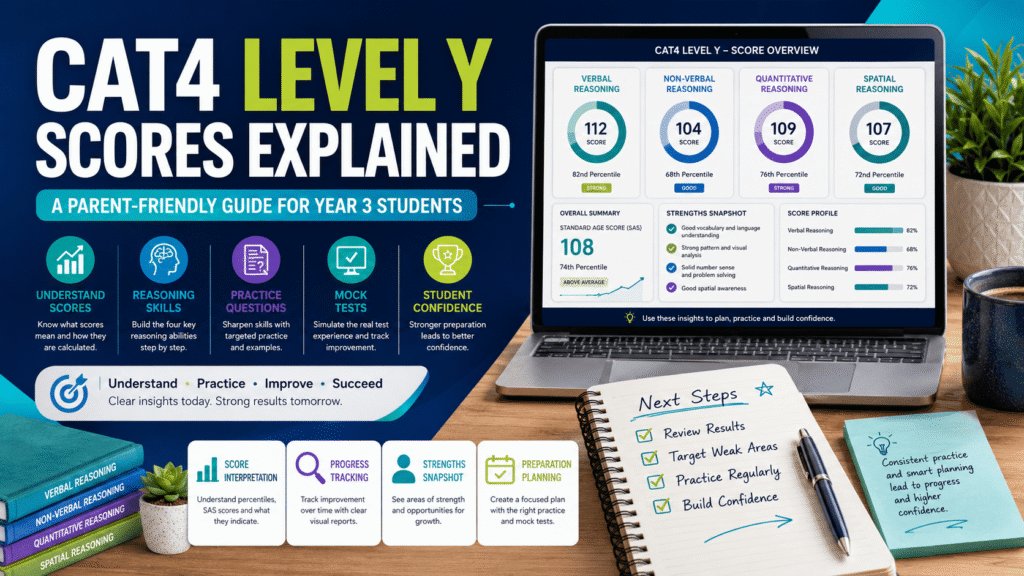
CAT4 Level Y scores can look confusing at first, especially for parents who are used to seeing normal school marks, percentages, or grades. Many parents expect a simple result such as “pass,” “fail,” or a percentage score. However, CAT4 scores work differently because CAT4 is not designed to measure only classroom knowledge. It is designed to show how a child thinks, reasons, solves problems, recognises patterns, and learns.
For Year 3 students, CAT4 Level Y scores can provide useful insight into learning strengths and areas that may need more support. These scores should not be used to label a child. Instead, they should be used as a guide to understand how the child approaches verbal, non-verbal, quantitative, and spatial reasoning tasks.
This guide explains CAT4 Level Y scores in clear, parent-friendly and student-friendly language. It covers what the scores mean, how parents should read them, what different reasoning areas show, how practice questions help, why mock tests matter, and how to build student confidence after receiving results.
1. What Are CAT4 Level Y Scores?
CAT4 Level Y scores are results from a reasoning-based assessment commonly used with Year 3 students. These scores help schools and parents understand a child’s thinking profile.
CAT4 does not simply ask, “How many questions did the child get right?” It looks deeper into how the child performs in different reasoning areas.
CAT4 Level Y scores may help show how well a student can:
- Understand word relationships
- Spot visual patterns
- Work with number logic
- Recognise rotated shapes
- Compare information
- Solve unfamiliar problems
- Think carefully under test conditions
- Apply reasoning skills across different question types
The score report can help parents see where their child is confident and where extra practice may be useful.
1.1 Why CAT4 Scores Are Different from Normal School Marks
A normal school test often checks what a child has learned in class. For example, a maths test may check addition, subtraction, multiplication, or problem-solving based on classroom lessons.
CAT4 scores are different because CAT4 focuses on reasoning ability. A child may see question types that are unfamiliar. They need to use logic, patterns, and clues to work out the answer.
This means CAT4 scores are not the same as ordinary classroom grades.
They are designed to give insight into:
- Learning potential
- Reasoning strengths
- Thinking style
- Problem-solving ability
- Support needs
- Confidence with unfamiliar tasks
1.2 Why Parents Should Understand the Scores
When parents understand CAT4 Level Y scores, they can support their child more effectively. Instead of focusing only on whether a score looks high or low, parents can look at the full learning profile.
This helps parents answer useful questions such as:
- Which reasoning area is my child strongest in?
- Which area needs more practice?
- Does my child rush through questions?
- Does my child struggle with patterns, words, numbers, or shapes?
- How can we build confidence before future assessments?
- What type of practice questions will help most?
Understanding scores helps turn results into a clear preparation plan.
2. Why CAT4 Level Y Scores Matter for Year 3 Students
Year 3 is an important stage in a child’s learning journey. Students are becoming more independent and are expected to think more carefully, solve problems, explain answers, and apply knowledge in different ways.
CAT4 Level Y scores can help identify how a child thinks at this stage.
2.1 Scores Help Show Learning Strengths
Every child has different strengths. CAT4 Level Y scores can help identify whether a child is stronger in language-based thinking, number logic, visual problem-solving, or spatial awareness.
A child may show strength in:
- Verbal reasoning
- Non-verbal reasoning
- Quantitative reasoning
- Spatial reasoning
- Pattern recognition
- Number sequences
- Shape comparison
- Visual thinking
- Vocabulary understanding
Knowing these strengths can help parents encourage the child in a positive and specific way.
2.2 Scores Help Identify Support Areas
CAT4 scores can also highlight areas where a child may need more practice.
For example:
- A lower verbal reasoning score may suggest the child needs more vocabulary and word relationship practice.
- A lower quantitative reasoning score may suggest the child needs more number pattern practice.
- A lower non-verbal reasoning score may suggest the child needs more shape and visual pattern practice.
- A lower spatial reasoning score may suggest the child needs more rotation, movement, and visualisation practice.
This does not mean the child is weak. It simply shows where support can be focused.
2.3 Scores Can Guide Better Preparation
CAT4 Level Y scores are most useful when they lead to action. Parents can use the results to create a focused preparation plan.
A good plan may include:
- Practice questions in weaker reasoning areas
- Regular mistake review
- Short topic-based sessions
- Mixed reasoning practice
- Gentle mock tests
- Confidence-building activities
- Clear explanations after each mistake
The aim is to improve reasoning skills step by step.
3. Main CAT4 Level Y Score Types Parents May See
CAT4 reports may include several score types. At first, these terms can feel technical, but they become easier once explained clearly.
The common score types include:
- Standard Age Score
- Percentile Rank
- Stanine Score
- Battery Scores
- Overall Profile
Each score gives a different kind of information.
3.1 Standard Age Score
The Standard Age Score is one of the most important CAT4 score types. It compares a child’s performance with other students of a similar age.
This is important because children in the same year group may still be different ages. A few months can make a difference in confidence, vocabulary, attention, and reasoning development.
In simple terms, the Standard Age Score helps answer:
“How did my child perform compared with children of a similar age?”
Parents should remember that this is not a percentage score. It is a standardised score that helps make comparisons fairer.
3.2 Percentile Rank
The percentile rank shows how a child performed compared with other students.
For example, a higher percentile rank suggests that the child performed as well as or better than many students in the comparison group.
Parents should not treat percentile rank as a pass or fail result. It is a comparison measure. It gives context, but it should be read alongside the child’s full learning profile.
3.3 Stanine Score
A stanine score is a broad score band. It simplifies performance into a smaller scale, which can make results easier to understand.
Stanines can help parents quickly see whether a result is generally:
- Below the typical range
- Around the typical range
- Above the typical range
Stanines are useful because they prevent parents from worrying too much about tiny score differences.
3.4 Battery Scores
CAT4 Level Y usually reports scores across different reasoning batteries. These are the main reasoning areas tested.
The common batteries include:
- Verbal Reasoning
- Quantitative Reasoning
- Non-Verbal Reasoning
- Spatial Reasoning
Battery scores help show the child’s learning profile. A child may be stronger in one area and need more practice in another. This is normal.
4. What the Verbal Reasoning Score Means
The verbal reasoning score shows how well a child thinks using words, meanings, and language relationships.
This score can be useful for understanding a child’s language-based reasoning skills.
4.1 Skills Linked to Verbal Reasoning
Verbal reasoning may involve:
- Understanding word meanings
- Spotting word relationships
- Finding similarities
- Finding differences
- Identifying odd words
- Completing word patterns
- Using vocabulary clues
These skills support reading comprehension, writing, speaking, listening, and classroom learning.
4.2 What a Strong Verbal Score May Suggest
A strong verbal reasoning score may suggest that a child is confident with language-based thinking.
The child may be good at:
- Understanding instructions
- Making word connections
- Explaining ideas
- Reading with understanding
- Using vocabulary clues
- Comparing meanings
This can support many areas of school learning.
4.3 How to Support a Lower Verbal Score
If verbal reasoning is lower than other areas, parents can support the child with regular language practice.
Helpful activities include:
- Reading short stories
- Discussing new words
- Finding synonyms
- Finding opposites
- Playing word games
- Practising word relationship questions
- Asking the child to explain answers aloud
The aim is to build vocabulary and confidence gradually.
5. What the Non-Verbal Reasoning Score Means
The non-verbal reasoning score shows how well a child thinks using shapes, pictures, diagrams, and visual patterns.
This section does not rely heavily on reading, so it can show visual problem-solving ability.
5.1 Skills Linked to Non-Verbal Reasoning
Non-verbal reasoning may involve:
- Spotting visual patterns
- Completing shape sequences
- Finding the odd shape out
- Comparing diagrams
- Identifying missing figures
- Noticing changes in size, position, or direction
These skills support problem-solving, observation, and logical thinking.
5.2 What a Strong Non-Verbal Score May Suggest
A strong non-verbal reasoning score may suggest that a child is good at visual thinking.
The child may be confident with:
- Pattern recognition
- Shape comparison
- Visual puzzles
- Picture-based logic
- Careful observation
- Problem-solving without relying only on words
This can be a strong learning advantage.
5.3 How to Support a Lower Non-Verbal Score
If non-verbal reasoning is lower, the child may need more practice with visual patterns and shape questions.
Helpful practice includes:
- Odd one out activities
- Shape pattern questions
- Picture matching
- Spot the difference tasks
- Visual sequence puzzles
- Comparing shape changes
- Completing missing figure questions
Parents should encourage children to look carefully before answering.
6. What the Quantitative Reasoning Score Means
The quantitative reasoning score shows how well a child thinks with numbers and number relationships.
This is not only about calculation speed. It is about number logic.
6.1 Skills Linked to Quantitative Reasoning
Quantitative reasoning may involve:
- Number sequences
- Missing numbers
- Counting patterns
- Comparing quantities
- Spotting number rules
- Understanding number relationships
- Applying simple mathematical logic
These skills support maths problem-solving and logical thinking.
6.2 What a Strong Quantitative Score May Suggest
A strong quantitative reasoning score may suggest that a child is comfortable with number patterns and logical number thinking.
The child may be good at:
- Finding number rules
- Counting in steps
- Comparing values
- Understanding sequences
- Solving number puzzles
- Thinking logically with maths ideas
This can support classroom maths and problem-solving confidence.
6.3 How to Support a Lower Quantitative Score
If quantitative reasoning is lower, parents can help by practising number patterns regularly.
Useful activities include:
- Counting forwards and backwards
- Completing number sequences
- Finding missing numbers
- Comparing groups of numbers
- Practising simple addition and subtraction patterns
- Asking, “What is happening to the numbers?”
Children should learn to explain the number rule, not just give the answer.
7. What the Spatial Reasoning Score Means
The spatial reasoning score shows how well a child can think about shapes, space, position, movement, and rotation.
Spatial reasoning can feel challenging because students need to imagine how objects move or fit together.
7.1 Skills Linked to Spatial Reasoning
Spatial reasoning may involve:
- Recognising rotated shapes
- Matching shapes from different angles
- Understanding how parts fit together
- Visualising movement
- Comparing positions
- Identifying shapes after turning or flipping
- Understanding simple 3D-style thinking
These skills support visualisation and problem-solving.
7.2 What a Strong Spatial Score May Suggest
A strong spatial reasoning score may suggest that a child is confident with visualising shapes and movement.
The child may be good at:
- Shape rotation
- Visual puzzles
- Building tasks
- Jigsaw-style thinking
- Understanding direction
- Imagining how objects fit together
This can support maths, science, design, problem-solving, and visual learning.
7.3 How to Support a Lower Spatial Score
If spatial reasoning is lower, hands-on activities can help.
Useful activities include:
- Jigsaw puzzles
- Building blocks
- Paper folding
- Shape matching
- Drawing patterns
- Rotating objects
- Completing grid designs
- Matching turned shapes
Spatial reasoning often improves with practice and visual exposure.
8. How to Read the Overall CAT4 Level Y Profile
Parents should avoid focusing on one score only. The overall profile is more useful than a single number.
A child’s CAT4 Level Y profile shows how scores compare across reasoning areas.
8.1 Look for Strengths First
Start by identifying the strongest area.
Ask:
- Which reasoning score is highest?
- Which type of question does my child seem to enjoy?
- Where does my child show confidence?
- Which skills can we use as motivation?
Starting with strengths keeps the conversation positive.
8.2 Identify the Main Support Area
Next, look for the area that needs the most support.
Ask:
- Which reasoning score is lower?
- Which question type caused difficulty?
- Did my child rush?
- Was the problem linked to understanding, timing, or confidence?
- What should we practise first?
This helps create a focused action plan.
8.3 Notice Uneven Score Patterns
It is normal for children to have uneven scores.
For example:
- Strong verbal reasoning but weaker spatial reasoning
- Strong quantitative reasoning but weaker verbal reasoning
- Strong non-verbal reasoning but weaker number logic
- Strong spatial reasoning but weaker vocabulary-based tasks
An uneven profile does not mean something is wrong. It simply shows different learning strengths.
9. What Is a Good CAT4 Level Y Score?
Parents often ask what counts as a “good” CAT4 score. The answer depends on the scoring system used, the school’s interpretation, and the child’s overall learning profile.
A good score should not be judged by one number alone.
9.1 Average Scores Can Still Be Positive
A score around the average range can still be a positive result. It means the child is performing broadly in line with students of a similar age.
Parents should focus on:
- Is the child improving?
- Does the child understand the question types?
- Is confidence growing?
- Are mistakes reducing?
- Are weaker areas being supported?
Progress matters.
9.2 Higher Scores Show Strengths
Higher scores may show areas of strong reasoning ability.
Parents should use higher scores to encourage confidence, not create pressure.
A strong score can show that the child has useful thinking strengths, but the child should still practise all reasoning areas for balance.
9.3 Lower Scores Show Practice Needs
A lower score should not be seen as failure.
It may show that the child needs:
- More familiarity with the question type
- Clearer explanations
- More targeted practice
- More confidence
- Better checking strategies
- More support with timing
With the right preparation, students can improve their reasoning confidence.
10. Is CAT4 Level Y a Pass or Fail Test?
CAT4 Level Y should not be treated as a pass or fail test. It is a reasoning assessment that helps build a picture of how a child thinks and learns.
10.1 Why CAT4 Should Not Be Used as a Label
A CAT4 score should never define a child’s ability permanently.
Children can improve through:
- Practice
- Better strategies
- Confidence-building
- Targeted support
- Regular review
- Encouragement
- Strong classroom learning
A score is information, not a label.
10.2 Why Scores Should Be Read with Other Evidence
CAT4 scores are most useful when read alongside other information.
Parents and teachers should also consider:
- Classroom performance
- Reading confidence
- Maths progress
- Teacher observations
- Homework habits
- Focus and attention
- Test-day confidence
- Emotional readiness
A full picture is more helpful than one score.
11. How Practice Questions Help Improve CAT4 Level Y Performance
Practice questions are one of the best ways to help students prepare for CAT4 Level Y.
They help children understand the test format and build confidence with different reasoning tasks.
11.1 Practice Questions Build Familiarity
When students practise CAT4-style questions, they begin to recognise common formats.
They become more familiar with:
- Word relationships
- Number sequences
- Shape patterns
- Spatial puzzles
- Odd one out tasks
- Multiple-choice answers
Familiarity reduces stress.
11.2 Practice Questions Improve Accuracy
Practice helps children learn to slow down and check carefully.
Students can improve by learning to:
- Find the rule
- Compare all options
- Avoid rushing
- Eliminate wrong answers
- Check visual details
- Explain their reasoning
Accuracy improves when students understand the method.
11.3 Practice Questions Reveal Weak Areas
Practice questions help parents identify the areas that need more attention.
For example:
- Repeated word mistakes may show a verbal reasoning need.
- Repeated number pattern mistakes may show a quantitative reasoning need.
- Repeated shape pattern mistakes may show a non-verbal reasoning need.
- Repeated rotation mistakes may show a spatial reasoning need.
This makes preparation more focused.
12. How Mock Tests Help After CAT4 Level Y Scores
Mock tests can help students practise under test-style conditions. They are especially useful after parents understand the child’s score profile.
12.1 Mock Tests Build Test Confidence
Mock tests help students become familiar with:
- Question order
- Time awareness
- Mixed question types
- Independent work
- Test-style focus
- Staying calm
- Moving between sections
This can reduce anxiety before future assessments.
12.2 Mock Tests Help Track Progress
Parents can use mock tests to see whether practice is helping.
Look for signs such as:
- Fewer careless mistakes
- Better focus
- Faster recognition of patterns
- Improved confidence
- More balanced performance
- Better time management
Progress should be measured calmly and positively.
12.3 Mock Test Review Is Essential
A mock test is only useful if mistakes are reviewed.
After a mock test, ask:
- Which section was strongest?
- Which section was hardest?
- Did my child rush?
- Did timing affect performance?
- Which question type needs more practice?
- What should we practise next?
Review helps turn results into improvement.
13. How Parents Should Talk About CAT4 Level Y Scores
The way parents talk about scores matters. Children should feel supported, not judged.
Scores should be discussed in a calm and positive way.
13.1 Use Positive Language
Parents can say:
- “This helps us understand how you learn.”
- “You have strengths we can build on.”
- “This area just needs more practice.”
- “Mistakes help us improve.”
- “You can get better with the right practice.”
- “Let’s work on one skill at a time.”
Positive language builds confidence.
13.2 Avoid Negative Labels
Avoid saying:
- “You are bad at this.”
- “This score is not good.”
- “You should have done better.”
- “Other children scored higher.”
- “You are weak at reasoning.”
These comments can reduce confidence and make practice stressful.
13.3 Focus on the Next Step
After reviewing scores, choose one clear next step.
For example:
- Practise number sequences twice this week.
- Read and discuss new words daily.
- Complete short shape pattern activities.
- Try one mini mock test at the weekend.
- Review spatial reasoning mistakes calmly.
A clear next step is more helpful than worry.
14. Best Preparation Plan After Receiving CAT4 Level Y Scores
After receiving CAT4 scores, parents can create a balanced and realistic preparation plan.
This plan should focus on improvement, not pressure.
14.1 Start with the Weakest Area
If one reasoning area is lower, start with that area first.
For example:
- Verbal reasoning: practise vocabulary and word links.
- Quantitative reasoning: practise number patterns.
- Non-verbal reasoning: practise visual patterns.
- Spatial reasoning: practise rotation and shape movement.
Short, focused sessions work best.
14.2 Keep Strong Areas Active
Do not ignore strong areas. They help build confidence.
A child may enjoy practising the area where they feel most successful. This can be used as a warm-up before practising harder topics.
14.3 Use Mixed Practice Later
Once the child has practised weaker areas, add mixed practice.
Mixed practice helps students switch between reasoning types, which is useful for CAT4-style assessments.
14.4 Add Mock Tests Gradually
Mock tests should be introduced gently.
Start with mini mock tests before moving to longer practice.
Mock tests should help the child feel prepared, not pressured.
15. Final Thoughts
CAT4 Level Y scores can help parents understand how their Year 3 child thinks, learns, and solves problems. These scores are different from normal school marks because they focus on reasoning skills rather than only classroom knowledge.
The most important score areas include verbal reasoning, non-verbal reasoning, quantitative reasoning, and spatial reasoning. Each area shows a different kind of thinking. A child may be strong in one area and need support in another, and that is completely normal.
Parents should not treat CAT4 scores as labels. They should use them as a guide. The best response is to identify strengths, support weaker areas, use practice questions, review mistakes, introduce mock tests gradually, and build confidence with positive encouragement.
With calm support and regular practice, Year 3 students can improve their reasoning skills, understand CAT4-style questions better, and approach future assessments with greater confidence.