
CAT4 Level Y is an important reasoning assessment for Year 3 students. For many children, it may feel different from normal classroom tests because it does not simply check memorised facts. Instead, it looks at how a child thinks, solves problems, recognises patterns, understands relationships, and uses logic.
For parents, understanding the CAT4 Level Y test format can make preparation much easier. When children know what to expect, they feel calmer, more confident, and more ready to answer unfamiliar reasoning questions.
This guide explains the CAT4 Level Y test format in clear, parent-friendly and student-friendly language. It covers the main reasoning areas, question styles, preparation tips, practice questions, mock tests, common mistakes, and confidence-building strategies for Year 3 students.
1. What Is the CAT4 Level Y Test?
CAT4 stands for Cognitive Abilities Test. It is designed to help schools understand how students think and learn. CAT4 Level Y is commonly linked with Year 3 students and focuses on developing reasoning skills.
Unlike a standard school test, CAT4 is not mainly about spelling lists, times tables, or facts learned in class. It is about how students approach new problems.
CAT4 Level Y may assess how well a child can:
- Spot patterns
- Compare shapes
- Understand word relationships
- Work with number patterns
- Recognise visual changes
- Think logically
- Solve unfamiliar questions
- Choose the best answer from options
The test helps show a child’s learning profile, including strengths and areas where more support may be helpful.
1.1 Why CAT4 Level Y Is Different from Normal School Tests
A normal school test often checks what a child has already learned. For example, a spelling test checks spelling, and a maths test checks taught maths skills.
CAT4 Level Y is different because it checks reasoning ability.
Students may see questions they have never seen before. They need to use clues, patterns, and logic to find the answer.
This means preparation should focus on:
- Understanding question types
- Practising reasoning skills
- Learning how to spot patterns
- Comparing answer choices carefully
- Building confidence with unfamiliar tasks
- Practising mock test-style questions
1.2 Why Parents Should Understand the Format
Parents can support their child better when they understand the test format. Instead of asking children to memorise facts, parents can help them practise thinking strategies.
Understanding the format helps parents guide children to:
- Look carefully at each question
- Find the hidden rule
- Check all answer options
- Avoid rushing
- Learn from mistakes
- Build test confidence gradually
The more familiar the test feels, the less stressful it becomes.
2. Who Takes CAT4 Level Y?
CAT4 Level Y is commonly used for Year 3 students. At this stage, children are developing stronger reading, number, visual, and problem-solving skills.
Year 3 is an important learning stage because students are becoming more independent. They are expected to think more carefully, explain their answers, solve problems, and apply knowledge in different ways.
CAT4 Level Y supports this by assessing reasoning skills across different areas.
2.1 CAT4 Level Y for Year 3 Students
Year 3 students are usually more confident than younger learners, but CAT4-style questions can still feel unfamiliar.
Children may need support with:
- Understanding instructions
- Staying focused
- Working through patterns
- Thinking before choosing
- Managing time
- Reviewing mistakes
- Staying calm during test-style practice
A child does not need to be perfect. They need to practise the format and build confidence step by step.
2.2 What Year 3 Students Need Most
Year 3 students need preparation that is structured but not stressful.
They benefit from:
- Clear explanations
- Short practice sessions
- Topic-by-topic practice
- Mixed reasoning questions
- Simple test strategies
- Regular mistake review
- Gentle mock tests
- Encouraging feedback
The aim is to help students feel prepared, not pressured.
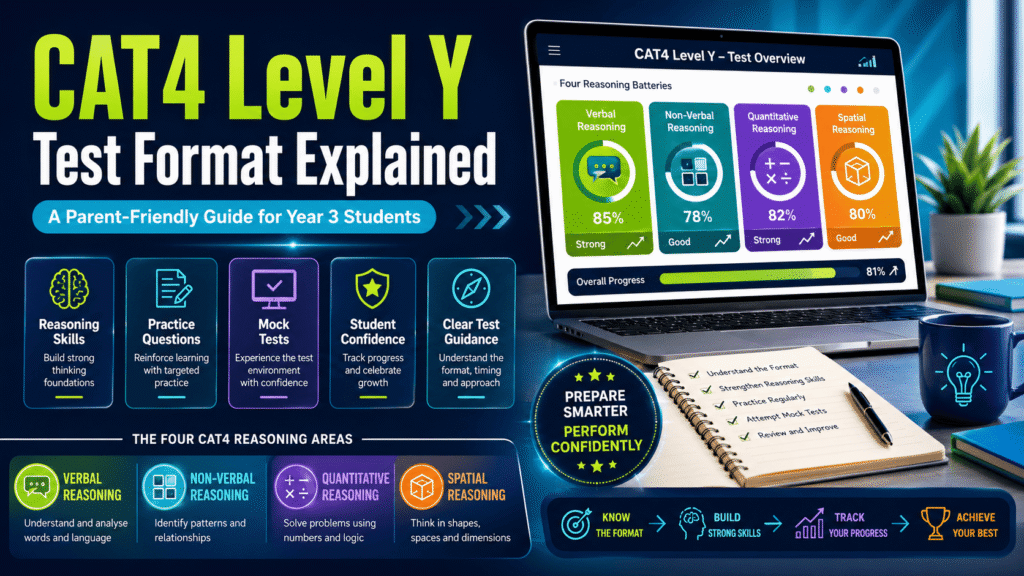
3. Main Reasoning Areas in CAT4 Level Y
CAT4 Level Y focuses on different types of reasoning. Each reasoning area helps show how a child thinks and solves problems.
The main reasoning areas are:
- Verbal Reasoning
- Non-Verbal Reasoning
- Quantitative Reasoning
- Spatial Reasoning
Each area uses a different type of thinking.
3.1 Verbal Reasoning
Verbal reasoning focuses on words, meanings, and relationships between ideas.
Students may need to:
- Find word similarities
- Choose a matching word
- Understand word relationships
- Identify the odd word out
- Complete simple verbal patterns
- Use vocabulary clues
Verbal reasoning supports reading comprehension, vocabulary, writing, speaking, and classroom understanding.
A child with strong verbal reasoning may find it easier to understand instructions, explain ideas, and make connections between words.
3.2 Non-Verbal Reasoning
Non-verbal reasoning focuses on shapes, pictures, patterns, and visual logic.
Students may need to:
- Complete a visual pattern
- Find the odd shape out
- Match similar figures
- Identify changes in size or direction
- Choose the shape that follows a rule
- Compare diagrams carefully
This section does not rely heavily on reading. It gives students a chance to show visual problem-solving skills.
3.3 Quantitative Reasoning
Quantitative reasoning focuses on number logic.
It is not just about doing sums quickly. It is about understanding how numbers relate to each other.
Students may need to:
- Complete number sequences
- Find missing numbers
- Recognise number patterns
- Compare quantities
- Work out number relationships
- Apply simple logical rules
This supports mathematical thinking and problem-solving confidence.
3.4 Spatial Reasoning
Spatial reasoning focuses on how shapes move, rotate, fold, or fit together.
Students may need to:
- Recognise a shape after it has turned
- Match figures from different angles
- Understand how shapes combine
- Visualise movement
- Identify shapes inside other shapes
- Compare positions and directions
Spatial reasoning can feel tricky at first, but it often improves with regular practice.
4. CAT4 Level Y Test Format Explained
The CAT4 Level Y test format is usually divided into reasoning sections. Each section focuses on a different type of thinking.
The exact format may vary depending on the school or testing platform, but students are normally expected to answer a range of reasoning-based questions.
4.1 Multiple-Choice Question Style
CAT4 Level Y questions are commonly presented in a multiple-choice format. This means students choose the best answer from a set of options.
This format helps assess whether students can:
- Understand the question
- Compare answer choices
- Remove incorrect options
- Find the best match
- Apply reasoning skills
- Avoid careless guessing
Students should practise checking all options before choosing an answer.
4.2 Visual and Pattern-Based Questions
Many CAT4 Level Y questions include shapes, symbols, diagrams, or pictures.
Students may need to find:
- What comes next
- Which figure is missing
- Which shape is different
- Which option completes the pattern
- Which figure follows the same rule
Visual reasoning questions require careful observation. Small details can change the answer.
4.3 Number and Word Reasoning Questions
CAT4 Level Y may also include questions based on words and numbers.
Students may need to:
- Find a word relationship
- Choose a similar word
- Identify a number pattern
- Complete a number sequence
- Compare values
- Apply a simple rule
These questions test logical thinking rather than memorisation alone.
5. CAT4 Level Y Verbal Reasoning Format
Verbal reasoning questions help assess how students think using words and language. For Year 3 students, this can include vocabulary, word relationships, classification, and simple analogies.
5.1 Common Verbal Reasoning Question Types
Students may see questions such as:
- Which word belongs with the group?
- Which word is the odd one out?
- Which word means almost the same?
- Which word completes the relationship?
- Which word best fits the pattern?
These questions help measure language-based thinking.
5.2 How to Prepare for Verbal Reasoning
Parents can help children improve verbal reasoning by using daily reading and vocabulary practice.
Helpful activities include:
- Reading short stories
- Discussing new words
- Finding synonyms
- Finding opposites
- Playing word games
- Asking children to explain meanings
- Practising word relationship questions
The child should learn to explain why an answer is correct.
5.3 Best Strategy for Verbal Questions
Students should ask:
- What do these words have in common?
- Which word does not fit?
- What is the relationship?
- Does the answer make sense?
- Are there any better options?
This helps them think carefully before choosing.
6. CAT4 Level Y Non-Verbal Reasoning Format
Non-verbal reasoning questions use shapes, patterns, and pictures. These questions are important because they test visual thinking rather than reading ability.
6.1 Common Non-Verbal Reasoning Question Types
Students may need to:
- Complete a shape pattern
- Find the odd figure out
- Match similar shapes
- Choose the missing image
- Identify a visual rule
- Compare changes in diagrams
The rule may involve size, position, direction, number, shading, or shape type.
6.2 How to Prepare for Non-Verbal Reasoning
Parents can support this skill through visual activities.
Useful practice includes:
- Shape puzzles
- Pattern completion
- Spot the difference
- Odd one out activities
- Matching diagrams
- Visual sequence questions
- Drawing and comparing shapes
Children should learn to look carefully at every detail.
6.3 Best Strategy for Non-Verbal Questions
Students should check:
- Shape
- Size
- Direction
- Position
- Number of parts
- Shading
- Repetition
- Order
A small difference can completely change the answer.
7. CAT4 Level Y Quantitative Reasoning Format
Quantitative reasoning questions focus on number relationships. Students need to find the rule behind the numbers rather than simply calculate quickly.
7.1 Common Quantitative Reasoning Question Types
Students may see questions such as:
- What number comes next?
- Which number is missing?
- Which number does not belong?
- What is the number rule?
- Which pair follows the same pattern?
These questions help assess logical number thinking.
7.2 How to Prepare for Quantitative Reasoning
Parents can help by practising number patterns in a simple way.
Useful activities include:
- Counting forwards and backwards
- Completing number sequences
- Finding missing numbers
- Comparing number groups
- Practising simple addition patterns
- Practising simple subtraction patterns
- Explaining number rules aloud
The key is to understand the rule, not just guess the answer.
7.3 Best Strategy for Number Questions
Students should ask:
- Are the numbers going up or down?
- What is the gap between the numbers?
- Is the same rule repeated?
- Does the answer fit the whole pattern?
- Can I check it again?
This builds accuracy and confidence.
8. CAT4 Level Y Spatial Reasoning Format
Spatial reasoning questions focus on visualising movement, rotation, and position. This can be challenging for some students, but it improves with practice.
8.1 Common Spatial Reasoning Question Types
Students may need to:
- Recognise rotated shapes
- Match shapes from different angles
- Visualise folded or moved shapes
- Identify how parts fit together
- Compare shape positions
- Choose the figure that matches a transformation
This type of reasoning is like solving a visual puzzle.
8.2 How to Prepare for Spatial Reasoning
Hands-on practice can be very helpful.
Useful activities include:
- Building blocks
- Jigsaw puzzles
- Paper folding
- Shape matching
- Drawing patterns
- Rotating objects
- Completing grid designs
- Matching turned shapes
These activities help students imagine how objects move.
8.3 Best Strategy for Spatial Questions
Students should ask:
- Has the shape turned?
- Has it flipped?
- Has its position changed?
- Is it still the same shape?
- Which option matches the movement?
This helps children slow down and visualise carefully.
9. Why CAT4 Level Y Practice Questions Matter
Practice questions are one of the best ways to prepare for CAT4 Level Y. They help students understand the format and become familiar with question styles.
A child may have strong reasoning ability but still struggle if the format feels new. Practice reduces that problem.
9.1 Practice Builds Familiarity
When students practise regularly, they begin to recognise common question styles.
They become more comfortable with:
- Word relationships
- Number sequences
- Shape patterns
- Spatial puzzles
- Odd one out tasks
- Multiple-choice answers
Familiarity helps reduce test anxiety.
9.2 Practice Improves Accuracy
Practice teaches students to slow down and check carefully.
It helps them avoid mistakes such as:
- Rushing
- Guessing too soon
- Missing visual details
- Misreading the question
- Ignoring answer options
- Forgetting to check the rule
Accuracy improves when students learn from explanations.
9.3 Practice Supports Confidence
Confidence is very important for Year 3 students.
When students practise CAT4-style questions, they begin to feel:
- More prepared
- Less nervous
- More familiar with the format
- Better at spotting patterns
- More willing to try difficult questions
Confidence can make a real difference on test day.
10. How Mock Tests Help CAT4 Level Y Preparation
Mock tests are useful because they give students a test-like experience before the real assessment.
They help students practise focus, timing, and switching between question types.
10.1 When to Start Mock Tests
Students should usually practise individual question types first. Once they understand the main reasoning areas, they can begin mini mock tests.
A good approach is:
- Practise one skill at a time
- Review mistakes
- Try mixed practice
- Start mini mock tests
- Move towards longer mock test-style practice
This prevents students from feeling overwhelmed.
10.2 What Mock Tests Help Students Learn
Mock tests help students practise:
- Staying focused
- Managing time
- Reading instructions
- Answering independently
- Moving between question types
- Staying calm under pressure
- Checking answers carefully
They also help parents identify which areas need more practice.
10.3 Why Mock Test Review Is Important
The score is not the only important part of a mock test.
Parents should review:
- Which questions were correct
- Which questions were wrong
- Which reasoning area was strongest
- Which area needs support
- Whether mistakes were careless
- Whether timing caused difficulty
- Whether the child stayed calm
Review helps turn mock tests into real progress.
11. Common Mistakes in CAT4 Level Y
Many Year 3 students make similar mistakes during CAT4 preparation. These mistakes are normal and can improve with practice.
11.1 Rushing Through Questions
Some students choose the first answer that looks correct. This can lead to careless mistakes.
Teach children to:
- Look carefully
- Find the rule
- Check all options
- Remove wrong answers
- Choose the best answer
- Check once before moving on
11.2 Missing Small Details
In visual reasoning questions, small details matter.
Students may miss changes in:
- Shape
- Size
- Direction
- Position
- Number of parts
- Shading
- Rotation
Careful observation is essential.
11.3 Guessing Without Finding the Rule
Some students guess before understanding the question.
Parents should remind children to ask:
“What is the pattern?”
This simple question can improve reasoning accuracy.
11.4 Avoiding Difficult Categories
Some children avoid the question types they find hardest. This creates gaps in preparation.
Students should practise all four reasoning areas, even if one feels more difficult.
12. Best CAT4 Level Y Preparation Tips
Preparation should be calm, consistent, and balanced. Students do not need long, stressful sessions.
The best preparation helps children understand the format and build confidence step by step.
12.1 Use Short Practice Sessions
For Year 3 students, short sessions work well.
A useful session may include:
- 10 to 20 minutes of practice
- One reasoning skill focus
- A few carefully chosen questions
- Clear explanations
- Gentle mistake review
- Positive encouragement
Short sessions help students stay focused.
12.2 Practise All Reasoning Areas
Students should practise:
- Verbal reasoning
- Non-verbal reasoning
- Quantitative reasoning
- Spatial reasoning
Balanced practice helps students feel ready for different question types.
12.3 Review Mistakes Carefully
Mistake review is one of the most important parts of preparation.
Ask:
- What did we miss?
- What was the rule?
- Why is the correct answer right?
- Why was the other option wrong?
- How can we solve this next time?
This helps children learn the method.
12.4 Build Confidence with Encouragement
Parents should use positive language.
Say:
- “You are learning the method.”
- “You found the pattern well.”
- “Mistakes help us improve.”
- “Let’s try another one together.”
- “You are getting more confident.”
- “Take your time and think carefully.”
Confidence grows through support and steady progress.
13. How Parents Can Support Year 3 Students
Parents play an important role in CAT4 Level Y preparation. The way parents guide practice can affect how confident the child feels.
13.1 Create a Calm Practice Routine
A calm routine helps children feel secure.
Parents can support by providing:
- A quiet study space
- Short practice sessions
- A regular schedule
- Encouraging feedback
- Breaks when needed
- Clear explanations
- No unnecessary pressure
A relaxed student is more likely to think clearly.
13.2 Focus on Progress, Not Perfection
CAT4 preparation should not be about getting every answer right immediately.
Parents should celebrate:
- Better focus
- Improved accuracy
- Clear explanations
- Fewer careless mistakes
- More confidence
- Stronger pattern recognition
Small improvements matter.
13.3 Avoid Comparing Children
Every child develops at a different pace.
Parents should avoid comparing their child with classmates, siblings, or friends.
A better focus is:
“Is my child improving compared with last week?”
This keeps preparation positive.
14. Final Week Before CAT4 Level Y
The final week should focus on review and confidence. It is not the time to overload the child with too many new question types.
14.1 Review Familiar Question Types
Students should review:
- Word relationship questions
- Shape pattern questions
- Number sequence questions
- Spatial reasoning tasks
- Odd one out questions
- Common mistake areas
- Mini mock test results
Keep the review light and positive.
14.2 Use Gentle Mock Test Practice
A short mock test can help students stay familiar with the format.
Avoid too many mock tests in the final week. Too much testing can create pressure.
Use mock tests to build confidence, not fear.
14.3 Keep a Healthy Routine
Students should have:
- Good sleep
- Short practice sessions
- Encouragement
- Breaks
- Calm mornings
- Positive reminders
A rested and confident child is more likely to perform well.
15. Final Thoughts
CAT4 Level Y is a reasoning-based assessment that helps schools understand how Year 3 students think, learn, and solve problems. It is different from normal school tests because it focuses on verbal reasoning, non-verbal reasoning, quantitative reasoning, and spatial reasoning.
Parents can support preparation by helping children understand the test format, practise question types, review mistakes, and build confidence through mock tests and regular practice.
The best CAT4 Level Y preparation is calm, structured, and positive. Students should not feel pressured to be perfect. They should learn how to think carefully, find patterns, compare options, and stay confident when facing unfamiliar questions.
With the right preparation, CAT4 Level Y can become much less stressful. Year 3 students can build stronger reasoning skills, improve accuracy, and approach the test with greater confidence.