
CAT4 Level A is a reasoning-based assessment designed to help schools understand how students think, solve problems, recognise patterns, and approach unfamiliar tasks. Unlike normal classroom tests, CAT4 does not only check what a child has memorised. It focuses on how a student uses logic, language, numbers, shapes, and visual information to find the best answer.
For parents, the CAT4 Level A test format can feel confusing at first because it is different from standard Maths or English tests. There is no simple “revise these facts” approach. Instead, students need to become familiar with question styles, practise reasoning skills, review mistakes, and build confidence with mock tests.
This guide explains the CAT4 Level A test format in clear, parent-friendly and student-friendly language. It covers the main reasoning areas, question types, preparation strategies, practice questions, mock tests, common mistakes, and confidence-building tips.
1. What Is the CAT4 Level A Test?
CAT4 stands for Cognitive Abilities Test. It is used to assess how students think and learn across different reasoning areas. CAT4 Level A is part of the CAT4 level structure and is usually used when a school wants to assess students at the appropriate stage for this level.
The test may include tasks based on:
- Words and meanings
- Shapes and patterns
- Number relationships
- Visual puzzles
- Spatial movement
- Logical thinking
- Multiple-choice reasoning
- Problem-solving with unfamiliar information
CAT4 Level A helps schools build a wider picture of a student’s learning profile.
1.1 Why CAT4 Level A Is Different from Normal School Tests
A normal school test usually checks what a student has already learned in class. For example, a Maths test may check calculation skills, and an English test may check spelling, grammar, reading, or writing.
CAT4 Level A is different because it focuses on reasoning ability. Students may face questions they have not seen before. They need to use clues, patterns, relationships, and logic to work out the answer.
This means CAT4 preparation should focus on:
- Understanding the format
- Practising reasoning question types
- Improving accuracy
- Learning from explanations
- Building test confidence
- Developing problem-solving habits
The goal is not memorisation. The goal is smarter thinking.
1.2 Why Parents Should Understand the Format
When parents understand the CAT4 Level A format, they can support preparation in a more useful way.
Instead of saying, “Revise more,” parents can guide students with specific practice such as:
- “Let’s practise number patterns.”
- “Let’s review shape sequences.”
- “Let’s work on word relationships.”
- “Let’s try a mini mock test.”
- “Let’s check why that answer was wrong.”
This makes preparation clearer, calmer, and more effective.
2. What Does CAT4 Level A Measure?
CAT4 Level A measures reasoning skills across different areas. These skills help show how a student processes information, solves problems, and applies logic.
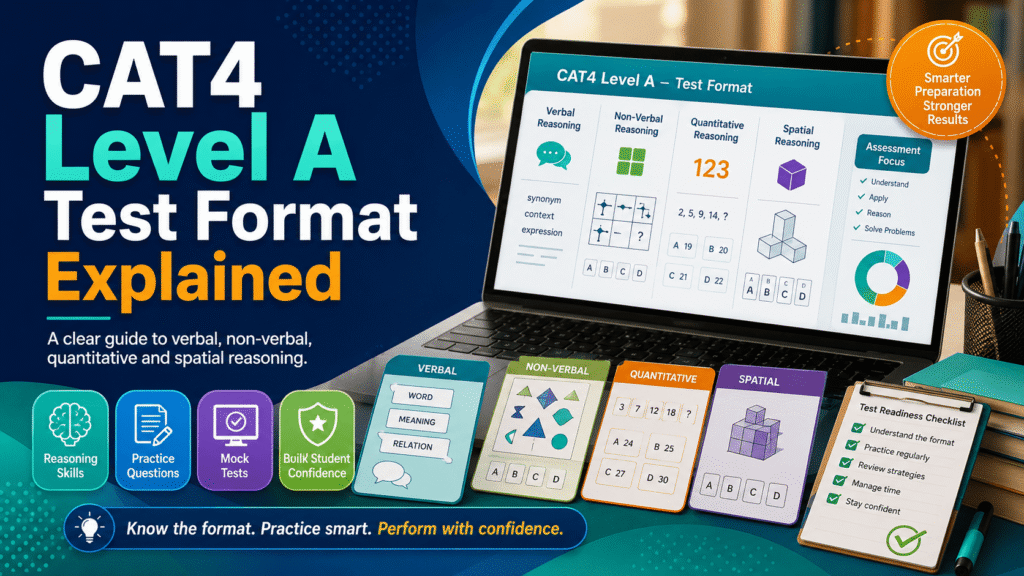
The four main reasoning areas are:
- Verbal Reasoning
- Non-Verbal Reasoning
- Quantitative Reasoning
- Spatial Reasoning
Each area looks at a different type of thinking.
2.1 Verbal Reasoning
Verbal reasoning focuses on words, meanings, and language relationships.
Students may need to:
- Understand word meanings
- Identify word relationships
- Find similarities and differences
- Complete word patterns
- Choose the odd word out
- Use vocabulary clues
- Work out simple analogies
This area supports reading comprehension, vocabulary, writing, speaking, listening, and classroom understanding.
2.2 Non-Verbal Reasoning
Non-verbal reasoning focuses on shapes, pictures, diagrams, and visual patterns.
Students may need to:
- Complete a shape pattern
- Find the odd figure out
- Match similar diagrams
- Identify missing shapes
- Notice changes in size, direction, or position
- Understand visual rules
This area helps students show visual problem-solving ability without relying heavily on reading.
2.3 Quantitative Reasoning
Quantitative reasoning focuses on number logic and number relationships.
Students may need to:
- Complete number sequences
- Find missing numbers
- Compare values
- Identify number rules
- Understand patterns
- Use logical mathematical thinking
This area supports Maths confidence, problem-solving, and flexible number thinking.
2.4 Spatial Reasoning
Spatial reasoning focuses on how shapes move, rotate, fit together, or appear from different angles.
Students may need to:
- Recognise rotated shapes
- Match shapes from different positions
- Visualise movement
- Understand how parts combine
- Compare directions
- Identify turned or flipped figures
Spatial reasoning can feel challenging at first, but it often improves with regular practice.
3. CAT4 Level A Test Format Explained
The CAT4 Level A test format usually includes different reasoning sections. Each section focuses on a particular type of thinking. Students are expected to answer questions by choosing the best option from the choices given.
The exact test layout may vary depending on the school or testing platform, but the main purpose remains the same: to assess reasoning skills across language, numbers, shapes, and visual thinking.
3.1 Multiple-Choice Question Style
CAT4 Level A questions are commonly multiple-choice. This means students see a question and choose the best answer from several options.
This format tests whether students can:
- Understand the question
- Compare answer choices
- Eliminate wrong options
- Find the hidden rule
- Apply reasoning skills
- Choose carefully under test conditions
Students should practise looking at every option before selecting an answer.
3.2 Reasoning-Based Tasks
CAT4 Level A questions are reasoning-based. They may not look like normal worksheets.
Students may be asked to:
- Find what comes next
- Choose the missing item
- Complete a relationship
- Find a pattern
- Compare figures
- Work out a number rule
- Match a rotated shape
- Identify the odd one out
These tasks reward careful thinking and attention to detail.
3.3 Timed Test Practice
CAT4-style assessments often require students to work carefully within a set time. This is why mock tests and timed practice can be useful.
Timed practice helps students learn to:
- Stay focused
- Avoid spending too long on one question
- Keep calm under pressure
- Move through questions steadily
- Balance speed and accuracy
- Check answers when possible
At the start of preparation, accuracy matters more than speed. Speed can improve gradually with practice.
4. CAT4 Level A Verbal Reasoning Format
Verbal reasoning questions focus on language-based thinking. Students need to understand how words are connected and choose the answer that best fits the relationship.
4.1 Common Verbal Reasoning Question Types
CAT4 Level A verbal reasoning may include questions such as:
- Which word belongs in the group?
- Which word is the odd one out?
- Which word has a similar meaning?
- Which word has the opposite meaning?
- Which word completes the relationship?
- Which pair follows the same rule?
These questions test vocabulary, word meaning, and logical language skills.
4.2 How Students Should Approach Verbal Questions
Students should ask:
- What do these words have in common?
- Is this asking for a similar word?
- Is this asking for an opposite?
- Which word does not belong?
- What is the relationship between the words?
- Does the answer make sense?
A good verbal reasoning answer should fit the meaning and the relationship.
4.3 How Parents Can Support Verbal Reasoning
Parents can support verbal reasoning through simple daily activities.
Helpful activities include:
- Reading short texts
- Discussing new words
- Finding synonyms
- Finding opposites
- Grouping words by category
- Practising word analogies
- Asking students to explain word links
The explanation is important because it shows that the student understands the relationship.
5. CAT4 Level A Non-Verbal Reasoning Format
Non-verbal reasoning questions use shapes, symbols, pictures, and patterns. Students need to look carefully and identify the rule.
This section is important because it allows students to show problem-solving ability without relying only on language.
5.1 Common Non-Verbal Reasoning Question Types
Students may need to:
- Complete a shape pattern
- Find the missing figure
- Choose the odd shape out
- Match similar diagrams
- Identify a visual sequence
- Spot changes in position, direction, or size
The rule may involve more than one change, so careful checking is essential.
5.2 What Students Should Look For
Students should check:
- Shape
- Size
- Direction
- Position
- Number of parts
- Shading
- Rotation
- Order
- Repetition
A small visual detail can change the answer.
5.3 How Parents Can Support Non-Verbal Reasoning
Parents can support non-verbal reasoning with visual activities such as:
- Shape puzzles
- Pattern games
- Odd one out tasks
- Picture matching
- Spot the difference activities
- Visual sequence practice
- Completing missing-pattern questions
Students should always explain why an answer fits the pattern.
6. CAT4 Level A Quantitative Reasoning Format
Quantitative reasoning focuses on number thinking. It is not only about fast calculation. It is about understanding number relationships and patterns.
6.1 Common Quantitative Reasoning Question Types
Students may see questions such as:
- What number comes next?
- Which number is missing?
- Which number does not belong?
- What is the number rule?
- Which pair follows the same pattern?
- Which number completes the relationship?
These questions test logical number thinking.
6.2 How Students Should Approach Number Questions
Students should ask:
- Are the numbers going up?
- Are the numbers going down?
- What is the gap between numbers?
- Is the same rule repeated?
- Is the pattern adding, subtracting, multiplying, or dividing?
- Does the answer fit the whole sequence?
The answer should match the full pattern, not just one part of it.
6.3 How Parents Can Support Quantitative Reasoning
Parents can support quantitative reasoning through regular number pattern practice.
Helpful activities include:
- Counting forwards and backwards
- Completing number sequences
- Finding missing numbers
- Comparing number groups
- Practising simple rule-based patterns
- Asking students to explain number rules aloud
Students should learn to say the rule clearly, such as:
“The numbers are increasing by 4 each time.”
This shows real understanding.
7. CAT4 Level A Spatial Reasoning Format
Spatial reasoning questions ask students to think about shapes, space, direction, rotation, and movement. This area can feel difficult because students must visualise how objects change.
7.1 Common Spatial Reasoning Question Types
Students may need to:
- Recognise rotated shapes
- Match figures from another angle
- Identify turned or flipped shapes
- Understand how shapes fit together
- Visualise folded or moved shapes
- Compare positions and directions
Spatial reasoning is like solving a visual puzzle.
7.2 How Students Should Approach Spatial Questions
Students should ask:
- Has the shape turned?
- Has it flipped?
- Is it still the same shape?
- Which part moved?
- Which option matches the movement?
- Does the shape keep the same parts?
Students should avoid choosing an answer just because it looks similar. They need to check direction and position carefully.
7.3 How Parents Can Support Spatial Reasoning
Hands-on activities can help students improve spatial reasoning.
Useful activities include:
- Jigsaw puzzles
- Building blocks
- Paper folding
- Shape matching
- Drawing patterns
- Rotating objects
- Completing grid designs
- Matching turned figures
Spatial reasoning improves when students practise visualising movement.
8. Why CAT4 Level A Practice Questions Matter
Practice questions are one of the best ways to prepare for CAT4 Level A. They help students understand question styles and become familiar with reasoning tasks.
A student may have strong thinking ability but still struggle if the format feels unfamiliar.
8.1 Practice Builds Familiarity
Practice questions help students recognise common CAT4-style formats.
They become more comfortable with:
- Word relationships
- Number sequences
- Shape patterns
- Spatial puzzles
- Odd one out tasks
- Multiple-choice answers
- Missing item questions
Familiarity reduces uncertainty and supports confidence.
8.2 Practice Improves Accuracy
Practice helps students learn to slow down and check carefully.
It teaches them to:
- Read or view the question properly
- Find the rule
- Compare all answer choices
- Eliminate wrong answers
- Avoid rushing
- Review mistakes
- Explain their reasoning
Accuracy improves when students understand the method.
8.3 Practice Reveals Weak Areas
Practice questions also help parents identify which areas need more attention.
For example:
- Word mistakes may show a need for verbal reasoning practice.
- Shape mistakes may show a need for non-verbal reasoning practice.
- Number pattern mistakes may show a need for quantitative reasoning practice.
- Rotation mistakes may show a need for spatial reasoning practice.
This makes preparation more focused.
9. How Mock Tests Help CAT4 Level A Preparation
Mock tests are useful because they give students a test-like experience before the real assessment. They help students understand timing, focus, and mixed question types.
9.1 When to Start Mock Tests
Students should usually practise individual question types first. Once they understand the main reasoning areas, they can start mini mock tests.
A good preparation order is:
- Learn the test format
- Practise one reasoning area at a time
- Review mistakes
- Try mixed practice
- Start mini mock tests
- Move towards longer mock test-style practice
This prevents students from feeling overwhelmed.
9.2 What Mock Tests Help Students Learn
Mock tests help students practise:
- Staying focused
- Managing time
- Reading instructions carefully
- Answering independently
- Switching between question types
- Staying calm under pressure
- Checking answers when possible
They also help parents track progress.
9.3 Why Mock Test Review Is Important
The mock test score is not the only important part. The review is more valuable.
Parents should look at:
- Which questions were correct
- Which questions were wrong
- Which section was strongest
- Which section needs more practice
- Whether mistakes were careless
- Whether timing caused difficulty
- Whether the student understood the question type
Review turns mock tests into real learning.
10. Common Mistakes in CAT4 Level A
Many students make similar mistakes when preparing for CAT4 Level A. These mistakes are normal and can improve with practice.
10.1 Rushing Through Questions
Some students choose the first answer that looks correct. This can lead to avoidable errors.
Students should learn to:
- Slow down
- Find the rule
- Check all options
- Remove wrong answers
- Choose carefully
Accuracy should come before speed during early preparation.
10.2 Missing Small Details
Visual reasoning questions often depend on small details.
Students may miss changes in:
- Direction
- Size
- Position
- Shading
- Number of parts
- Rotation
- Shape order
Careful observation is essential.
10.3 Guessing Without Finding the Rule
Guessing too early can reduce accuracy.
Students should ask:
- What is the pattern?
- What is changing?
- What stays the same?
- Which option fits the whole rule?
This improves logical thinking.
10.4 Ignoring Explanations
Answer keys are useful, but explanations are more important.
Students should understand:
- Why the answer is correct
- Why the other options are wrong
- What rule was used
- How to solve similar questions next time
This builds long-term reasoning ability.
11. Best CAT4 Level A Preparation Tips
CAT4 Level A preparation should be structured, balanced, and confidence-focused.
Students do not need pressure. They need clear practice and steady progress.
11.1 Practise One Skill at a Time
Start with one reasoning area before moving to mixed practice.
For example:
- Verbal reasoning one day
- Non-verbal reasoning another day
- Quantitative reasoning another day
- Spatial reasoning another day
This helps students understand each skill clearly.
11.2 Keep Practice Sessions Manageable
Short, focused practice is usually more effective than long sessions.
A useful session may include:
- One reasoning focus
- A small set of questions
- Clear explanations
- Mistake review
- Positive feedback
Students learn better when they are calm and focused.
11.3 Use Mixed Practice Later
Once students understand individual question types, they should move to mixed practice.
Mixed practice helps students:
- Switch between question types
- Build flexibility
- Improve focus
- Prepare for mock tests
- Develop test confidence
11.4 Review Mistakes Carefully
Mistakes should be used as learning clues.
Ask:
- What did we miss?
- What was the rule?
- Why is the correct answer right?
- Why was the chosen answer wrong?
- How can we solve this next time?
This turns mistakes into progress.
12. How Parents Can Build Student Confidence
Confidence is one of the most important parts of CAT4 Level A preparation. A confident student is more likely to stay calm, think clearly, and keep trying.
12.1 Use Positive Language
Parents can say:
- “You are learning the method.”
- “Mistakes help us improve.”
- “You found the pattern well.”
- “Let’s try another one together.”
- “You are getting more confident.”
- “Take your time and think carefully.”
Positive language supports motivation.
12.2 Praise Thinking, Not Just Correct Answers
Parents should praise the process, not only the result.
Praise when the student:
- Checks carefully
- Explains an answer
- Finds a pattern
- Tries again after a mistake
- Improves accuracy
- Stays calm during practice
This builds a growth mindset.
12.3 Avoid Pressure and Comparisons
Do not compare students with siblings, classmates, or friends. Every child develops at a different pace.
Focus on:
- Personal progress
- Better focus
- Fewer mistakes
- Stronger reasoning
- Greater confidence
- Improved test readiness
This keeps preparation healthy and productive.
13. Final Week Before CAT4 Level A
The final week should focus on review and confidence. It is not the time for heavy pressure or too many new question types.
13.1 Review Familiar Question Types
Students should review:
- Word relationships
- Shape patterns
- Number sequences
- Spatial reasoning tasks
- Odd one out questions
- Common mistake areas
- Mini mock test results
Keep practice light and positive.
13.2 Use Gentle Mock Test Practice
A short mock test can help students stay familiar with the format.
Avoid too many mock tests in the final week. Too much testing can create stress.
13.3 Keep a Calm Routine
Students should have:
- Good sleep
- Short practice
- Breaks
- Encouragement
- Calm mornings
- Positive reminders
A relaxed student is more likely to think clearly.
14. Test-Day Tips for CAT4 Level A
On test day, students should use simple strategies and stay calm.
Parents should avoid giving too many instructions at the last minute.
14.1 Simple Reminders for Students
Remind students to:
- Read or look carefully
- Find the pattern
- Check all answer choices
- Remove clearly wrong answers
- Stay calm
- Try their best
- Move on if a question feels difficult
These reminders are easy to remember and helpful during the test.
14.2 Encourage Effort, Not Perfection
Tell the student:
“You do not need to be perfect. Just think carefully and try your best.”
This reduces pressure and supports confidence.
14.3 Stay Positive After the Test
After the test, avoid asking too many detailed questions immediately.
A supportive response is:
“Well done for trying your best.”
This helps students feel encouraged regardless of how they think the test went.
15. Final Thoughts
CAT4 Level A is a reasoning-based assessment that helps schools understand how students think, learn, and solve problems. It is different from normal classroom tests because it focuses on verbal reasoning, non-verbal reasoning, quantitative reasoning, and spatial reasoning.
Parents can support CAT4 Level A preparation by helping students understand the format, practise question types, review mistakes, and build confidence through practice questions and mock tests.
The best preparation is calm, structured, and balanced. Students should practise each reasoning area step by step before moving to mixed practice and mock tests.
With regular preparation, clear explanations, and positive support, students can build stronger reasoning skills, improve accuracy, and approach CAT4 Level A with greater confidence.