
CAT4 Level X scores can feel confusing when parents first see them. Many parents expect a simple percentage, pass mark, or grade, but CAT4 results work differently. Instead of only showing how many questions a child answered correctly, CAT4 scores help schools understand how a child thinks, learns, solves problems, and responds to different reasoning tasks.
For Year 2 students, this is especially important because children are still developing confidence, attention, vocabulary, number sense, visual awareness, and problem-solving skills. A CAT4 Level X score should never be seen as a final label on a child’s ability. It is a useful learning guide that helps parents and teachers understand strengths, support needs, and next steps.
This guide explains CAT4 Level X scores in clear, parent-friendly language. It covers what the scores mean, how parents should read them, why different reasoning areas matter, and how practice questions and mock tests can help students feel more prepared and confident.
1. What Are CAT4 Level X Scores?
CAT4 Level X scores are designed to show how a young student performs in different reasoning areas. The test does not simply measure memory or classroom knowledge. It looks at thinking skills.
These scores help show how well a child can:
- Understand patterns
- Compare pictures and shapes
- Work with number ideas
- Recognise word relationships
- Solve unfamiliar problems
- Think logically
- Use visual information
- Stay focused on different question types
For parents, the most important point is this: CAT4 scores are not just about being “good” or “bad” at school. They provide a wider picture of how a child learns.
1.1 Why CAT4 Scores Are Different from Normal Test Marks
In many school tests, a child may receive a percentage such as 70%, 80%, or 90%. Parents can quickly understand that kind of result.
CAT4 is different.
CAT4 scores are usually standardised. This means the result is adjusted so the child can be compared fairly with other children of a similar age. This is important because younger students develop at different speeds, especially in early primary years.
A CAT4 score does not simply say:
“How many questions did my child get right?”
It helps answer:
“How did my child perform compared with students of a similar age?”
1.2 Why Parents Should Not Panic About Scores
Parents sometimes worry if one CAT4 score looks lower than another. However, one lower score does not mean a child cannot do well.
A lower score may simply show that the child needs more practice in a specific type of reasoning.
For example:
- A child may be strong with words but need more practice with shapes.
- A child may enjoy number patterns but find spatial tasks harder.
- A child may understand the question but rush through answer choices.
- A child may lose focus because the format is unfamiliar.
This is why preparation matters. With regular CAT4 Level X practice questions and gentle mock test experience, students can become more confident with the format.
2. Why CAT4 Level X Scores Matter for Year 2 Students
CAT4 Level X scores are useful because they give parents and teachers information beyond normal classroom work. They help identify how a child approaches new problems.
For Year 2 students, this can support early learning decisions.
2.1 Scores Help Identify Learning Strengths
Every child has different strengths. CAT4 can help show where a student naturally feels more confident.
Some children may show strength in:
- Verbal reasoning
- Non-verbal reasoning
- Quantitative reasoning
- Spatial reasoning
- Pattern recognition
- Visual problem-solving
- Number logic
- Word relationships
When parents understand these strengths, they can encourage the child more effectively.
For example, if a child performs well in non-verbal reasoning, they may be good at spotting visual patterns, comparing shapes, or solving picture-based puzzles.
2.2 Scores Help Identify Support Areas
CAT4 scores can also show where a child may need extra support.
This is helpful because support becomes more focused.
Instead of saying, “My child needs more practice,” parents can say:
“My child needs more practice with number patterns.”
That small change makes preparation more useful and less stressful.
2.3 Scores Can Support Better Preparation
CAT4 scores can guide future practice. If parents know which reasoning areas need improvement, they can choose practice questions more carefully.
This helps avoid random preparation.
A focused practice plan may include:
- More verbal reasoning questions
- More shape pattern questions
- More number sequence practice
- More spatial reasoning activities
- More mixed mock test practice
- More explanation-based review
This creates a smarter and calmer preparation routine.
3. Main Types of CAT4 Scores Parents May See
CAT4 reports may include different score types. Parents do not need to become assessment experts, but they should understand the basic meaning of each score.
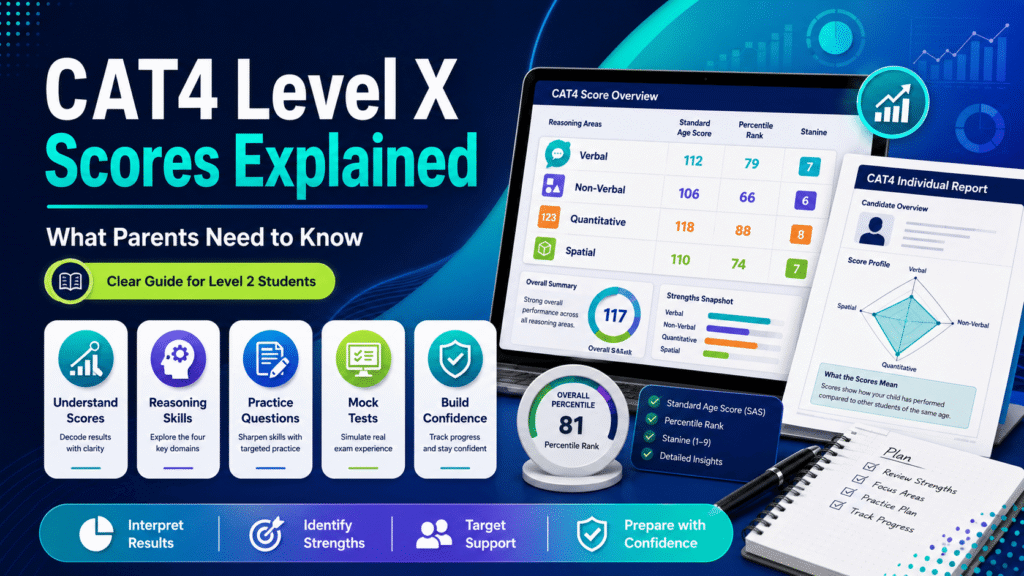
The most common score types include Standard Age Score, percentile rank, stanine, and reasoning battery scores.
3.1 Standard Age Score
The Standard Age Score is one of the most important CAT4 score types. It compares a child’s performance with other children of a similar age.
This is helpful because children in the same year group may still differ in age by several months. For young learners, a few months can make a noticeable difference in attention, vocabulary, reading confidence, and reasoning development.
A Standard Age Score helps make the comparison fairer.
In simple terms, it answers:
“How did my child perform compared with children of a similar age?”
Parents should remember that this is not a percentage score. It is a standardised score.
3.2 Percentile Rank
A percentile rank shows how a child performed compared with other students.
For example, if a child is in the 60th percentile, it generally means they performed as well as or better than many students in the comparison group.
Parents should not treat percentile rank as a pass or fail mark. It is a comparison score.
A percentile rank can help parents understand where their child sits compared with a wider group, but it should always be read together with the child’s overall learning profile.
3.3 Stanine Score
A stanine score is a simplified score band. It usually groups performance into a smaller number of levels, making it easier for parents and teachers to interpret.
Stanine scores are useful because they provide a broad overview.
Instead of focusing on tiny score differences, parents can understand whether a child’s performance is generally:
- Lower than expected
- Around the expected range
- Higher than expected
This broad view can be less stressful than focusing on exact numbers.
3.4 Battery Scores
CAT4 is usually divided into different reasoning batteries. Each battery focuses on a different type of thinking.
These may include:
- Verbal reasoning
- Quantitative reasoning
- Non-verbal reasoning
- Spatial reasoning
Battery scores help parents see the child’s learning profile. A child may not perform the same way in every area.
This is normal.
A child may have a high score in one battery and a lower score in another. The difference helps parents understand where confidence is stronger and where more support may be useful.
4. What CAT4 Level X Reasoning Scores Mean
CAT4 Level X scores are connected to reasoning skills. Each reasoning area gives a different kind of information about how a child thinks.
Understanding these areas can help parents support their child more effectively.
4.1 Verbal Reasoning Scores
Verbal reasoning focuses on words and language-based thinking.
A verbal reasoning score may reflect how well a child can:
- Understand word relationships
- Recognise similarities
- Make simple language connections
- Follow meaning
- Use vocabulary clues
- Compare ideas
Strong verbal reasoning can support reading comprehension, writing, vocabulary development, and classroom communication.
If a child finds verbal reasoning difficult, they may benefit from:
- Reading short stories regularly
- Discussing word meanings
- Practising word pairs
- Talking about similarities and differences
- Building vocabulary through simple daily conversations
4.2 Quantitative Reasoning Scores
Quantitative reasoning focuses on number thinking. It is not only about arithmetic. It is about understanding number patterns and relationships.
A quantitative reasoning score may reflect how well a child can:
- Spot number patterns
- Compare quantities
- Understand simple sequences
- Recognise number changes
- Think logically with numbers
If a child needs support in this area, useful practice may include:
- Counting patterns
- Missing number questions
- Simple number sequences
- Number comparison activities
- Step-by-step explanation of number rules
The aim is not to rush maths. The aim is to help the child understand how numbers behave.
4.3 Non-Verbal Reasoning Scores
Non-verbal reasoning focuses on visual thinking. It often uses shapes, patterns, pictures, and diagrams.
A non-verbal reasoning score may reflect how well a child can:
- Spot visual patterns
- Find the odd one out
- Compare shapes
- Notice changes
- Complete picture sequences
- Identify visual rules
This area is useful because it does not depend heavily on reading ability. It gives children another way to show their thinking skills.
If a child struggles with non-verbal reasoning, they may need practice with:
- Shape matching
- Pattern completion
- Visual puzzles
- Odd one out questions
- Comparing size, direction, and position
4.4 Spatial Reasoning Scores
Spatial reasoning focuses on how shapes and objects move, turn, rotate, or fit together.
A spatial reasoning score may reflect how well a child can:
- Imagine shapes turning
- Recognise rotated figures
- Understand how parts fit together
- Visualise movement
- Compare objects from different angles
Spatial reasoning can feel challenging at first because it requires mental visualisation.
Helpful practice may include:
- Building blocks
- Shape rotation activities
- Jigsaw puzzles
- Matching objects from different positions
- Simple drawing and folding tasks
With regular practice, many children improve their spatial confidence.
5. How Parents Should Read a CAT4 Level X Report
A CAT4 report should be read calmly and carefully. Parents should avoid focusing on only one number.
The best approach is to look at the full pattern of results.
5.1 Look at the Overall Profile
The overall profile gives a broad view of the child’s reasoning ability.
Parents should ask:
- Which areas look strongest?
- Which areas need support?
- Are the scores balanced?
- Is one area much higher or lower than the others?
- Does the result match what teachers notice in class?
This helps parents understand the bigger picture.
5.2 Compare Reasoning Areas
It is common for children to have different scores across different reasoning areas.
For example:
- A child may be strong in verbal reasoning but weaker in spatial reasoning.
- A child may be confident with number patterns but less confident with word relationships.
- A child may perform well in visual tasks but need support with language-based questions.
This pattern is more useful than one score alone.
5.3 Avoid Labelling the Child
Parents should never use CAT4 scores to label a child as “clever,” “weak,” or “not academic.”
Scores are information. They are not identity.
A child’s learning can improve with:
- Better strategies
- More confidence
- Regular practice
- Supportive teaching
- Clear explanations
- Good habits
- Positive encouragement
CAT4 scores should guide support, not limit expectations.
6. What Is a Good CAT4 Level X Score?
Parents often ask, “What is a good CAT4 score?”
The answer depends on the scoring system used in the report and the child’s learning context. A good score should not be judged only by a number. It should be interpreted alongside the child’s age, effort, confidence, school performance, and reasoning profile.
6.1 Average Scores Can Still Be Positive
Many children score around the average range. This is normal.
An average score does not mean the child is failing. It means the child is performing within the expected range compared with similar-age students.
For younger students, this can still be a strong foundation.
Parents should focus on:
- Is the child improving?
- Does the child understand the question types?
- Is the child becoming more confident?
- Are there specific areas to practise?
- Does the child stay calm during test-style tasks?
Progress matters more than panic.
6.2 Higher Scores Show Strengths
A higher score may suggest that the child is strong in a particular reasoning area.
This can be encouraging, but parents should still support balanced development.
A child with high verbal reasoning may still need practice in spatial reasoning. A child with high quantitative reasoning may still need support with language tasks.
Strong scores should be used to build confidence, not pressure.
6.3 Lower Scores Show Practice Needs
A lower score does not mean a child cannot succeed.
It may mean the child needs:
- More time
- More exposure to question types
- Clearer explanations
- Extra support in one reasoning area
- More practice with focus and attention
- Better test confidence
For Year 2 students, early support can make a big difference.
7. Why CAT4 Scores Are Not the Same as School Grades
CAT4 scores and school grades measure different things.
School grades often show how well a child is performing in taught subjects. CAT4 scores focus more on reasoning ability and learning potential.
7.1 A Child Can Have Strong CAT4 Scores and Average Grades
Sometimes a child may have strong reasoning scores but average classroom grades.
This may happen if the child:
- Rushes work
- Finds writing difficult
- Lacks confidence
- Does not revise well
- Gets distracted
- Struggles to show working
- Needs better study habits
In this case, CAT4 scores may show potential that is not yet fully visible in schoolwork.
7.2 A Child Can Have Good Grades and Need CAT4 Practice
A child may do well in normal schoolwork but still find CAT4 questions difficult.
This is because CAT4 uses unfamiliar reasoning tasks.
The child may need practice with:
- Visual patterns
- Spatial puzzles
- Number logic
- Word relationships
- Multiple-choice strategies
- Timed mock tests
This does not mean the child is weak. It means the test format is different.
7.3 CAT4 Helps Show Learning Style
CAT4 can help parents understand how their child learns best.
For example:
- Verbal strength may suggest strong language learning.
- Quantitative strength may suggest number confidence.
- Non-verbal strength may suggest visual problem-solving ability.
- Spatial strength may suggest strong mental visualisation.
This can help parents choose better practice methods.
8. How Practice Questions Can Improve CAT4 Confidence
Practice questions are one of the best ways to help children feel more comfortable with CAT4 Level X.
The goal is not to memorise answers. The goal is to understand question styles and learn how to think through them.
8.1 Practice Builds Familiarity
When students practise CAT4-style questions, they become more familiar with the format.
They learn how to:
- Read the question carefully
- Look at all answer options
- Spot patterns
- Compare shapes
- Identify word relationships
- Find number rules
- Avoid quick guessing
This makes the real test feel less unfamiliar.
8.2 Practice Helps Students Learn from Mistakes
Mistakes are useful when they are reviewed properly.
Parents should help children understand:
- What clue was missed
- Why the correct answer works
- Why another option is wrong
- How to solve a similar question next time
This turns practice into real improvement.
8.3 Practice Strengthens Reasoning Skills
Regular practice can improve reasoning habits.
Students become better at:
- Observing details
- Thinking logically
- Comparing choices
- Staying focused
- Solving problems step by step
- Checking answers before moving on
These skills are useful beyond CAT4. They support wider learning in school.
9. Why Mock Tests Are Useful After Receiving CAT4 Scores
Mock tests can help children prepare more realistically. They show how a child performs when different question types are mixed together.
For parents, mock tests can also help track progress.
9.1 Mock Tests Show Readiness
A mock test helps parents see whether the child is ready for test-style conditions.
It can show:
- Whether the child understands the format
- Whether the child can stay focused
- Whether timing is an issue
- Which question types are still difficult
- Whether confidence is improving
This is very helpful for planning preparation.
9.2 Mock Tests Reduce Test Anxiety
Children often feel nervous when they face something new.
Mock tests reduce anxiety by making the test format familiar.
A child who has practised mock tests may think:
“I know how this works.”
That simple feeling can improve confidence on test day.
9.3 Mock Tests Should Be Reviewed Carefully
A mock test is not only about the final score. The review is just as important.
Parents should look at:
- Which sections were strongest
- Which sections were weakest
- Which mistakes were careless
- Which mistakes showed misunderstanding
- Which questions took too long
- Which skills need more practice
This helps create a focused preparation plan.
10. How to Improve Lower CAT4 Level X Scores
If a child receives a lower score in one area, parents should respond calmly. Lower scores can improve with the right support and consistent practice.
The key is to focus on one skill at a time.
10.1 Improve Verbal Reasoning
To improve verbal reasoning, parents can encourage:
- Reading short texts
- Talking about word meanings
- Comparing similar words
- Playing simple vocabulary games
- Practising word relationship questions
- Asking children to explain their answers
This helps children build language confidence.
10.2 Improve Quantitative Reasoning
To improve quantitative reasoning, students can practise:
- Counting patterns
- Missing number questions
- Number sequences
- Simple addition and subtraction logic
- Comparing numbers
- Finding rules in number groups
The aim is to help children understand number relationships, not just memorise sums.
10.3 Improve Non-Verbal Reasoning
To improve non-verbal reasoning, students can practise:
- Shape patterns
- Odd one out questions
- Picture sequences
- Matching figures
- Completing visual patterns
- Spotting differences
This helps students become more observant and careful.
10.4 Improve Spatial Reasoning
To improve spatial reasoning, parents can use:
- Jigsaw puzzles
- Building blocks
- Shape matching
- Simple rotation tasks
- Drawing and folding activities
- Spatial reasoning practice questions
Spatial reasoning often improves with hands-on activities.
11. Common Parent Mistakes When Reading CAT4 Scores
Parents want the best for their children, but CAT4 scores can sometimes be misunderstood.
Avoiding common mistakes can help parents respond more positively.
11.1 Treating CAT4 as a Pass or Fail Test
CAT4 should not be seen as a simple pass or fail test.
It is a reasoning assessment. It gives information about how a child thinks and learns.
The result should be used to guide support, not create fear.
11.2 Comparing Children Too Harshly
Parents should avoid comparing one child’s CAT4 scores with another child’s results.
Children develop at different speeds. They also have different learning strengths.
A better question is:
“What does this result tell us about my child’s next step?”
11.3 Ignoring the Score Pattern
Looking at only one score can be misleading.
Parents should look at the pattern across all reasoning areas.
A child’s profile may show:
- Balanced development
- Strong verbal skills
- Strong visual reasoning
- A need for number practice
- A need for spatial support
- A need for confidence-building
The pattern tells a better story than one number.
11.4 Putting Too Much Pressure on Practice
Practice is important, but pressure can reduce confidence.
Young students need:
- Short practice sessions
- Encouragement
- Breaks
- Clear explanations
- Positive feedback
- A calm routine
Confidence grows better in a supportive environment.
12. Best CAT4 Level X Preparation Plan After Scores
After receiving CAT4 scores, parents can use them to build a practical preparation plan.
This plan should be simple, balanced, and consistent.
12.1 Start with the Weakest Area
If one reasoning area is clearly lower, start there.
For example:
- Low verbal reasoning: practise vocabulary and word relationships.
- Low quantitative reasoning: practise number patterns.
- Low non-verbal reasoning: practise shape and picture patterns.
- Low spatial reasoning: practise rotation and visualisation tasks.
Short, focused practice is usually more effective than long sessions.
12.2 Keep Strengths Active
Parents should not ignore strong areas.
If a child is strong in one section, continue light practice to maintain confidence.
Strengths can also motivate children. A child who enjoys visual puzzles may feel more positive before moving to harder number tasks.
12.3 Use Mixed Practice Later
Once individual areas improve, students should try mixed practice.
Mixed practice helps them switch between different question types, just like they may need to do in the real test.
This improves:
- Flexibility
- Focus
- Test readiness
- Confidence
- Speed
- Accuracy
12.4 Add Mock Tests Gradually
Mock tests should come after topic-based practice.
Start with mini mock tests, then move towards fuller practice when the child is ready.
A gentle mock test routine helps students understand timing without feeling overwhelmed.
13. How to Talk to Your Child About CAT4 Scores
The way parents explain scores matters. A child should feel supported, not judged.
The best message is simple:
“These scores help us understand how you learn. They show what you are already good at and what we can practise together.”
13.1 Use Positive Language
Parents can say:
- “This shows your strengths.”
- “This tells us what to practise next.”
- “Mistakes help us learn.”
- “You can improve with practice.”
- “Let’s work on one skill at a time.”
Positive language builds confidence.
13.2 Avoid Negative Labels
Parents should avoid saying:
- “You are bad at this.”
- “This score is not good enough.”
- “You should have done better.”
- “Other children scored higher.”
- “This means you are weak.”
These comments can reduce confidence and make practice stressful.
13.3 Focus on Progress
Progress is more important than one result.
Parents should celebrate:
- Better focus
- More careful answers
- Improved pattern spotting
- More confidence
- Better timing
- Fewer careless mistakes
- Clearer explanations
This helps children stay motivated.
14. CAT4 Level X Scores and Student Confidence
Confidence plays a major role in CAT4 performance. A child who understands the format is more likely to stay calm and think clearly.
Scores should be used to build confidence, not reduce it.
14.1 Confidence Helps Students Think Clearly
When children feel nervous, they may rush or forget strategies.
Confidence helps them:
- Read carefully
- Notice details
- Compare options
- Think step by step
- Stay calm
- Keep trying
This is why mock tests and practice questions are so helpful.
14.2 Familiarity Reduces Fear
The more familiar students are with CAT4-style questions, the less scary the test feels.
Familiarity helps children understand:
- What the question is asking
- How answer options work
- How to find patterns
- How to manage tricky questions
- How to keep going
A familiar format can turn anxiety into confidence.
14.3 Confidence Comes from Small Wins
Young students build confidence through small achievements.
Parents should celebrate when a child:
- Solves a tricky pattern
- Explains an answer
- Improves a score
- Completes a mini mock test
- Stays focused
- Learns from a mistake
Small wins create steady progress.
15. Final Thoughts
CAT4 Level X scores can give parents valuable insight into how their child thinks, learns, and solves problems. The results may include different score types, such as standardised scores, percentile ranks, stanines, and reasoning battery scores. At first, these may seem confusing, but they become much easier to understand when parents focus on the overall learning profile.
For Year 2 students, CAT4 scores should not be treated as labels. They are learning indicators. They show strengths, highlight support areas, and guide better preparation.
The best way to respond to CAT4 scores is with calm, focused action. Use practice questions to build reasoning skills. Use mock tests to improve confidence. Review mistakes gently. Support weaker areas step by step. Keep strong areas active. Most importantly, help your child believe that improvement is possible.
With the right preparation, CAT4 Level X can become less stressful and more useful. It can help parents understand their child better and help students approach reasoning questions with greater confidence.