
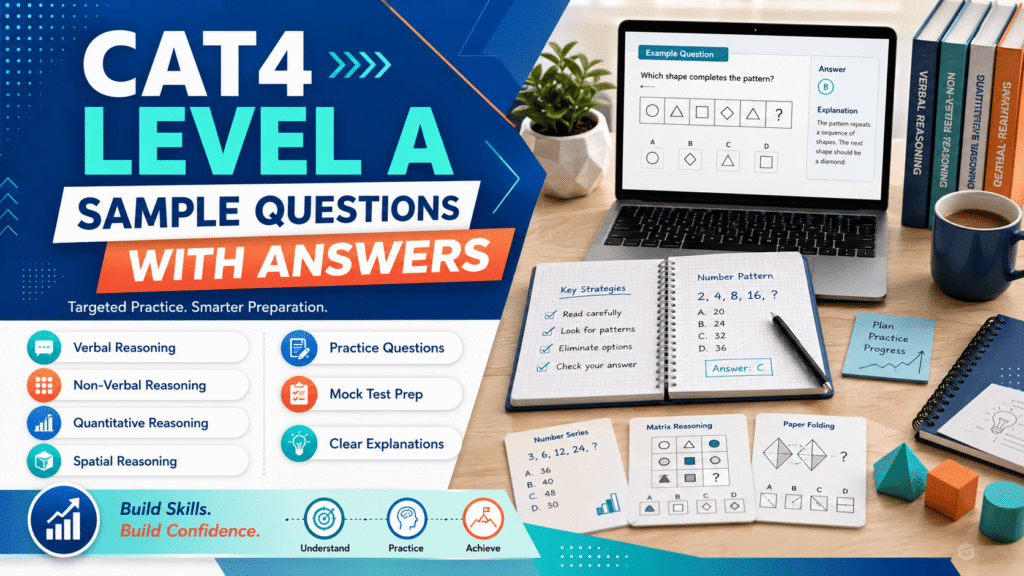
CAT4 Level A can feel different from normal classroom tests because it is not only about remembering facts. It focuses on reasoning skills, problem-solving, pattern recognition, number logic, word relationships, and visual thinking. Students need to look carefully, find rules, compare answer choices, and choose the best answer.
For parents, CAT4 Level A sample questions are useful because they show how the test may ask students to think. When students practise with answers and explanations, they begin to understand the method behind each question. This helps improve confidence, reduce careless mistakes, and prepare more effectively for mock tests and real assessment-style practice.
This guide includes CAT4 Level A sample questions with answers across the four main reasoning areas: Verbal Reasoning, Non-Verbal Reasoning, Quantitative Reasoning, and Spatial Reasoning. Each section includes 5 sample questions with correct answers and simple explanations.
1. What Are CAT4 Level A Sample Questions?
CAT4 Level A sample questions are practice questions designed to help students understand the style of reasoning used in the assessment. These questions are not only about school knowledge. They focus on how students think through unfamiliar problems.
Sample questions may include:
- Word relationships
- Odd one out questions
- Shape patterns
- Number sequences
- Missing number questions
- Visual puzzles
- Spatial reasoning tasks
- Multiple-choice answers
The purpose of these questions is to help students become familiar with the test format and build confidence before attempting mock tests.
1.1 Why Sample Questions Are Important
Sample questions help students understand what CAT4-style reasoning looks like. Many students feel unsure at first because the questions may not look like ordinary school worksheets.
Practice helps students:
- Recognise common question styles
- Find patterns more quickly
- Compare answer choices carefully
- Avoid guessing too early
- Learn from mistakes
- Build confidence step by step
- Improve accuracy through explanations
The goal is not to memorise answers. The goal is to understand how to solve similar questions.
1.2 How Parents Should Use These Questions
Parents should use these CAT4 Level A sample questions as a learning tool, not as a pressure test. Students learn best when practice feels calm, structured, and supportive.
A good method is:
- Let the student try the question first.
- Ask them to explain their thinking.
- Check the correct answer together.
- Read the explanation carefully.
- Discuss why the wrong options do not fit.
- Practise a similar question later.
This helps students understand the method behind the answer.
2. What Skills Do CAT4 Level A Questions Test?
CAT4 Level A questions focus on reasoning skills. These skills help students solve problems using logic, patterns, relationships, and careful thinking.
The four main reasoning areas are:
- Verbal Reasoning
- Non-Verbal Reasoning
- Quantitative Reasoning
- Spatial Reasoning
Each area checks a different type of thinking.
2.1 Verbal Reasoning Skills
Verbal reasoning focuses on words, meanings, vocabulary, and language relationships.
Students may need to:
- Find similar meanings
- Identify opposite meanings
- Complete word relationships
- Find the odd word out
- Recognise word groups
- Understand simple analogies
This skill supports reading comprehension, vocabulary, writing, communication, and classroom understanding.
2.2 Non-Verbal Reasoning Skills
Non-verbal reasoning focuses on shapes, diagrams, pictures, and visual patterns.
Students may need to:
- Complete a shape pattern
- Find the odd shape out
- Choose a missing figure
- Match similar diagrams
- Notice changes in direction, size, or position
- Identify visual rules
This skill supports visual problem-solving and careful observation.
2.3 Quantitative Reasoning Skills
Quantitative reasoning focuses on number logic and number relationships.
Students may need to:
- Complete number sequences
- Find missing numbers
- Compare values
- Identify number patterns
- Understand number rules
- Solve simple logic-based number questions
This skill supports Maths reasoning and problem-solving confidence.
2.4 Spatial Reasoning Skills
Spatial reasoning focuses on how shapes move, rotate, fit together, or appear from different angles.
Students may need to:
- Recognise rotated shapes
- Match shapes from different positions
- Understand how parts combine
- Visualise movement
- Compare directions
- Identify turned or flipped figures
This skill can improve with regular visual practice and hands-on activities.
3. How to Answer CAT4 Level A Sample Questions
Before starting sample questions, students should understand a simple answering method. CAT4 questions reward careful thinking, not rushed guessing.
3.1 Use a Step-by-Step Method
Students can use this method for most CAT4 Level A questions:
- Read or look at the question carefully.
- Decide what type of question it is.
- Find the rule, pattern, or relationship.
- Check every answer choice.
- Remove answers that clearly do not fit.
- Choose the best answer.
- Check once before moving on.
This method helps reduce careless mistakes.
3.2 Avoid Guessing Too Quickly
Some students choose the first answer that looks correct. This can lead to mistakes because CAT4 questions often include answer choices that look similar.
Before choosing, students should ask:
- What is the rule?
- What is changing?
- What stays the same?
- Which answer fits the whole pattern?
- Which options are clearly wrong?
- Can I explain why my answer is correct?
If students can explain their answer, they are more likely to understand the reasoning.
4. Verbal Reasoning Sample Questions with Answers
Verbal reasoning questions help students think logically using words. These questions support vocabulary, reading comprehension, and language confidence.
Below are 5 CAT4 Level A verbal reasoning sample questions with answers and explanations.
4.1 Verbal Reasoning Question 1
Question 1:
Which word means almost the same as “quick”?
A. Fast
B. Heavy
C. Quiet
D. Empty
Correct Answer: A. Fast
Explanation: Quick means fast. Heavy, quiet, and empty do not have the same meaning.
4.2 Verbal Reasoning Question 2
Question 2:
Find the odd one out.
Car, bus, train, apple
A. Car
B. Bus
C. Train
D. Apple
Correct Answer: D. Apple
Explanation: Car, bus, and train are types of transport. Apple is a fruit, so it does not belong in the group.
4.3 Verbal Reasoning Question 3
Question 3:
Complete the relationship.
Puppy is to dog as kitten is to _______.
A. Cat
B. Bird
C. Horse
D. Fish
Correct Answer: A. Cat
Explanation: A puppy is a young dog. A kitten is a young cat. The relationship is young animal to adult animal.
4.4 Verbal Reasoning Question 4
Question 4:
Which word is the opposite of “begin”?
A. Start
B. Open
C. Finish
D. Move
Correct Answer: C. Finish
Explanation: Begin means to start. Finish is the opposite because it means to end.
4.5 Verbal Reasoning Question 5
Question 5:
Which word belongs with this group?
Monday, Tuesday, Friday, _______
A. Chair
B. Sunday
C. Pencil
D. Window
Correct Answer: B. Sunday
Explanation: Monday, Tuesday, Friday, and Sunday are days of the week. The other options are objects.
5. Non-Verbal Reasoning Sample Questions with Answers
Non-verbal reasoning questions use shapes, symbols, and visual patterns. Students need to look carefully and notice what is changing.
Below are 5 CAT4 Level A non-verbal reasoning sample questions with answers and explanations.
5.1 Non-Verbal Reasoning Question 1
Question 1:
Choose the option that follows the same pattern as the three given figures:
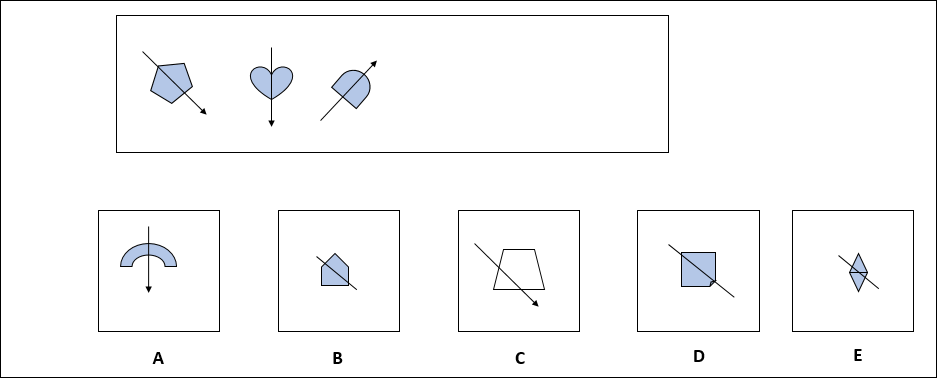
Correct Answer: B
Explanation: Each shape has an arrow crossing it from the centre.
5.2 Non-Verbal Reasoning Question 2
Question 2:
Choose the option that follows the same pattern as the three given figures:
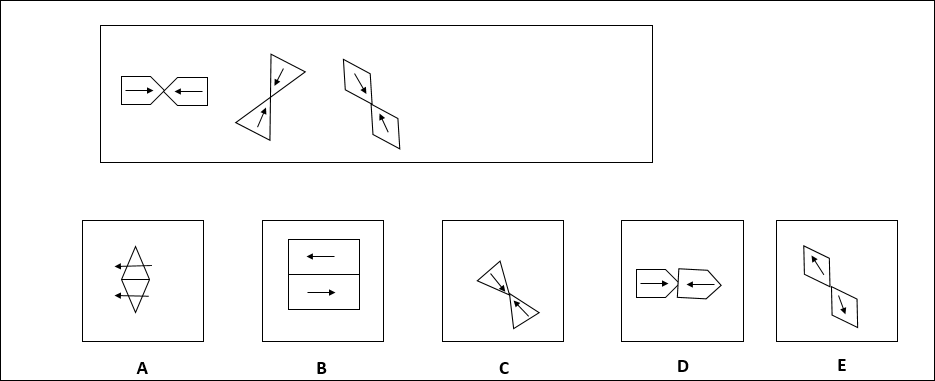
Correct Answer: C
Explanation: In each connect the same shapes, arrows inside them pointing towards each other.
5.3 Non-Verbal Reasoning Question 3
Question 3:
Choose the option that follows the same pattern as the three given figures:
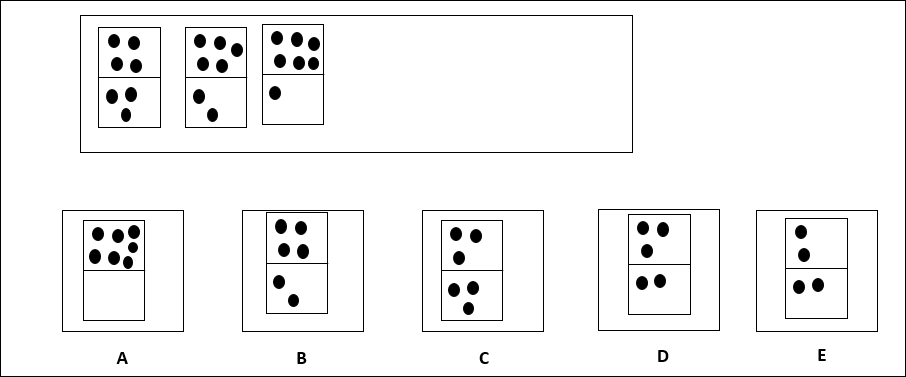
Correct Answer: A
Explanation: Each figure has seven black dots as whole. Option A is correct.
5.4 Non-Verbal Reasoning Question 4
Question 4:
Choose the answer choice that follows the pattern and complete the matrix.
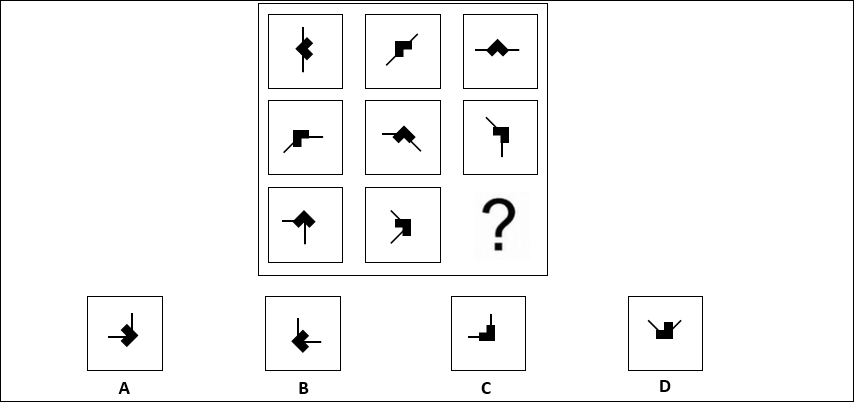
Correct Answer: A
Explanation: Across the rows, each shape rotates by 45° in the clockwise direction. Therefore, the missing box should contain the shape rotated 45° clockwise from the previous figure. The only answer that meets this criteria is answer A.
5.5 Non-Verbal Reasoning Question 5
Question 5:
Choose the answer choice that follows the pattern and complete the matrix.
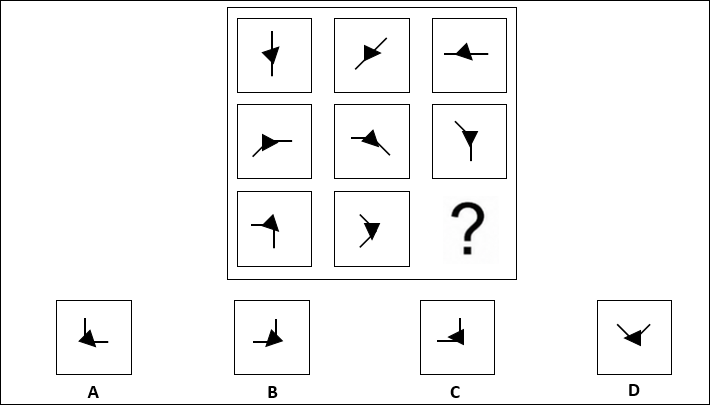
Correct Answer: B
Explanation: Across the rows, each shape rotates by 45° in the clockwise direction. Therefore, the missing box should contain the shape rotated 45° clockwise from the previous figure. The only answer that meets this criteria is answer B.
6. Quantitative Reasoning Sample Questions with Answers
Quantitative reasoning questions focus on number patterns and number logic. Students need to find the rule before choosing the answer.
Below are 5 CAT4 Level A quantitative reasoning sample questions with answers and explanations.
6.1 Quantitative Reasoning Question 1
Question 1:
What number comes next?
4, 8, 12, 16, _______
A. 18
B. 20
C. 22
D. 24
Correct Answer: B. 20
Explanation: The numbers increase by 4 each time. After 16, the next number is 20.
6.2 Quantitative Reasoning Question 2
Question 2:
What number is missing?
6, 12, 18, _______ , 30
A. 20
B. 22
C. 24
D. 28
Correct Answer: C. 24
Explanation: The numbers go up by 6 each time. After 18, the missing number is 24.
6.3 Quantitative Reasoning Question 3
Question 3:
Which number is the odd one out?
7, 14, 21, 25, 28
A. 7
B. 14
C. 25
D. 28
Correct Answer: C. 25
Explanation: 7, 14, 21, and 28 are counting in 7s. 25 does not fit the pattern.
6.4 Quantitative Reasoning Question 4
Question 4:
What number comes next?
40, 35, 30, 25, _______
A. 15
B. 20
C. 22
D. 30
Correct Answer: B. 20
Explanation: The numbers decrease by 5 each time. After 25, the next number is 20.
6.5 Quantitative Reasoning Question 5
Question 5:
Complete the pattern.
3, 6, 12, 24, _______
A. 30
B. 36
C. 42
D. 48
Correct Answer: D. 48
Explanation: Each number is doubled. 3 doubled is 6, 6 doubled is 12, 12 doubled is 24, and 24 doubled is 48.
7. Spatial Reasoning Sample Questions with Answers
Spatial reasoning questions ask students to think about shape position, direction, movement, and rotation. These questions help build visualisation skills.
Below are 5 CAT4 Level A spatial reasoning sample questions with answers and explanations.
7.1 Spatial Reasoning Question 1
Question 1:
Choose the answer choice that shows the final product of the unfolded punched-in paper.
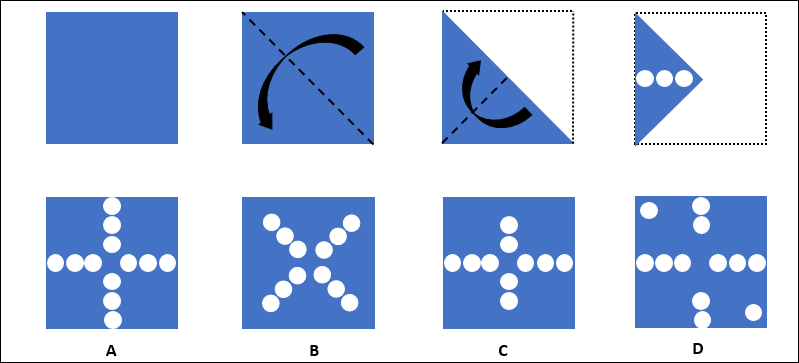
Correct Answer: A
Explanation. The paper was folded in half diagonally from the top right corner to the bottom left corner and then folded again from bottom right corner to the top left corner. The shapes go through four layers of paper.
7.2 Spatial Reasoning Question 2
Question 2:
Choose the answer choice that shows the final product of the unfolded punched-in paper.
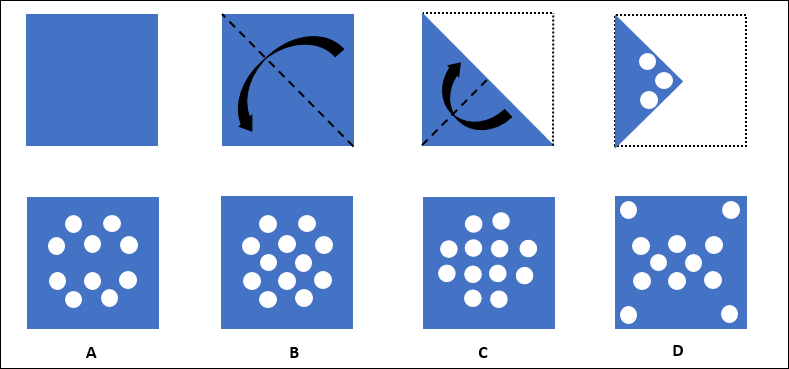
Correct Answer: B
Explanation. The paper was folded in half diagonally from the top right corner to the bottom left corner and then folded again from bottom right corner to the top left corner. The shapes go through four layers of paper.
7.3 Spatial Reasoning Question 3
Question 3:
Choose the answer choice that shows the final product of the unfolded punched-in paper.
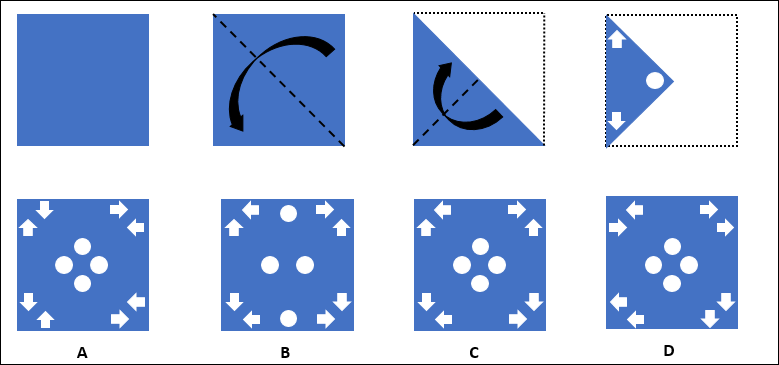
Correct Answer: C
Explanation. The paper was folded in half diagonally from the top right corner to the bottom left corner and then folded again from bottom right corner to the top left corner. The shapes go through four layers of paper.
7.4 Spatial Reasoning Question 4
Question 4:
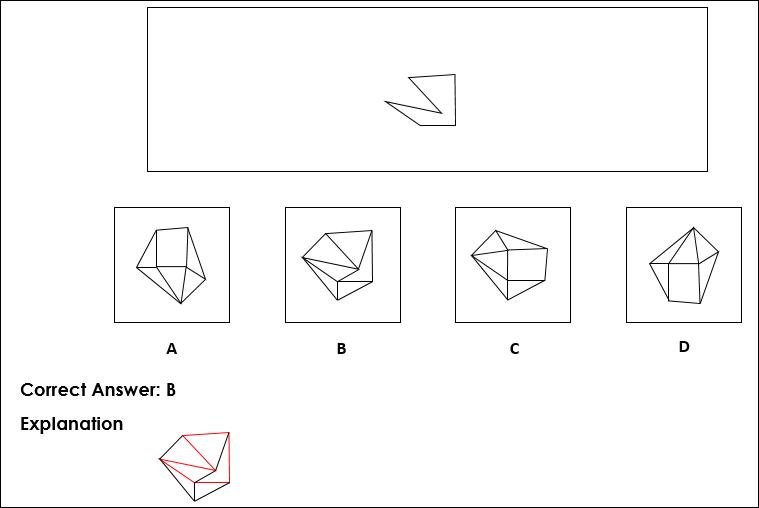
Choose the answer choice that contains the given shape. The shape must keep its size and orientation.
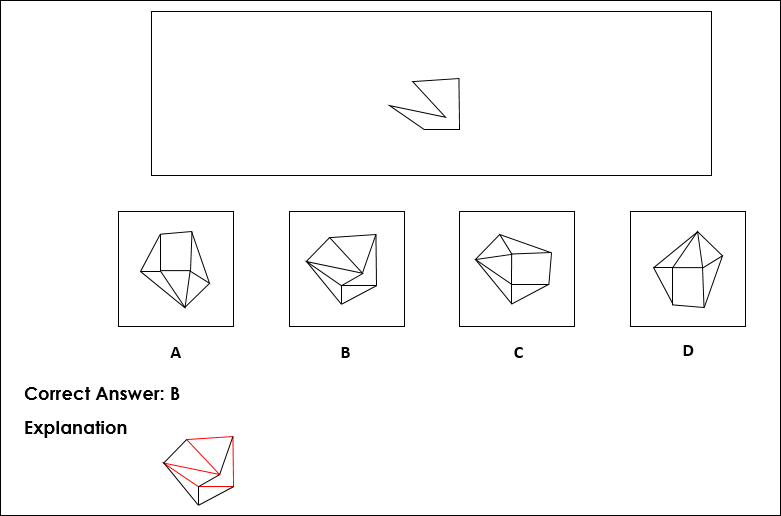
7.5 Spatial Reasoning Question 5
Question 5:
Choose the answer choice that contains the given shape. The shape must keep its size and orientation.
8. How to Review CAT4 Level A Sample Questions
Sample questions are most useful when students review them properly. The aim is not only to check whether the answer is correct. The aim is to understand the reasoning process.
8.1 Ask Students to Explain Their Thinking
After each question, parents can ask:
- Why did you choose that answer?
- What pattern did you notice?
- Which options were wrong?
- What clue helped you?
- What changed in the sequence?
- How can you solve a similar question next time?
When students explain their thinking, they become more confident and careful.
8.2 Look for Repeated Mistakes
If a student keeps making the same kind of mistake, it usually shows an area that needs more practice.
For example:
- Word mistakes may mean verbal reasoning needs support.
- Shape mistakes may mean non-verbal reasoning needs practice.
- Number sequence mistakes may mean quantitative reasoning needs attention.
- Rotation mistakes may mean spatial reasoning needs more practice.
This helps parents target preparation more effectively.
8.3 Practise Similar Questions Again
If a student struggles with one category, repeat similar questions.
For example:
- More word relationship questions for verbal reasoning
- More pattern questions for non-verbal reasoning
- More number sequences for quantitative reasoning
- More rotation tasks for spatial reasoning
Targeted practice helps students improve more quickly.
9. How Mock Tests Support CAT4 Level A Preparation
Sample questions help students learn individual skills. Mock tests help students practise a full test-style experience.
Both are important for strong preparation.
9.1 Start with Mini Mock Tests
Students should usually begin with mini mock tests before attempting longer mock test-style practice.
A mini mock test may include:
- A few verbal reasoning questions
- A few non-verbal reasoning questions
- A few quantitative reasoning questions
- A few spatial reasoning questions
- A short review afterwards
This helps students build confidence gradually.
9.2 Review Mock Test Performance
After a mock test, parents should review:
- Which questions were correct
- Which questions were wrong
- Which category was strongest
- Which category needs more practice
- Whether the student rushed
- Whether timing caused stress
- Whether the student understood the question type
This makes mock tests more useful than simply checking a score.
9.3 Use Mock Tests to Build Confidence
Mock tests should not create fear. They should help students become familiar with the format.
Parents can say:
“This is just practice. It helps us learn what to improve.”
This keeps preparation positive and confidence-focused.
10. Best Preparation Tips for CAT4 Level A
CAT4 Level A preparation should be calm, consistent, and balanced. Students need regular exposure to all reasoning areas.
10.1 Keep Practice Short and Regular
Short practice sessions are usually better than long, stressful sessions.
A useful session may include:
- 15 to 25 minutes of practice
- One reasoning area
- A few carefully chosen questions
- Clear explanations
- Gentle mistake review
- Positive feedback
This helps students stay focused.
10.2 Practise All Four Reasoning Areas
Students should practise:
- Verbal reasoning
- Non-verbal reasoning
- Quantitative reasoning
- Spatial reasoning
Balanced practice helps students feel ready for different question types.
10.3 Review Answers with Explanations
Explanations help students understand the method.
A good explanation shows:
- What the rule was
- Why the correct answer fits
- Why the other answers do not fit
- What clue to look for next time
This builds real reasoning ability.
11. Common Mistakes to Avoid
Many students make similar mistakes when practising CAT4 Level A questions. These mistakes are normal and can improve with practice.
11.1 Rushing Through Questions
Students may rush because they want to finish quickly. This can lead to careless errors.
Encourage students to:
- Slow down
- Look carefully
- Find the rule
- Check all options
- Choose calmly
Accuracy should come before speed.
11.2 Guessing Without Finding the Rule
Some students guess before understanding the question.
Teach them to ask:
- What is the pattern?
- What is changing?
- What stays the same?
- Which answer fits best?
This improves logical thinking.
11.3 Ignoring Mistake Review
Answer checking is not enough. Students need to understand why an answer was wrong.
Mistake review helps students avoid repeating the same errors and improves future performance.
12. Final Thoughts
CAT4 Level A sample questions with answers are a helpful way to prepare students for reasoning-style assessments. They allow students to practise different question types, understand answer explanations, and build confidence before attempting mock tests or longer practice sessions.
This blog included sample questions for the four main CAT4 Level A reasoning areas: Verbal Reasoning, Non-Verbal Reasoning, Quantitative Reasoning, and Spatial Reasoning. Each question included a correct answer and a simple explanation to support learning.
The best preparation is not about pressure or memorisation. It is about understanding the method, practising regularly, reviewing mistakes, and building confidence step by step.
With clear explanations, balanced practice, and supportive parent guidance, students can approach CAT4 Level A questions with stronger reasoning skills and greater confidence.