
CAT4 Level B sample questions are a helpful way for Year 5 students to understand the style of reasoning they may face in the assessment. Unlike ordinary school tests, CAT4 does not simply check memorised facts. It focuses on how students think, compare information, recognise patterns, solve problems, and apply logic in unfamiliar situations.
For parents, sample questions are especially useful because they show how CAT4-style practice works. When students practise with answers and explanations, they do not just learn the correct option. They learn the thinking method behind the answer. This helps improve confidence, accuracy, and readiness for mock tests.
This guide includes CAT4 Level B sample questions with answers for Year 5 students. It covers the four key reasoning areas: Verbal Reasoning, Non-Verbal Reasoning, Quantitative Reasoning, and Spatial Reasoning. Each section includes clear explanations so students and parents can practise together in a calm and structured way.
1. What Are CAT4 Level B Sample Questions?
CAT4 Level B sample questions are practice questions designed to help students become familiar with reasoning-style tasks. These questions are not only about what a student has learned in school. They are about how well the student can think through a problem and find the rule.
CAT4 Level B questions may include:
- Word relationships
- Number patterns
- Shape sequences
- Odd one out questions
- Missing number questions
- Visual puzzles
- Spatial rotation tasks
- Multiple-choice reasoning
- Pattern completion questions
For Year 5 students, the questions are usually more developed than earlier levels. Students may need to think more carefully, compare more details, and explain their reasoning more clearly.
1.1 Why Sample Questions Help Year 5 Students
Sample questions help Year 5 students understand what to expect before taking mock tests or real assessment-style practice.
They help students:
- Recognise common CAT4 question types
- Build reasoning confidence
- Improve pattern recognition
- Practise number logic
- Strengthen vocabulary skills
- Understand visual relationships
- Avoid careless mistakes
- Learn from answer explanations
The aim is not to memorise answers. The aim is to understand how to solve similar questions.
1.2 How Parents Should Use These Questions
Parents should use these sample questions as a learning activity rather than a pressure test.
A helpful method is:
- Let the student try the question independently.
- Ask them to explain their thinking.
- Check the correct answer together.
- Read the explanation carefully.
- Discuss why the other options do not fit.
- Practise a similar question later.
If the student gets an answer wrong, stay positive. Mistakes are useful because they show what needs more practice.
2. What Skills Do CAT4 Level B Questions Test?
CAT4 Level B focuses on reasoning skills. These skills help students solve unfamiliar problems using logic, patterns, and careful thinking.
The four main reasoning areas are:
- Verbal Reasoning
- Non-Verbal Reasoning
- Quantitative Reasoning
- Spatial Reasoning
Each area checks a different type of thinking, so students should practise all four.
2.1 Verbal Reasoning Skills
Verbal reasoning focuses on words, meanings, vocabulary, and language relationships.
Students may need to:
- Find similar meanings
- Identify opposite meanings
- Complete word analogies
- Find the odd word out
- Recognise word groups
- Understand relationships between ideas
This area supports reading comprehension, vocabulary, writing, communication, and classroom understanding.
2.2 Non-Verbal Reasoning Skills
Non-verbal reasoning focuses on shapes, diagrams, symbols, and visual patterns.
Students may need to:
- Complete a shape sequence
- Find a missing figure
- Identify the odd shape out
- Spot changes in direction or position
- Recognise visual rules
- Compare diagrams carefully
This area helps students develop visual problem-solving skills.
2.3 Quantitative Reasoning Skills
Quantitative reasoning focuses on number logic and number relationships.
Students may need to:
- Complete number sequences
- Find missing numbers
- Identify number rules
- Compare values
- Recognise patterns
- Apply logical maths thinking
This area supports mathematical reasoning and problem-solving confidence.
2.4 Spatial Reasoning Skills
Spatial reasoning focuses on how shapes move, rotate, fold, fit together, or appear from different angles.
Students may need to:
- Recognise rotated shapes
- Match figures after movement
- Visualise shape changes
- Understand how parts combine
- Compare directions
- Identify turned or flipped figures
This area can feel challenging at first, but it improves with regular practice.
3. How to Answer CAT4 Level B Sample Questions
Before attempting sample questions, students should understand a simple answering method. CAT4 questions often include answer choices that look similar, so students need to think carefully.
3.1 Use a Step-by-Step Reasoning Method
Students can use this method:
- Read or view the question carefully.
- Decide what type of reasoning is needed.
- Look for the pattern, rule, or relationship.
- Check all answer choices.
- Remove options that clearly do not fit.
- Choose the best answer.
- Check the answer against the rule.
This method helps students avoid rushing and improves accuracy.
3.2 Do Not Guess Too Quickly
Some students choose the first answer that looks correct. This can lead to mistakes.
Before choosing, students should ask:
- What is the rule?
- What is changing?
- What stays the same?
- Which answer follows the full pattern?
- Which options are clearly wrong?
- Can I explain why my answer is correct?
If students can explain their answer, they are more likely to understand the reasoning.
4. Verbal Reasoning Sample Questions with Answers
Verbal reasoning questions help students think logically using words. These questions are useful for vocabulary, comprehension, and language-based problem-solving.
Below are 5 CAT4 Level B verbal reasoning sample questions with answers and explanations.
4.1 Verbal Reasoning Question 1
Question 1:
Which word means almost the same as “ancient”?
A. Modern
B. Old
C. Bright
D. Simple
Correct Answer: B. Old
Explanation: Ancient means very old. Modern means new or current, bright means giving light, and simple means easy to understand.
4.2 Verbal Reasoning Question 2
Question 2:
Find the odd one out.
Oak, pine, rose, maple
A. Oak
B. Pine
C. Rose
D. Maple
Correct Answer: C. Rose
Explanation: Oak, pine, and maple are trees. Rose is a flower, so it does not belong in the group.
4.3 Verbal Reasoning Question 3
Question 3:
Choose the word that belongs in the same group as the first three words: cork, bamboo, linen
Choice A. nylon
Choice B. rubber
Choice C. brick
Choice D. plastic
Choice E. steel
Correct Answer: B
Explanation: Cork, bamboo, and linen are natural materials. Choice B is correct because rubber can also be a natural material when it comes from rubber trees. Choice A is incorrect because nylon is man-made. Choice C is incorrect because brick is a man-made building material. Choice D is incorrect because plastic is man-made. Choice E is incorrect because steel is a metal made by people.
4.4 Verbal Reasoning Question 4
Question 4:
Choose the word that belongs in the same group as the first three words: fox, rabbit, horse
Choice A. goat
Choice B. duck
Choice C. snake
Choice D. trout
Choice E. wasp
Correct Answer: A
Explanation: Fox, rabbit, and horse are mammals. Choice A is correct because a goat is also a mammal. Choice B is incorrect because a duck is a bird. Choice C is incorrect because a snake is a reptile. Choice D is incorrect because a trout is a fish. Choice E is incorrect because a wasp is an insect.
4.5 Verbal Reasoning Question 5
Question 5:
Choose the word that belongs in the same group as the first three words: heron, parrot, goose
Choice A. squirrel
Choice B. bat
Choice C. moth
Choice D. turtle
Choice E. pelican
Correct Answer: E
Explanation: Heron, parrot, and goose are birds. Choice E is correct because a pelican is also a bird. Choice A is incorrect because a squirrel is a mammal. Choice B is incorrect because a bat is a mammal, even though it has wings. Choice C is incorrect because a moth is an insect. Choice D is incorrect because a turtle is a reptile.
5. Non-Verbal Reasoning Sample Questions with Answers
Non-verbal reasoning questions use shapes and visual patterns. Students need to look carefully at changes in shape, size, position, direction, order, and repetition.
Below are 5 CAT4 Level B non-verbal reasoning sample questions with answers and explanations.
5.1 Non-Verbal Reasoning Question 1
Question 1:
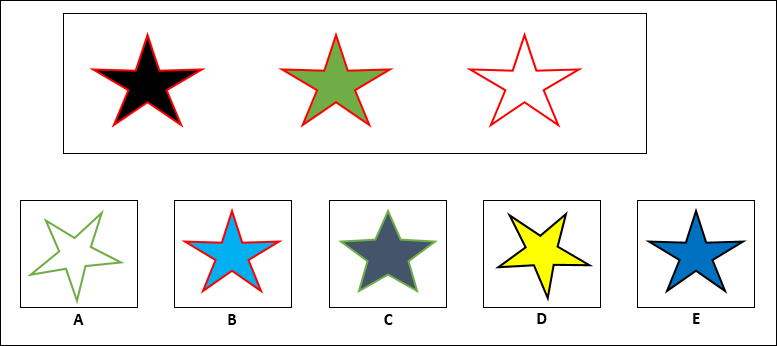
Choose the answer which shares the same connection/characteristic as the three given images.
Explanation
The correct answer is B.
All the stars have red borders. Therefore, the correct answer will be the arrow with a red border.
Choices A and C have green borders. Choice D and E have green border.
Hence, B is the only choice that matches the pattern and it is the correct answer.
5.2 Non-Verbal Reasoning Question 2
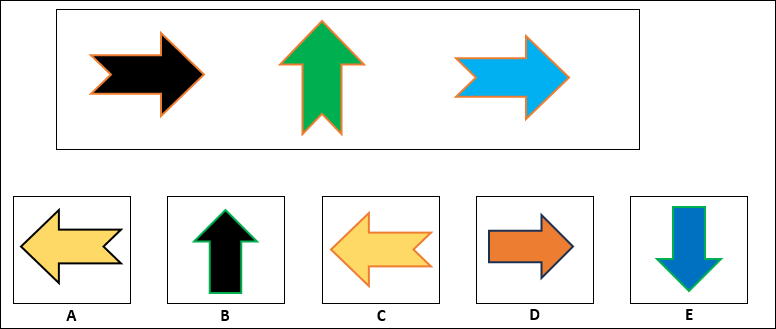
Question 2:
Choose the answer which shares the same connection/characteristic as the three given images.
Explanation
The correct answer is C.
All the arrows have orange borders. Therefore, the correct answer will be the arrow with a orange border.
Choices A and D have black borders. Choice B and E have green border.
Hence, C is the only choice that matches the pattern and it is the correct answer.
5.3 Non-Verbal Reasoning Question 3
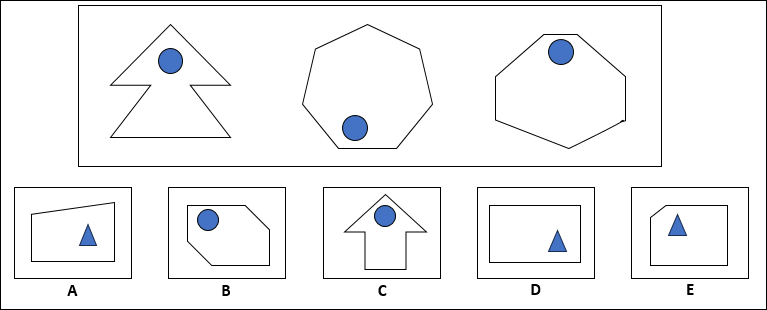
Question 3:
Choose the option that fits together with the three given images.
Explanation
The correct answer is C.
Each of the figures in this question has seven sides and a circle on the inside.
The only answer choice which follows these rules is the 3rd choice.
All of the other answer choices contain shapes with fewer than seven sides, and/or the inner shape is not a circle.
5.4 Non-Verbal Reasoning Question 4
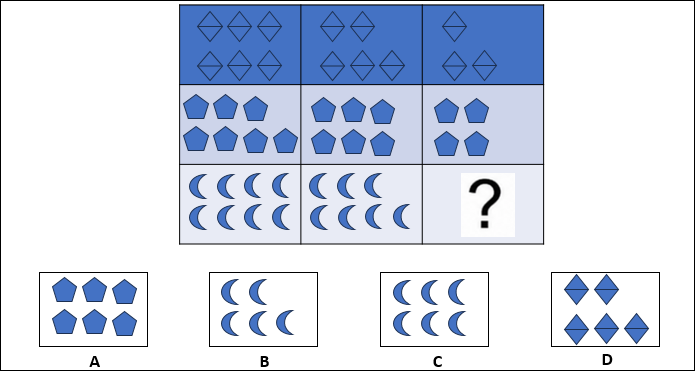
Question 4:
Choose the picture that belongs with the bottom picture in the same way the pictures on top belong together.
Explanation
The correct answer is B
In this matrix: Across a row (from left to right), first one shape is removed (from the upper-right corner), then two shapes are removed (from the top, the remaining shapes are always in the same position).
Down a column the shape changes and one shape is added in each successive frame.
5.5 Non-Verbal Reasoning Question 5
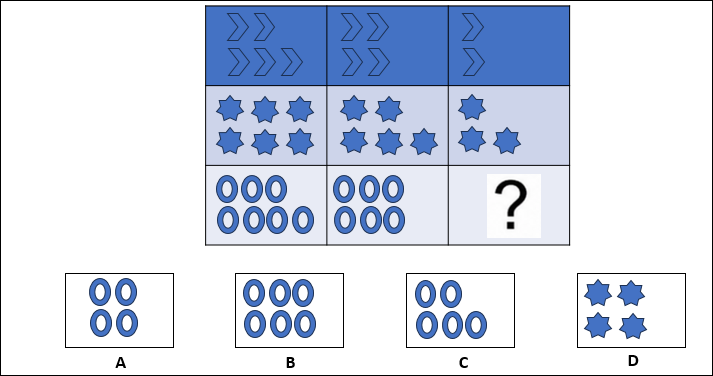
Question 5:
Choose the picture that belongs with the bottom picture in the same way the pictures on top belong together.
Explanation
The correct answer is A
In this matrix: Across a row (from left to right), first one shape is removed (from the upper-right corner), then two shapes are removed (from the top, the remaining shapes are always in the same position).
Down a column the shape changes and one shape is added in each successive frame.
6. Quantitative Reasoning Sample Questions with Answers
Quantitative reasoning questions focus on number patterns and number relationships. Students should find the rule before choosing the answer.
Below are 5 CAT4 Level B quantitative reasoning sample questions with answers and explanations.
6.1 Quantitative Reasoning Question 1
Question 1:
Choose the number that completes the third pair so that it demonstrates the same relationship as the first two pairs: [62 → 55] [49 → 42] [71 → ?]
Choice A. 64
Choice B. 63
Choice C. 62
Choice D. 61
Choice E. 60
Answer: A
Explanation: In each completed pair, 7 is subtracted from the first number, so 62 becomes 55 and 49 becomes 42; applying the same rule to 71 gives 71 − 7 = 64, so the missing number is 64.
6.2 Quantitative Reasoning Question 2
Question 2:
Choose the number that completes the third pair so that it demonstrates the same relationship as the first two pairs: [83 → 74] [56 → 47] [68 → ?]
Choice A. 57
Choice B. 58
Choice C. 60
Choice D. 59
Choice E. 61
Answer: D
Explanation: In each completed pair, 9 is subtracted from the first number, so 83 becomes 74 and 56 becomes 47; applying the same rule to 68 gives 68 − 9 = 59, so the missing number is 59.
6.3 Quantitative Reasoning Question 3
Question 3:
Choose the number that completes the third pair so that it demonstrates the same relationship as the first two pairs: [45 → 53] [72 → 80] [39 → ?]
Choice A. 45
Choice B. 47
Choice C. 48
Choice D. 49
Choice E. 50
Answer: B
Explanation: In each completed pair, 8 is added to the first number, so 45 becomes 53 and 72 becomes 80; applying the same rule to 39 gives 39 + 8 = 47, so the missing number is 47.
6.4 Quantitative Reasoning Question 4
Question 4:
. What number comes next in the series: 92, 88, 84, 80, 76, 72, ?
Choice A. 70
Choice B. 69
Choice C. 67
Choice D. 68
Choice E. 66
Answer: D
Explanation: The series decreases by 4 each time, so 92 − 4 = 88, 88 − 4 = 84, 84 − 4 = 80, 80 − 4 = 76 and 76 − 4 = 72; applying the same rule gives 72 − 4 = 68, so the next number is 68.
6.5 Quantitative Reasoning Question 5
Question 5:
What number comes next in the series: 105, 100, 95, 90, 85, 80, ?
Choice A. 75
Choice B. 76
Choice C. 74
Choice D. 73
Choice E. 78
Answer: A
Explanation: The numbers decrease by 5 each time, so 105 becomes 100, 100 becomes 95, 95 becomes 90, 90 becomes 85 and 85 becomes 80; continuing the same pattern gives 80 − 5 = 75, so the correct answer is 75.
7. Spatial Reasoning Sample Questions with Answers
Spatial reasoning questions ask students to think about shape movement, direction, rotation, and how parts fit together. These questions build visualisation skills.
Below are 5 CAT4 Level B spatial reasoning sample questions with answers and explanations.
7.1 Spatial Reasoning Question 1
Question 1:
A triangle is pointing up: ▲
Choose the answer choice that shows the final product of the unfolded punched-in paper.
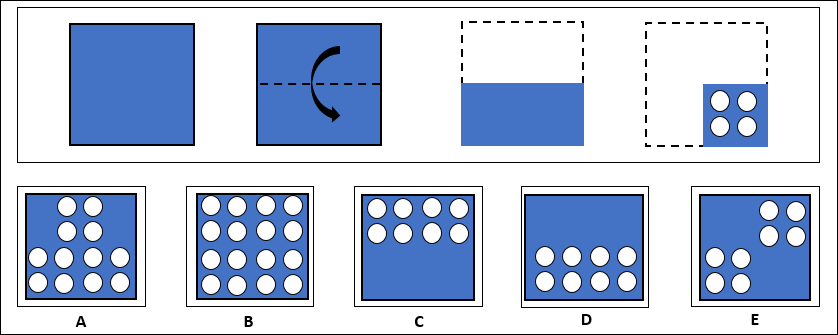
Explanation
The correct answer is B.
First, the square paper was folded in half widthwise, and then it was folded in half again lengthwise.
Then, four holes were cut out of the folded paper. Since the paper was folded in half twice, the holes were cut through four layers of paper. Therefore, when the paper is unfolded it will have sixteen holes: 4 x 4 = 16.
Since the paper was folded in half widthwise and then again in half lengthwise, each quarter must mirror the quarters above or below it and the quarter to its left or right.
7.2 Spatial Reasoning Question 2
Question 2:
Choose the answer choice that contains the given shape. The shape must keep its size and orientation.
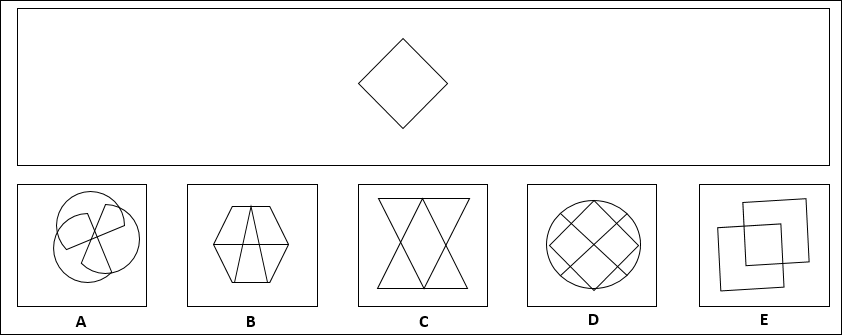
Explanation
The correct answer is D.
7.3 Spatial Reasoning Question 3
Question 3:
Choose the answer choice that shows the final product of the unfolded punched-in paper.
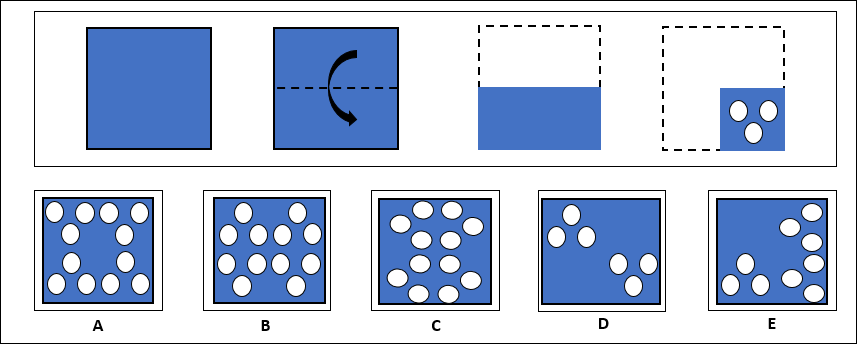
Explanation
The correct answer is B.
First, the square paper was folded in half widthwise, and then it was folded in half again lengthwise.
Then, three holes were cut out of the folded paper. Since the paper was folded in half twice, the holes were cut through four layers of paper. Therefore, when the paper is unfolded it will have twelve holes: 3 x 4 = 12.
Since the paper was folded in half widthwise and then again in half lengthwise, each quarter must mirror the quarters above or below it and the quarter to its left or right.
7.4 Spatial Reasoning Question 4
Question 4:
Choose the answer choice that contains the given shape. The shape must keep its size and orientation.
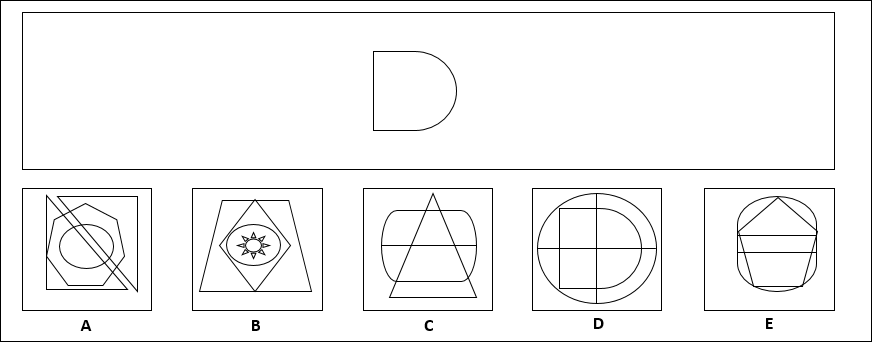
The correct answer is D.
7.5 Spatial Reasoning Question 5
Question 5:
Choose the answer choice that contains the given shape. The shape must keep its size and orientation.
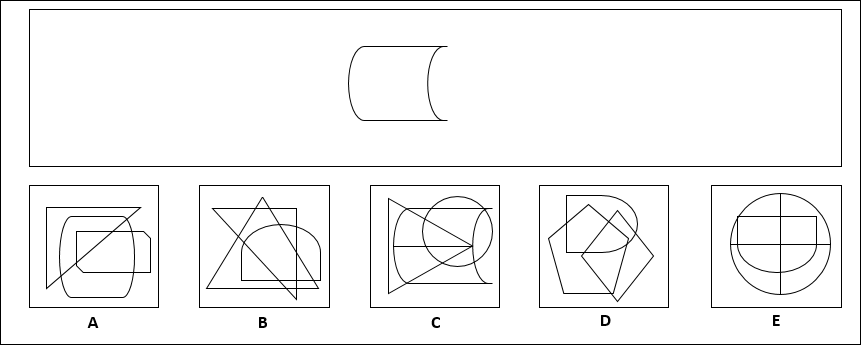
The correct answer is C.
8. How to Review CAT4 Level B Sample Questions
Sample questions are most helpful when students review them properly. The answer is important, but the explanation is even more important.
8.1 Ask Students to Explain Their Reasoning
After each question, parents can ask:
- Why did you choose that answer?
- What pattern did you notice?
- Which answer choices were clearly wrong?
- What clue helped you?
- What changed in the sequence?
- How can you solve a similar question next time?
When students explain their thinking, they build stronger reasoning habits.
8.2 Look for Repeated Mistakes
Repeated mistakes show where more practice is needed.
For example:
- Word mistakes may show a need for verbal reasoning practice.
- Shape mistakes may show a need for non-verbal reasoning practice.
- Number pattern mistakes may show a need for quantitative reasoning practice.
- Rotation mistakes may show a need for spatial reasoning practice.
This helps parents create a more focused preparation plan.
8.3 Practise Similar Questions Again
If a student struggles with one category, repeat similar question types.
For example:
- More word analogies for verbal reasoning
- More shape sequences for non-verbal reasoning
- More number patterns for quantitative reasoning
- More rotation questions for spatial reasoning
Targeted repetition helps students improve faster.
9. How Mock Tests Support CAT4 Level B Preparation
Sample questions help students learn individual skills. Mock tests help students practise a more complete test-style experience.
Both are important for strong CAT4 Level B preparation.
9.1 Start with Mini Mock Tests
Students should begin with mini mock tests before moving to longer practice.
A mini mock test may include:
- A few verbal reasoning questions
- A few non-verbal reasoning questions
- A few quantitative reasoning questions
- A few spatial reasoning questions
- A short review afterwards
This helps students build confidence gradually.
9.2 Review Mock Test Performance
After a mock test, parents should review:
- Which questions were correct
- Which questions were incorrect
- Which category was strongest
- Which category needs more practice
- Whether the student rushed
- Whether timing caused difficulty
- Whether the student understood each question type
This makes mock tests more useful than simply checking a score.
9.3 Use Mock Tests to Build Confidence
Mock tests should support confidence, not create fear.
Parents can say:
“This is practice. It helps us understand what to improve next.”
This helps students stay calm and motivated.
10. Best Preparation Tips for CAT4 Level B
CAT4 Level B preparation should be balanced, consistent, and confidence-focused. Students need regular practice across all reasoning areas.
10.1 Keep Practice Focused and Regular
A useful practice routine may include:
- Short practice sessions
- One reasoning area at a time
- Clear explanations
- Gentle mistake review
- Mixed practice later
- Mini mock tests when ready
Focused practice helps students learn more effectively.
10.2 Practise All Four Reasoning Areas
Students should practise:
- Verbal reasoning
- Non-verbal reasoning
- Quantitative reasoning
- Spatial reasoning
Balanced practice helps students feel ready for different question types.
10.3 Review Answers with Explanations
A good explanation shows:
- What the rule was
- Why the correct answer fits
- Why the other answers do not fit
- What clue to look for next time
- How to solve a similar question
This builds real understanding.
11. Common Mistakes to Avoid
Many students make similar mistakes when practising CAT4 Level B questions. These mistakes are normal and can improve with better strategies.
11.1 Rushing Through Questions
Students may rush because they want to finish quickly. This can lead to careless mistakes.
Encourage students to:
- Slow down
- Read or look carefully
- Find the rule
- Check all options
- Choose calmly
Accuracy should come before speed during early practice.
11.2 Guessing Without Finding the Rule
Some students guess before understanding the question.
Teach them to ask:
- What is the pattern?
- What is changing?
- What stays the same?
- Which answer fits best?
This improves logical thinking.
11.3 Ignoring Mistake Review
Answer checking is not enough. Students need to understand why an answer was wrong.
Mistake review helps students avoid repeating the same errors and improves future performance.
12. Final Thoughts
CAT4 Level B sample questions with answers are a helpful way for Year 5 students to prepare for reasoning-style assessments. They allow students to practise different question types, understand answer explanations, and build confidence before attempting mock tests or longer practice sessions.
This blog included sample questions for the four main CAT4 Level B reasoning areas: Verbal Reasoning, Non-Verbal Reasoning, Quantitative Reasoning, and Spatial Reasoning. Each question included a correct answer and a clear explanation to support learning.
The best preparation is not about pressure or memorisation. It is about understanding the method, practising regularly, reviewing mistakes, and building confidence step by step.
With clear explanations, balanced practice, and supportive parent guidance, Year 5 students can approach CAT4 Level B questions with stronger reasoning skills and greater confidence.