
Moving into Year 7 brings new subjects, greater independe(GL Support) For many students, it may also involve completing the CAT4 Level D assessment.
The CAT4 Level D test format can initially seem unfamiliar because it is different from a standard English, Maths or Science examination. Students are not simply asked to recall facts they have recently learned. Instead, they must recognise relationships, identify rules, interpret patterns and solve unfamiliar problems.
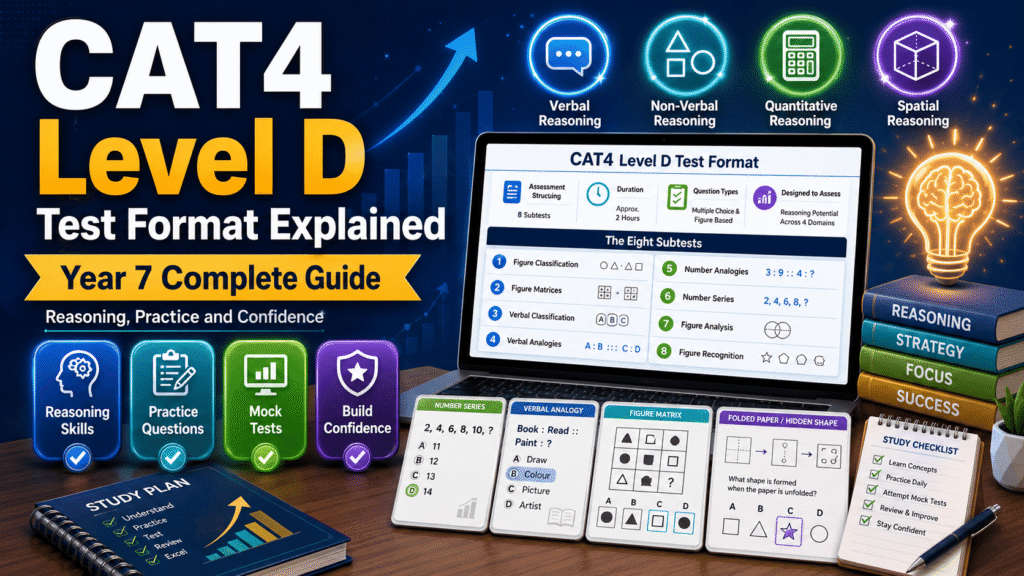
CAT4 Level D is commonly associated with students entering or studying in Year 7. It assesses four broad areas of reasoning:
- Verbal Reasoning
- Non-Verbal Reasoning
- Quantitative Reasoning
- Spatial Reasoning
Within these four areas, students complete eight short subtests. The digital assessment is normally divided into three parts, with each subtest focusing on a particular type of thinking. (SmartExams)nding this structure before the assessment can make a significant difference to student confidence. Familiar question formats feel less intimidating, instructions become easier to follow and students can focus their attention on solving each problem.
This complete guide explains the CAT4 Level D test format for Year 7, including the reasoning batteries, question types, timings, assessment sequence, preparation strategies, practice questions and mock-test guidance.
1. What Is the CAT4 Level D Assessment?
CAT4 Level D is a reasoning assessment designed for students around the Year 7 stage.
It examines how students process different kinds of information rather than measuring their knowledge of one particular school subject.
Students may be asked to:
- Compare groups of words
- Complete verbal relationships
- Identify visual rules
- Continue number sequences
- Compare number relationships
- Analyse shape transformations
- Recognise hidden figures
- Imagine how folded shapes will look when opened
The questions are designed to reveal how students approach new information and which types of reasoning they find most natural.
1.1 CAT4 Level D Is Focused on Year 7
CAT4 Level D is commonly used for Year 7 students, particularly around the transition into secondary school.
At this stage, students are expected to become increasingly independent. They must read more complex instructions, manage several steps in a problem and apply their knowledge across different subjects.
CAT4 Level D reflects this stage by presenting more demanding reasoning relationships than earlier CAT4 levels.
1.2 CAT4 Level D Is Not a Curriculum Knowledge Test
A normal school test may ask students to recall:
- A mathematical formula
- A scientific definition
- A historical event
- A grammar rule
- Information from a recent lesson
CAT4 Level D is different. It focuses on the ability to work out a rule from the information provided.
Students may use familiar words, numbers and figures, but the main challenge is deciding how those elements are connected.
This means preparation should not be based on memorising large amounts of content. Students should instead learn how to approach unfamiliar reasoning questions logically.
1.3 Why Schools May Use CAT4 in Year 7
Year 7 is an important transition point. Teachers are meeting students from different primary schools, learning backgrounds and educational experiences.
A reasoning assessment can help schools develop a broader understanding of how students think and learn. CAT4 is commonly used at the beginning of Year 7 to provide an additional picture of new students and their reasoning profiles. (GL Assessment)lts may help teachers consider:
- Areas of reasoning strength
- Areas that may need support
- Different approaches to learning
- Appropriate levels of challenge
- Patterns across verbal and visual thinking
- How students respond to unfamiliar problems
A CAT4 result should be considered as one part of a wider educational picture rather than a complete definition of a student’s ability.
2. What Does the CAT4 Level D Test Measure?
CAT4 Level D measures four main types of reasoning.
Each reasoning battery focuses on a different way of processing information. A student may perform similarly across all four areas, or they may show stronger performance in particular batteries.
2.1 Verbal Reasoning
Verbal Reasoning examines how students understand words, meanings and relationships between ideas.
Students need to:
- Recognise categories
- Compare word meanings
- Identify precise relationships
- Complete word analogies
- Distinguish between related and unrelated words
- Apply a relationship to a new pair
Strong reading habits can support Verbal Reasoning, but these questions require more than recognising vocabulary. Students must understand how words are logically connected.
2.2 Non-Verbal Reasoning
Non-Verbal Reasoning uses shapes, figures and visual patterns.
Students may need to identify changes involving:
- Direction
- Position
- Rotation
- Reflection
- Number
- Size
- Shading
- Lines
- Symbols
- Combined figures
Because the questions use limited written language, students must rely on visual analysis and pattern recognition.
2.3 Quantitative Reasoning
Quantitative Reasoning focuses on relationships between numbers.
Students may need to:
- Recognise number patterns
- Complete sequences
- Compare number pairs
- Apply repeated operations
- Identify alternating rules
- Work with increasing or decreasing differences
- Use more than one mathematical operation
The calculations are only one part of the challenge. Students must first identify the correct numerical relationship.
2.4 Spatial Reasoning
Spatial Reasoning examines how students mentally manipulate, transform and recognise shapes.
Students may be asked to:
- Follow folds in a piece of paper
- Predict the position of cuts or holes
- Recognise a shape after rotation
- Locate a hidden figure
- Track lines through a complex design
- Imagine a figure from another viewpoint
Spatial questions reward careful visualisation and the ability to track one feature through several transformations.
3. How Is the CAT4 Level D Test Structured?
For Level D, the four reasoning batteries are divided into eight short subtests.
The eight subtests are:
- Figure Classification
- Figure Matrices
- Verbal Classification
- Verbal Analogies
- Number Analogies
- Number Series
- Figure Analysis
- Figure Recognition
These subtests are normally delivered in a fixed sequence across three assessment parts. (GL Support)Part 1: Non-Verbal Reasoning
The first part focuses on Non-Verbal Reasoning and includes:
- Figure Classification
- Figure Matrices
Students work with visual figures, patterns and relationships.
The two subtests measure related skills, but the task is different in each one. Figure Classification focuses on shared characteristics, while Figure Matrices focuses on completing visual relationships within a grid.
3.2 Part 2: Verbal and Quantitative Reasoning
The second part includes:
- Verbal Classification
- Verbal Analogies
- Number Analogies
Students move from word-based questions to number relationships.
This section requires careful attention because the type of reasoning changes. Students should read the introductory example for each new subtest rather than assuming that the same method continues.
3.3 Part 3: Quantitative and Spatial Reasoning
The third part includes:
- Number Series
- Figure Analysis
- Figure Recognition
Students begin with numerical sequences and then move into spatial visualisation.
This part can be demanding because students must switch from number logic to mental folding and hidden-shape recognition. Practice can help make these transitions feel more manageable.
3.4 Why the Test Is Split Into Parts
The three-part structure prevents students from completing all eight subtests as one uninterrupted block.
Each part contains instructions and practice examples before the timed questions begin. The division also allows schools to organise the assessment in manageable sessions.
The precise school schedule may vary, but the subtests follow a set standardised order.
4. CAT4 Level D Test Timings Explained
CAT4 Level D is a timed assessment.
For the digital Levels A to G format, the eight timed subtests have the following standard durations:
- Figure Classification: 10 minutes
- Figure Matrices: 10 minutes
- Verbal Classification: 8 minutes
- Verbal Analogies: 8 minutes
- Number Analogies: 10 minutes
- Number Series: 8 minutes
- Figure Analysis: 9 minutes
- Figure Recognition: 9 minutes
This produces approximately 72 minutes of active question time. Additional time is needed for settling students, explaining each section and completing practice examples. The complete administration is normally arranged across three parts and may take approximately two hours overall, depending on the school’s organisation. (GL Support)Are the Practice Examples Timed?
The introductory information and practice examples are separate from the timed question section.
Students should use these examples carefully. They demonstrate:
- What the question is asking
- How the answer options work
- Which relationship needs to be identified
- How to select an answer
- What changes from the previous subtest
The assessment should not be started until the student understands the example.
4.2 What Happens When the Digital Timer Ends?
During the digital assessment, the timer counts down for each subtest.
When the available time ends, the test moves forward. Students cannot continue working indefinitely on unanswered questions in that section. (GL Support)why students need to develop a balanced pace. They should work carefully, but they should also avoid spending most of the section on a small number of difficult questions.
4.3 Does Every Student Finish Every Question?
Some students may not reach every question before a section ends.
This does not mean that they have failed. CAT4 is designed as a timed assessment, so pace forms part of the testing experience.
Students should aim to:
- Read accurately
- Work steadily
- Avoid unnecessary delays
- Make logical decisions
- Move on from questions that are consuming too much time
4.4 Why Timing Practice Matters
Timing practice helps students learn how long they can reasonably spend on a question.
It can also reveal whether a student:
- Rushes at the beginning
- Checks answers too many times
- Becomes stuck on difficult questions
- Loses concentration near the end
- Works accurately but too slowly
- Guesses before examining the options
Timing should be introduced gradually. Students should understand the method before being expected to work quickly.
5. Figure Classification Test Format
Figure Classification is part of the Non-Verbal Reasoning battery.
Students are usually shown several figures that share a common characteristic. They must identify which answer option follows the same rule.
5.1 What Figure Classification Questions Assess
These questions measure whether students can:
- Compare visual features
- Identify a shared rule
- Ignore unimportant differences
- Recognise equivalent arrangements
- Apply a visual rule to new figures
The shared characteristic may involve one feature or several connected features.
5.2 Features Students Should Check
Students should compare:
- Number of shapes
- Shape type
- Position
- Direction
- Shading
- Number of lines
- Interior and exterior elements
- Symmetry
- Rotation
- Relative size
A good strategy is to describe the rule in words before checking the answer choices.
For example:
- “Each figure contains two shaded shapes.”
- “The smaller shape is always inside the larger shape.”
- “The arrow points towards the circle.”
- “Every figure has one curved line and two straight lines.”
5.3 Common Figure Classification Mistakes
Students may:
- Focus only on the most obvious shape
- Ignore the number of objects
- Miss a difference in shading
- Confuse rotation with reflection
- Select an option that follows only part of the rule
- Choose an answer because it looks generally similar
The correct option must follow the complete rule shared by the original figures.
6. Figure Matrices Test Format
Figure Matrices is the second Non-Verbal Reasoning subtest.
Students are presented with figures arranged in a grid or matrix. One position is missing, and they must select the figure that completes the pattern.
6.1 How Figure Matrices Work
The visual rule may operate:
- From left to right
- From top to bottom
- Across both rows and columns
- Between corresponding positions
- Through combining or removing features
Students need to determine how one figure changes into the next.
6.2 Common Matrix Rules
A figure matrix may involve:
- Rotation
- Reflection
- Addition of shapes
- Removal of lines
- Movement between corners
- Alternating shading
- Increasing or decreasing numbers
- Combining two figures
- Cancelling repeated elements
- Changing direction
More challenging questions may apply two rules at the same time.
6.3 A Reliable Figure Matrices Strategy
Students can use this process:
- Compare the first two figures in a row.
- Describe what changes.
- Check whether the same change appears elsewhere.
- Examine the columns for confirmation.
- Predict the missing figure.
- Eliminate options that break any part of the rule.
Students should not choose an answer simply because it fits one row. The correct answer should also make sense within the wider matrix.
7. Verbal Classification Test Format
Verbal Classification is part of the Verbal Reasoning battery.
Students are shown words that share a connection and must identify another word that belongs to the same group.
7.1 What Verbal Classification Measures
This subtest assesses:
- Vocabulary knowledge
- Category recognition
- Understanding of meaning
- Ability to identify a shared concept
- Precision when comparing words
The words may be connected by meaning, purpose, category or use.
7.2 Examples of Verbal Categories
Words may all be:
- Types of movement
- Emotions
- Building materials
- Tools
- Parts of a plant
- Ways of communicating
- Types of weather
- Musical terms
- Occupations
- Descriptions of size
Students should create the narrowest accurate description of the group.
“Things” is too broad. “Tools used for cutting” is much more useful.
7.3 What If a Student Does Not Know a Word?
An unfamiliar word can make the question more difficult, but students can still reason from the remaining information.
They should:
- Identify the meanings they do know
- Look for a possible category
- Examine prefixes or suffixes
- Eliminate obviously unrelated options
- Consider whether the word has a familiar root
- Test the most likely relationship
Regular reading and vocabulary practice can make these questions more approachable.
8. Verbal Analogies Test Format
Verbal Analogies is the second Verbal Reasoning subtest.
Students must identify the relationship between one pair of words and apply the same relationship to another pair.
8.1 Common Verbal Analogy Relationships
The relationship may involve:
- Synonyms
- Antonyms
- Part and whole
- Object and purpose
- Worker and workplace
- Tool and user
- Animal and habitat
- Young animal and adult animal
- Cause and effect
- Product and source
- Degree of intensity
- Item and category
8.2 The Sentence Method
The most reliable approach is to express the first pair as a sentence.
For example:
“An author writes a book.”
The second pair must then follow the same structure:
“An artist creates a painting.”
The relationship is not simply that all four words are connected with creative work. It is specifically a person and what that person produces.
8.3 Direction Matters
Students must preserve the direction of the relationship.
For example:
- Finger is part of a hand.
- A hand is not part of a finger.
Both statements use the same words, but only one expresses the correct direction.
Many incorrect answer choices are designed to be related to the given word without matching the exact relationship.
9. Number Analogies Test Format
Number Analogies is the first Quantitative Reasoning subtest.
Students are shown number relationships and must identify the missing value by applying the same rule.
9.1 What Number Analogies Assess
These questions measure whether students can:
- Identify numerical relationships
- Apply operations consistently
- Compare number pairs
- Recognise multi-step rules
- Transfer a rule to a new set of numbers
9.2 Operations That May Be Used
Students should consider:
- Addition
- Subtraction
- Multiplication
- Division
- Doubling
- Halving
- Squaring
- Combining two numbers
- Applying two consecutive operations
For example, a rule might be:
- Multiply by 3
- Add 5
- Double and subtract 2
- Add the first two numbers
- Find the difference between two values
9.3 Test the Rule Completely
A possible rule must work for all the information shown.
Students should not choose a rule just because it works for one pair. They should test it against every completed relationship before applying it to the missing value.
9.4 Keep Working Clear
Rough working can help students avoid calculation errors.
They should:
- Write the operation clearly
- Keep numbers organised
- Check whether the answer is reasonable
- Apply the operations in the correct order
- Recalculate if two answer choices are close
10. Number Series Test Format
Number Series is the second Quantitative Reasoning subtest.
Students must identify the rule governing a sequence and determine the missing or next number.
10.1 Common Number Series Rules
A sequence may involve:
- Repeated addition
- Repeated subtraction
- Multiplication
- Division
- Alternating operations
- Increasing differences
- Decreasing differences
- Separate odd-position and even-position patterns
- Square or cube numbers
- A repeating cycle
10.2 Look at the Differences
Writing the changes between numbers is often the quickest way to reveal the pattern.
For example, a sequence may increase by:
- 3, 3, 3, 3
- 2, 4, 6, 8
- 5, 10, 15, 20
- 1, 3, 1, 3
- 2, 4, 8, 16
Students should examine whether the differences themselves form a pattern.
10.3 Check for Alternating Patterns
When one repeated operation does not work, the sequence may alternate.
For example:
- Add 4, multiply by 2, add 4, multiply by 2
- Subtract 3, add 6, subtract 3, add 6
- Double, subtract 1, double, subtract 1
Students can mark alternate steps to make the pattern more visible.
10.4 Common Number Series Mistakes
Students may:
- Stop after finding a rule that works once
- Miss an alternating operation
- Calculate mentally and make an arithmetic error
- Ignore a pattern in the differences
- Rush because the numbers look familiar
- Assume every sequence uses addition
The rule must explain the complete sequence.
11. Figure Analysis Test Format
Figure Analysis is part of the Spatial Reasoning battery.
Students may be shown a piece of paper being folded several times. A hole, cut or mark is then made. They must decide what the paper will look like when completely unfolded.
11.1 What Figure Analysis Measures
This subtest assesses:
- Mental folding
- Reflection
- Spatial tracking
- Symmetry
- Visualisation
- Multi-step thinking
Students must reverse the process shown in the question.
11.2 Reverse One Fold at a Time
Students should not try to unfold the whole figure mentally in one movement.
A better method is:
- Identify the final cut or mark.
- Reverse the most recent fold.
- Reflect the mark across that fold line.
- Reverse the next fold.
- Repeat the reflection.
- Count the final marks.
- Check their positions and symmetry.
Each fold usually affects both the number and placement of the marks.
11.3 Use the Fold Line as a Mirror
When paper is unfolded, the new mark appears as a reflection across the fold line.
Students should check:
- Whether the fold is horizontal, vertical or diagonal
- How far the mark is from the fold
- Whether the mark is near an edge
- Whether the shape of the cut changes after reflection
- How many layers were folded
11.4 Common Figure Analysis Mistakes
Students may:
- Reflect the mark across the wrong line
- Unfold in the wrong order
- Count the wrong number of marks
- Ignore a diagonal fold
- Move a mark instead of copying it symmetrically
- Choose an option with the right number but wrong placement
Both the number and position must be correct.
12. Figure Recognition Test Format
Figure Recognition is the second Spatial Reasoning subtest.
Students are shown a target shape and must find that exact arrangement hidden within a more complicated figure.
12.1 What Makes Figure Recognition Difficult?
The target figure may be:
- Rotated
- Tilted
- Surrounded by extra lines
- Embedded inside a larger shape
- Positioned at an unusual angle
- Partly disguised by overlapping figures
Students must ignore unnecessary lines and focus on the exact required structure.
12.2 How to Search for the Hidden Figure
Students can:
- Choose a distinctive corner or line.
- Look for that feature in the larger figure.
- Trace the connected lines in order.
- Check the angles and relative lengths.
- Ignore lines that continue beyond the target.
- Confirm that every required part is present.
The hidden figure does not need to face the same direction as the original.
12.3 Rotation Does Not Change Structure
A rotated figure still has:
- The same number of lines
- The same connections
- The same angles
- The same arrangement of parts
Students should search for structure rather than orientation.
13. What Does the CAT4 Level D Screen Look Like?
The exact appearance can depend on the administration method, but digital CAT4 questions are presented in a clear assessment interface.
Students normally see:
- Instructions for the subtest
- An example question
- Practice items
- The main question
- Several answer options
- A countdown timer during the assessed section
- Controls for selecting an answer and moving forward
13.1 Questions Are Presented in Short Sections
Students complete one question type at a time.
This means they do not constantly switch between words, numbers and shapes within the same subtest. However, they must adjust their thinking when a new subtest begins.
13.2 Practice Examples Come Before the Timed Questions
Each new section includes guidance and examples to help students understand the format before the timer begins. (GL Support) should use this opportunity to check:
- What relationship is being tested
- Whether more than one answer is needed
- How the options are displayed
- How to submit a response
- Whether figures can be rotated
- What information should be ignored
13.3 Students Should Not Rush the Instructions
A student who misunderstands the task may apply the wrong method to several questions.
Careful attention during the example can save more time than rushing into the assessed section.
14. How Difficult Is CAT4 Level D?
CAT4 Level D questions are intended to provide an appropriate reasoning challenge for students around the Year 7 stage.
The difficulty does not come only from advanced words, numbers or figures. Questions can feel difficult because:
- The format is unfamiliar
- The relationship is indirect
- Several visual features change
- Two operations are combined
- Time is limited
- Incorrect options are deliberately plausible
- Students must change strategies between subtests
14.1 Not Every Question Will Feel Equally Difficult
A student may find Verbal Analogies comfortable but struggle with Figure Analysis.
Another student may recognise number patterns quickly but need more time with vocabulary.
Different strengths are normal. CAT4 is designed to examine several types of reasoning rather than rewarding only one kind of learner.
14.2 Harder Questions Should Not Cause Panic
Students should expect to meet questions that require more thought.
When a question feels difficult, they can:
- Identify what they know
- Break the problem into smaller parts
- Look for one rule at a time
- Eliminate impossible options
- Make the best reasoned choice
- Continue to the next question
One difficult question does not determine the entire assessment.
15. How to Prepare for the CAT4 Level D Test Format
Effective CAT4 Level D preparation should develop familiarity, accuracy, timing and confidence.
The aim is not to memorise previous answers. Students need to learn methods they can apply to new questions.
15.1 Begin With Untimed Topic Practice
Students should first learn one question type at a time.
Untimed practice allows them to:
- Understand the instructions
- Explore possible strategies
- Check every visual feature
- Write out number operations
- Explain verbal relationships
- Study detailed solutions
Speed should be introduced after the method becomes familiar.
15.2 Practise All Eight Question Types
A balanced preparation programme should include:
- Figure Classification
- Figure Matrices
- Verbal Classification
- Verbal Analogies
- Number Analogies
- Number Series
- Figure Analysis
- Figure Recognition
Students should not spend all their time on the question types they already enjoy.
15.3 Use Short, Regular Sessions
Short sessions are easier to manage alongside Year 7 schoolwork.
A focused session may include:
- Five minutes reviewing a previous mistake
- Fifteen minutes practising one question type
- Five minutes checking answers
- Five minutes explaining the method
Regular practice can build familiarity without making preparation exhausting.
15.4 Move Gradually Into Timed Practice
A sensible progression is:
- Study worked examples.
- Complete untimed topic questions.
- Review every mistake.
- Complete short timed sets.
- Attempt timed mini-tests.
- Complete mixed practice.
- Attempt full mock tests.
This sequence protects accuracy while gradually improving pace.
16. Why CAT4 Level D Practice Questions Matter
Practice questions help students understand how CAT4-style reasoning tasks are constructed.
They also give students opportunities to test strategies before working under full assessment conditions.
16.1 Practice Builds Format Familiarity
Students become more comfortable with:
- Visual layouts
- Multiple-choice options
- Analogy structures
- Number relationships
- Fold diagrams
- Matrix arrangements
- Hidden figures
- Timed decision-making
When the format feels familiar, students can direct more attention towards reasoning.
16.2 Review Is More Important Than Quantity
Completing many questions is not automatically effective.
Students improve when they understand:
- Why the correct option works
- Why their answer was incorrect
- Which clue they missed
- Whether the error was careless or conceptual
- How they could solve a similar problem next time
Ten carefully reviewed questions may be more valuable than fifty rushed questions.
16.3 Students Should Explain Their Reasoning
After answering, students should try to state the rule aloud.
For example:
- “All three figures have one shaded shape inside an unshaded shape.”
- “The relationship is a worker and the place where they work.”
- “The sequence adds consecutive even numbers.”
- “The cut is reflected each time the paper opens.”
- “The hidden figure has been rotated but its lines remain connected.”
Explaining the method reveals whether the student truly understands it.
17. How CAT4 Level D Mock Tests Help
A CAT4 Level D mock test combines question types under more realistic conditions.
Mock tests can help students practise:
- Following changing instructions
- Switching between reasoning areas
- Managing the timer
- Maintaining concentration
- Recovering after a difficult question
- Working through several assessment parts
- Applying strategies independently
17.1 When Should Students Begin Mock Tests?
Full mock tests should come after students understand the individual question formats.
If mock testing begins too early, students may feel overwhelmed without knowing how to improve.
Before attempting a full mock test, students should ideally have:
- Seen all eight question types
- Practised each type separately
- Reviewed common mistakes
- Completed short timed sets
- Experienced mixed-question practice
17.2 What Can a Mock Test Reveal?
A mock test may show that a student:
- Understands the questions but works too slowly
- Rushes through easier items
- Struggles when the reasoning type changes
- Loses focus in later sections
- Needs stronger vocabulary
- Misses visual details
- Makes avoidable arithmetic errors
- Spends too long on one question
These findings can guide future preparation.
17.3 Always Review the Mock Test
A mock test is not complete when the score appears.
Students should review:
- Incorrect answers
- Unanswered questions
- Questions that took too long
- Correct answers based on guessing
- Repeated mistake patterns
- Sections where confidence decreased
The review should produce a short list of practical priorities rather than a general instruction to “work harder.”
18. Time-Management Strategies for Year 7 Students
Good time management does not mean answering every question as quickly as possible.
It means using the available time efficiently while protecting accuracy.
18.1 Start Each Question Carefully
Students should take enough time to understand what is being asked.
A few seconds spent reading accurately can prevent:
- Reversing a verbal analogy
- Following the wrong matrix direction
- Missing an alternating number rule
- Reflecting a shape incorrectly
- Searching for the wrong hidden figure
18.2 Avoid Becoming Trapped
When a student cannot identify the rule, they should avoid repeating the same unsuccessful approach.
They can:
- Re-read the task
- Check another feature
- Look at the answer options
- Eliminate impossible choices
- Make a logical selection
- Move forward
18.3 Use Elimination Strategically
Incorrect options may:
- Use the wrong number of shapes
- Reverse the verbal relationship
- Follow only half of a pattern
- Contain a calculation trap
- Reflect instead of rotate
- Place folds or holes incorrectly
Removing these options can make a difficult question more manageable.
18.4 Do Not Overcheck Every Answer
Students should check for a specific reason rather than restarting every question.
A focused check may ask:
- Does the relationship work in the correct direction?
- Does the rule fit every number?
- Have I counted all the figures?
- Did I track the fold correctly?
- Does the option preserve the complete shape?
19. Common CAT4 Level D Test-Format Mistakes
Understanding common mistakes can help students avoid them.
19.1 Assuming Every Section Works the Same Way
The eight subtests require different strategies.
Students must pay attention when the question type changes.
19.2 Ignoring the Practice Example
The introductory example explains the task.
Skipping it can lead to several avoidable errors.
19.3 Practising Only Favourite Areas
Students may prefer words, numbers or shapes.
Balanced preparation is needed because the assessment includes all four reasoning batteries.
19.4 Focusing Only on Speed
Working quickly without understanding the question reduces accuracy.
The correct preparation order is:
- Understand.
- Practise.
- Improve accuracy.
- Introduce timing.
- Build assessment stamina.
19.5 Memorising Answers
Real questions may use different words, numbers and figures.
Students need transferable methods rather than remembered responses.
19.6 Failing to Review Mistakes
A wrong answer is useful only when the student understands why it happened.
Mistakes should be grouped into causes such as:
- Misreading
- Vocabulary gaps
- Missed visual details
- Incorrect calculation
- Weak spatial tracking
- Rushing
- Timing pressure
20. How Parents Can Support CAT4 Level D Preparation
Parents do not need to teach every CAT4 method themselves.
Their most valuable role is to create a supportive routine and encourage thoughtful practice.
20.1 Provide a Calm Study Environment
Choose a place with:
- Minimal interruptions
- Suitable lighting
- Comfortable seating
- Space for rough working
- Limited device distractions
- Easy access to practice materials
20.2 Ask Guiding Questions
Instead of immediately supplying the answer, ask:
- What do you notice first?
- Which feature changes?
- Can you describe the relationship?
- Does your rule work everywhere?
- Which option can you eliminate?
- Is the figure rotated or reflected?
- What happens when you reverse one fold?
These prompts build independent reasoning.
20.3 Praise Useful Learning Behaviours
Helpful praise includes:
- “You checked the whole pattern.”
- “You explained that relationship clearly.”
- “You stayed calm when the first method did not work.”
- “You found and corrected your own calculation error.”
- “You used elimination effectively.”
- “Your pace was more balanced today.”
This builds confidence in the thinking process rather than focusing only on scores.
20.4 Keep Preparation Balanced
Year 7 students also need:
- Sleep
- Exercise
- Schoolwork
- Relaxation
- Social time
- Family time
Preparation should support readiness, not create exhaustion.
21. Building CAT4 Level D Student Confidence
Confidence grows when students know what to expect and have reliable strategies to use.
21.1 Familiarity Reduces Uncertainty
Students feel more secure when they recognise:
- The eight question types
- The three-part structure
- The role of the timer
- The multiple-choice format
- The introductory examples
- The need to switch reasoning methods
21.2 Mistakes Should Be Normalised
A mistake may reveal that a student needs to:
- Learn a new word
- Check directions more carefully
- Practise alternating sequences
- Slow down during calculations
- Track folds step by step
- Compare all parts of a figure
This information creates a clear next step.
21.3 Use Positive Self-Talk
Students can remind themselves:
- “I can examine one feature at a time.”
- “I can eliminate options.”
- “A difficult question is only one question.”
- “I do not need to see the answer immediately.”
- “I have practised this format.”
- “I can make a careful choice and move forward.”
22. CAT4 Level D Test-Day Preparation
The final preparation should be simple and reassuring.
22.1 The Day Before
Students should:
- Complete only light revision
- Organise anything needed for school
- Follow their normal evening routine
- Eat normally
- Avoid an exhausting full mock test
- Get sufficient sleep
22.2 On the Day
Students should remember to:
- Listen carefully to instructions
- Study each practice example
- Read the complete question
- Work steadily
- Use elimination
- Avoid spending too long on one item
- Begin every new subtest with a fresh mindset
22.3 During a Difficult Section
Students can:
- Take a calm breath.
- Identify the question type.
- Apply the method they practised.
- Check one feature at a time.
- Eliminate incorrect options.
- Make the best logical choice.
- Continue without dwelling on it.
23. Frequently Asked Questions About the CAT4 Level D Format
23.1 Is CAT4 Level D for Year 7?
Yes. CAT4 Level D is commonly associated with Year 7 students.
23.2 How many reasoning batteries are in CAT4 Level D?
There are four broad reasoning batteries:
- Verbal Reasoning
- Non-Verbal Reasoning
- Quantitative Reasoning
- Spatial Reasoning
23.3 How many subtests are there?
Level D uses eight short subtests:
- Figure Classification
- Figure Matrices
- Verbal Classification
- Verbal Analogies
- Number Analogies
- Number Series
- Figure Analysis
- Figure Recognition
23.4 Is CAT4 Level D timed?
Yes. Each subtest has a fixed time limit.
Students should prepare by developing accuracy first and then practising under gradually increasing time pressure.
23.5 How long does CAT4 Level D take?
The eight assessed subtests contain approximately 72 minutes of timed question work. Additional time is required for settling, instructions and practice examples, so the complete administration may take approximately two hours across three parts. (GL Support) Is CAT4 Level D an English and Maths exam?
No. It includes verbal and numerical material, but it is primarily a reasoning assessment.
Students must also complete non-verbal and spatial questions.
23.7 Can students prepare for CAT4 Level D?
Students can prepare by learning the question formats, practising reasoning strategies, reviewing explanations and becoming comfortable with timed sections.
Preparation should build familiarity rather than encourage memorisation.
23.8 Are mock tests useful?
Yes. Mock tests can improve familiarity with timing, question transitions and longer assessment sessions.
They are most useful after students have practised the individual question types.
23.9 What is the hardest CAT4 Level D section?
There is no single hardest section for every student.
Difficulty depends on the student’s reasoning profile, vocabulary, number confidence, visual awareness, spatial skills and experience with timed assessments.
23.10 What should students do if they cannot answer a question?
They should look for clues, eliminate incorrect options, make the best logical choice available and continue.
24. CAT4 Level D Test Format Checklist
Before the assessment, students should aim to understand:
- That Level D is commonly associated with Year 7
- The four reasoning batteries
- The eight short subtests
- The three-part assessment sequence
- How the digital timer works
- How multiple-choice options are presented
- Why practice examples matter
- How to approach word relationships
- How to analyse figure patterns
- How to identify number rules
- How to reverse paper folds
- How to locate hidden shapes
- When to use elimination
- When to move on
- How to stay calm under timed conditions
Students should also have experience with:
- Untimed topic practice
- Reviewed answer explanations
- Timed question sets
- Mixed reasoning practice
- Mini-tests
- Full CAT4 Level D mock tests
25. Final Thoughts
Understanding the CAT4 Level D test format is one of the best ways to make the assessment feel less unfamiliar.
Year 7 students complete four broad reasoning batteries covering verbal, non-verbal, quantitative and spatial thinking. These batteries are divided into eight short subtests and organised across three assessment parts.
Each question type requires a slightly different strategy:
- Verbal questions require precise understanding of relationships.
- Non-verbal questions require detailed visual comparison.
- Quantitative questions require recognition of number rules.
- Spatial questions require mental transformation and shape tracking.
Effective CAT4 Level D preparation should begin with clear explanations and untimed topic practice. Students can then move gradually into timed sets, mixed questions and full mock tests.
The goal is not to memorise answers or place unnecessary pressure on students. It is to develop familiarity, strengthen reasoning methods, improve pacing and build confidence with unfamiliar problems.
With regular practice, careful review and positive support, Year 7 students can approach the CAT4 Level D assessment with a clearer understanding of the format and a more confident problem-solving mindset.