
Receiving a CAT4 Level E report can feel confusing. Parents may see severn measures without immediately understanding what they mean.
Year 8 students may also wonder whether their CAT4 Level E score is “good,” whether one lower result is a problem or whether the assessment predicts exactly how they will perform in school.
CAT4 Level E scores should be interpreted as a reasoning profile rather than a simple pass-or-fail result. The assessment examines how students work with four different forms of information:
- Words and meanings
- Visual figures and patterns
- Numerical relationships
- Shapes and spatial transformations
These skills are reported through four reasoning batteries:
- Verbal Reasoning
- Non-Verbal Reasoning
- Quantitative Reasoning
- Spatial Reasoning
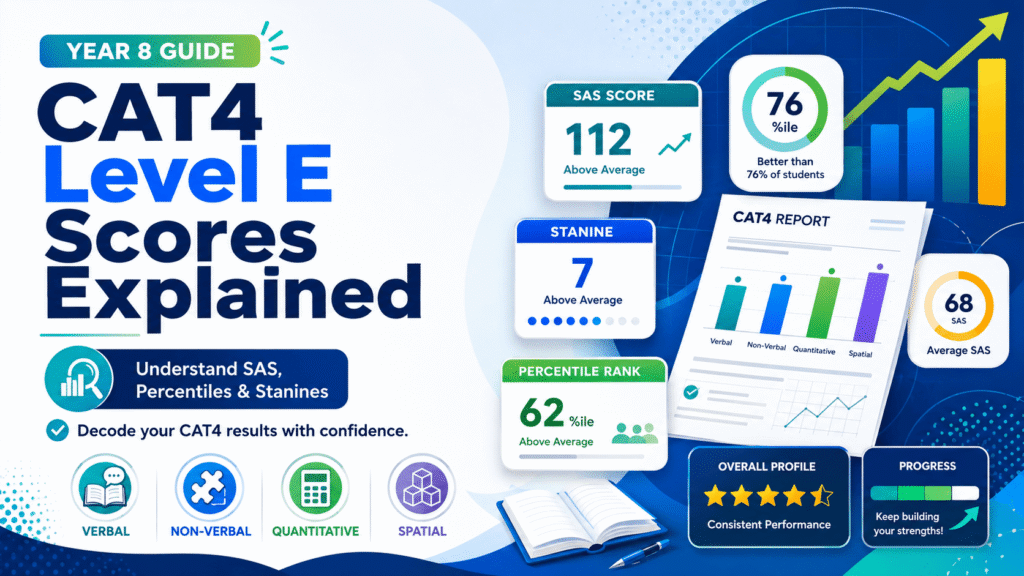
A CAT4 Level E report may include a raw score, Standard Age Score, percentile rank, stanine, group rank and an average or mean score. Each figure explains a different aspect of performance.
The most useful interpretation comes from examining:
- The complete reasoning profile
- Relative strengths
- Areas that may need support
- Differences between batteries
- Classroom performance
- Student confidence
- Accuracy and timing
- Learning habits
- Wider educational information
This detailed CAT4 Level E scores guide explains the main score types, what an average score means, how percentiles and stanines work, how parents should interpret differences between batteries and how practice questions and mock tests can support Year 8 students.
1. What Do CAT4 Level E Scores Show?
CAT4 Level E scores provide information about how a Year 8 student reasons with words, numbers, figures and shapes.
The assessment is not designed as a traditional examination in which students either pass or fail.
1.1 CAT4 Level E Produces a Reasoning Profile
The report normally presents separate results for:
- Verbal Reasoning
- Non-Verbal Reasoning
- Quantitative Reasoning
- Spatial Reasoning
These separate results help show whether a student has a balanced profile or finds certain forms of reasoning more comfortable than others.
1.2 The Scores Are Comparative
CAT4 Level E results are standardised so that a student’s performance can be interpreted in relation to other students of a similar age.
This is more useful than looking only at the number of correct answers because students of different ages may complete the same assessment level.
1.3 CAT4 Scores Are Not School Grades
A CAT4 score is not the same as:
- A Maths test mark
- An English grade
- A Science assessment result
- A homework score
- An end-of-term percentage
School grades usually measure how well students have learned particular content. CAT4 Level E focuses more closely on reasoning processes.
1.4 CAT4 Level E Is Not a Pass-or-Fail Test
There is no universal pass mark that every Year 8 student must reach.
Schools may use the results in different ways, but the report is primarily intended to provide information about reasoning strengths, learning needs and possible classroom support.
2. What Information May Appear on a CAT4 Level E Report?
CAT4 score reports may include several types of information.
Parents may see:
- Raw Score
- Standard Age Score
- National Percentile Rank
- Stanine
- Group Rank
- Mean Standard Age Score
- Individual battery scores
- A visual reasoning profile
- Comparison indicators
- Confidence bands
Not every report displays every item in exactly the same way.
2.1 Why Are Several Score Types Needed?
Each score answers a different question.
For example:
- The raw score shows how many answers were correct.
- The Standard Age Score adjusts performance for age.
- The percentile shows relative position within an age-based comparison group.
- The stanine places performance into one of nine broad bands.
- The group rank compares the student with a defined school group.
- The profile shows differences between reasoning areas.
2.2 Which Score Is Usually the Most Useful?
The Standard Age Score is generally the main score used when interpreting CAT4 Level E results.
It allows parents and teachers to compare performance across the four batteries using a consistent scale.
3. What Is the CAT4 Level E Raw Score?
The raw score is the number of questions a student answered correctly in a particular section.
For example, if a student answered 20 questions correctly, the raw score for that section would be 20.
3.1 Why Is the Raw Score Limited?
A raw score does not account for:
- The student’s exact age
- The difficulty of the questions
- How other students performed
- Differences between assessment sections
- The standardisation process
This means that two identical raw scores may not always produce the same interpretation.
3.2 Should Parents Compare Raw Scores?
Raw scores should not normally be used to compare students directly.
A student who is younger within the Year 8 cohort may require a slightly different age-based interpretation from an older student.
3.3 Why Is the Raw Score Converted?
The raw score is converted into standardised measures so that performance can be interpreted more fairly.
This conversion helps create:
- Standard Age Scores
- Percentile ranks
- Stanines
- Other comparative information
4. What Is the Standard Age Score?
The Standard Age Score, often shortened to SAS, is one of the most important figures on a CAT4 Level E report.
It adjusts the student’s raw performance according to age and places it on a standardised scale.
4.1 Why Is Age Adjustment Important?
Two Year 8 students can be almost a year apart in age.
Without adjustment, an older student might have an unfair advantage simply because they have had more time to develop vocabulary, number fluency and reasoning experience.
The Standard Age Score makes the comparison more age-appropriate.
4.2 What Is the Average Standard Age Score?
A Standard Age Score of 100 represents the central average on the standardised scale.
A score close to 100 generally indicates performance broadly in line with students of the same age in the comparison sample.
4.3 Is 100 a Pass Mark?
No.
A score of 100 is not a pass threshold. It is the central reference point used to interpret standardised performance.
Students can demonstrate useful learning strengths at many different score levels.
4.4 Can Two Students With Different Raw Scores Receive Similar SAS Results?
Yes.
Age adjustment and the performance of the standardisation sample influence the converted score.
This is one reason parents should focus on the Standard Age Score rather than trying to interpret raw totals independently.
5. How Should CAT4 Level E Standard Age Scores Be Interpreted?
Standard Age Scores should be interpreted as ranges rather than treated as exact labels.
A result around the centre of the scale usually indicates broadly age-typical performance. Scores further above or below the centre indicate increasing distance from the average.
5.1 What Does an Average Score Mean?
An average CAT4 Level E score suggests that the student performed within the broad range expected for their age.
It does not mean that the student is ordinary, unmotivated or unable to achieve highly.
An average reasoning score can support excellent academic outcomes when combined with:
- Consistent effort
- Effective teaching
- Strong study habits
- Subject knowledge
- Organisation
- Motivation
- Appropriate support
5.2 What Does an Above-Average Score Mean?
An above-average score suggests that the student performed more strongly than many students of the same age in that reasoning area.
It may indicate a relative strength that can be developed through suitable classroom challenge.
5.3 What Does a Lower Score Mean?
A lower score suggests that the student found that particular type of reasoning more difficult during the assessment.
It does not prove that the student cannot improve or succeed.
Possible influences may include:
- Unfamiliar question formats
- Vocabulary difficulty
- Limited experience with spatial tasks
- Timing pressure
- Anxiety
- Loss of concentration
- Misreading instructions
- Careless responding
- A genuine area requiring support
5.4 Should One Score Be Interpreted Alone?
No.
Parents should examine the score alongside:
- The other reasoning batteries
- Classroom performance
- Teacher observations
- Practice results
- Reading ability
- Maths confidence
- Student wellbeing
- The conditions on assessment day
6. What Is a National Percentile Rank?
The National Percentile Rank, often shortened to NPR, shows a student’s relative position compared with the standardisation sample.
Percentiles usually range from 1 to 99.
6.1 What Does the 50th Percentile Mean?
The 50th percentile represents the central point of the comparison group.
A student at the 50th percentile performed as well as or better than approximately half of the students in the comparison sample.
6.2 What Does the 75th Percentile Mean?
A result at the 75th percentile means the student performed as well as or better than approximately 75% of the comparison group.
It does not mean that the student answered 75% of the questions correctly.
6.3 What Does the 25th Percentile Mean?
A result at the 25th percentile means the student performed as well as or better than approximately 25% of the comparison group.
Again, this is a ranking measure rather than a percentage mark.
6.4 Why Do Parents Confuse Percentiles With Percentages?
Both are written using numbers out of 100, but they measure different things.
A test percentage tells you the proportion of questions answered correctly.
A percentile tells you the student’s relative position compared with other students.
6.5 Does a High Percentile Guarantee High School Grades?
No.
School achievement also depends on:
- Effort
- Attendance
- Motivation
- Organisation
- Subject knowledge
- Teaching
- Revision
- Emotional wellbeing
- Willingness to ask for help
A percentile can indicate reasoning strength, but it is not a guaranteed academic outcome.
7. What Is a Stanine Score?
A stanine places performance into one of nine broad bands.
The word “stanine” comes from “standard nine.”
7.1 How Does the Stanine Scale Work?
Stanines run from:
- Stanine 1 at the lower end
- Through stanine 5 near the centre
- To stanine 9 at the upper end
They provide a simplified overview of performance.
7.2 What Do Stanines 1 to 3 Suggest?
Stanines 1 to 3 generally indicate performance below the central average range.
This may signal that the student would benefit from:
- Further investigation
- Additional practice
- Targeted classroom support
- Review of reading or number skills
- Reduced time pressure during early preparation
- Careful monitoring
7.3 What Do Stanines 4 to 6 Suggest?
Stanines 4 to 6 broadly represent the average range.
Students in these bands may perform very successfully when supported by strong teaching, motivation and study habits.
7.4 What Do Stanines 7 to 9 Suggest?
Stanines 7 to 9 generally indicate performance above the central average range.
These results may identify areas in which the student could benefit from greater challenge, enrichment or more advanced problem-solving opportunities.
7.5 Why Are Stanines Useful?
Stanines are easier to understand than a long list of detailed numbers.
However, because they are broad bands, they provide less precision than the Standard Age Score or percentile rank.
8. What Is Group Rank?
Group Rank compares a student’s performance with other students in a defined group.
The group might be:
- A class
- A year group
- A school cohort
- Another selected school group
8.1 How Is Group Rank Different From National Percentile Rank?
National Percentile Rank compares the student with an age-based standardisation sample.
Group Rank compares the student with a specific local group.
8.2 Why Might the Two Ranks Differ?
A school group may not have the same performance distribution as the wider standardisation sample.
For example, a student could have a strong national percentile but appear closer to the middle of a particularly high-performing school group.
8.3 Should Group Rank Be Treated as a Competition?
No.
Group Rank is a comparative data point, not a judgement of personal worth.
It should not be used to create unnecessary comparisons between friends, classmates or siblings.
9. What Is the Mean CAT4 Level E Score?
The mean score summarises performance across the four reasoning batteries.
It may provide a broad indication of the student’s overall reasoning performance.
9.1 How Is the Mean Score Useful?
It can help parents and teachers see whether the student’s overall profile is broadly:
- Below the central range
- Around the central range
- Above the central range
9.2 Can the Mean Score Hide Important Differences?
Yes.
A student could have:
- A very strong Spatial Reasoning score
- A lower Verbal Reasoning score
- Average Quantitative and Non-Verbal scores
The mean may appear average even though the profile contains meaningful differences.
9.3 Which Is More Important: The Mean or the Battery Scores?
Both can be useful, but the separate battery scores often provide more practical learning information.
The mean gives an overview. The individual scores show where strengths and support needs may be located.
10. What Is the CAT4 Level E Verbal Reasoning Score?
The Verbal Reasoning score reflects performance on word-based reasoning tasks.
These commonly include:
- Verbal Classification
- Verbal Analogies
10.1 What Does a Strong Verbal Score Suggest?
A strong Verbal Reasoning score may indicate confidence with:
- Vocabulary
- Word relationships
- Categories
- Synonyms
- Antonyms
- Verbal concepts
- Language-based problem-solving
10.2 Which Subjects May Draw on Verbal Reasoning?
Verbal reasoning may support learning in:
- English
- History
- Geography
- Languages
- Religious Education
- Humanities
- Subjects involving extended reading and discussion
This does not mean the score predicts exact grades in those subjects.
10.3 What Can Affect the Verbal Score?
Possible influences include:
- Vocabulary range
- Reading fluency
- Familiarity with analogy questions
- Understanding of precise word meanings
- Reading confidence
- Language background
- Time pressure
10.4 How Can Students Strengthen Verbal Reasoning?
Useful activities include:
- Reading varied texts
- Keeping a vocabulary notebook
- Practising synonyms and antonyms
- Grouping words into categories
- Completing verbal analogies
- Exploring prefixes and suffixes
- Explaining relationships aloud
11. What Is the CAT4 Level E Non-Verbal Reasoning Score?
The Non-Verbal Reasoning score reflects performance on figure-based pattern questions.
These commonly include:
- Figure Classification
- Figure Matrices
11.1 What Does a Strong Non-Verbal Score Suggest?
It may indicate confidence with:
- Visual comparison
- Pattern recognition
- Logical relationships
- Shape classification
- Rotation
- Reflection
- Matrix-style problem-solving
11.2 Which Learning Activities May Use Non-Verbal Reasoning?
Non-Verbal Reasoning may support:
- Science diagrams
- Design tasks
- Technology
- Data interpretation
- Visual problem-solving
- Pattern-based mathematics
- Coding concepts
11.3 What Can Affect the Non-Verbal Score?
Possible influences include:
- Missing small details
- Confusing reflection with rotation
- Following only one part of a rule
- Weak matrix strategies
- Rushing
- Limited familiarity with figure questions
11.4 How Can Students Improve Non-Verbal Reasoning?
Students can practise:
- Figure Classification
- Figure Matrices
- Symmetry
- Rotations
- Reflections
- Shape sequences
- Tangrams
- Visual logic puzzles
- Pattern analysis
12. What Is the CAT4 Level E Quantitative Reasoning Score?
The Quantitative Reasoning score reflects performance on numerical relationship questions.
These commonly include:
- Number Analogies
- Number Series
12.1 What Does a Strong Quantitative Score Suggest?
It may indicate confidence with:
- Numerical patterns
- Logical operations
- Number relationships
- Sequences
- Multi-step calculations
- Mathematical problem-solving
12.2 Is Quantitative Reasoning the Same as a Maths Grade?
No.
A student may have strong mathematical knowledge but make mistakes in unfamiliar number patterns. Another student may recognise numerical relationships well while still needing support with curriculum topics.
12.3 What Can Affect the Quantitative Score?
Possible influences include:
- Calculation fluency
- Familiarity with sequences
- Recognition of alternating rules
- Multi-step working
- Careless arithmetic
- Avoiding rough working
- Time pressure
12.4 How Can Students Strengthen Quantitative Reasoning?
Useful practice includes:
- Number analogies
- Number sequences
- Missing-number problems
- Alternating operations
- Increasing differences
- Mental arithmetic
- Estimation
- Explaining number rules
13. What Is the CAT4 Level E Spatial Reasoning Score?
The Spatial Reasoning score reflects performance on tasks involving mental manipulation of shapes.
These commonly include:
- Figure Analysis
- Figure Recognition
13.1 What Does a Strong Spatial Score Suggest?
It may indicate confidence with:
- Mental rotation
- Folding and unfolding
- Hidden figures
- Shape transformations
- Visualising different viewpoints
- Tracking positions
- Three-dimensional thinking
13.2 Which Areas May Use Spatial Reasoning?
Spatial reasoning may support activities involving:
- Design
- Engineering concepts
- Geometry
- Art
- Architecture
- Technology
- Scientific models
- Maps and diagrams
13.3 What Can Affect the Spatial Score?
Possible influences include:
- Limited paper-folding experience
- Difficulty imagining rotations
- Confusion between reflection and rotation
- Losing track of fold order
- Missing hidden lines
- Rushing through diagrams
13.4 How Can Students Strengthen Spatial Reasoning?
Helpful activities include:
- Paper folding
- Cube nets
- Tangrams
- Building blocks
- Jigsaw puzzles
- Mental rotation exercises
- Hidden-figure questions
- Drawing objects from different viewpoints
14. What Is a Balanced CAT4 Level E Profile?
A balanced profile occurs when the four reasoning scores are relatively close.
This may suggest that the student approaches verbal, visual, numerical and spatial problems with a broadly similar level of confidence.
14.1 Does Balanced Mean Identical?
No.
Small differences between batteries are expected.
Scores do not need to be exactly the same for a profile to be considered broadly balanced.
14.2 What Are the Advantages of a Balanced Profile?
A balanced profile may indicate that the student can draw on several reasoning styles across the curriculum.
However, achievement still depends on effort, knowledge, motivation and study habits.
14.3 Can a Balanced Average Profile Lead to High Achievement?
Yes.
Students with balanced average reasoning scores can achieve strongly through:
- Consistent revision
- Good organisation
- Effective teaching
- Persistence
- Subject interest
- Strong classroom participation
15. What Is an Uneven CAT4 Level E Profile?
An uneven profile occurs when one or more battery scores differ noticeably from the others.
This is sometimes called a spiky profile.
15.1 Is an Uneven Profile a Problem?
Not automatically.
It may simply indicate that the student has stronger preferences or abilities in particular forms of reasoning.
15.2 What Can a Higher Verbal Than Non-Verbal Score Suggest?
The student may find language-based reasoning more natural than abstract visual patterns.
They may benefit from verbal explanations when learning unfamiliar visual material.
15.3 What Can a Higher Non-Verbal Than Verbal Score Suggest?
The student may understand diagrams and patterns more easily than complex language.
Clear visuals, demonstrations and vocabulary support may be helpful.
15.4 What Can a Higher Quantitative Score Suggest?
The student may be particularly comfortable with numerical relationships and logical operations.
They may benefit from challenging number-based problems.
15.5 What Can a Higher Spatial Score Suggest?
The student may be strong at visualising shapes, transformations and three-dimensional relationships.
Practical, diagram-based and design-oriented learning may be effective.
15.6 Should Parents Diagnose a Learning Difficulty From a Score Gap?
No.
A score difference may be worth discussing with the school, but it should not be used by itself to diagnose a condition or difficulty.
16. What Does a High CAT4 Level E Score Mean?
A high score suggests strong performance compared with students of a similar age in that reasoning area.
16.1 Does a High Score Mean the Student Needs No Support?
No.
High-performing students may still need:
- Appropriate challenge
- Motivation
- Organisation
- Feedback
- Opportunities for deeper learning
- Support with weaker subjects
- Help managing pressure
16.2 Can a High Reasoning Score Coexist With Lower School Grades?
Yes.
Possible reasons include:
- Limited effort
- Weak organisation
- Missed lessons
- Lack of subject knowledge
- Poor revision habits
- Low motivation
- Anxiety
- Difficulty completing written work
16.3 How Should High Scores Be Used Positively?
They can help identify opportunities for:
- Extension work
- Deeper problem-solving
- More challenging reading
- Enrichment activities
- Independent projects
- Advanced reasoning questions
17. What Does an Average CAT4 Level E Score Mean?
An average score means the student performed within the broad range commonly expected for their age.
17.1 Is an Average Score Disappointing?
No.
Most students are expected to fall within the broad central range.
An average reasoning score does not limit future academic success.
17.2 Can Students Improve After an Average Score?
Students can strengthen:
- Familiarity with question formats
- Vocabulary
- Pattern recognition
- Number reasoning
- Spatial visualisation
- Timing
- Confidence
17.3 What Matters Beyond the Score?
Long-term achievement is also influenced by:
- Effort
- Curiosity
- Resilience
- Organisation
- Practice
- Teaching
- Feedback
- Subject engagement
18. What Does a Lower CAT4 Level E Score Mean?
A lower score shows that the student found that reasoning area more difficult during the assessment.
It should lead to questions and support rather than negative labels.
18.1 Possible Reasons for a Lower Score
The student may have experienced:
- Difficulty understanding instructions
- Limited vocabulary
- Weak number fluency
- Unfamiliar visual questions
- Spatial visualisation difficulty
- Time pressure
- Test anxiety
- Tiredness
- Distraction
- Careless mistakes
18.2 What Should Parents Do First?
Parents should:
- Remain calm
- Look at the complete profile
- Discuss the result with the school
- Compare it with classroom performance
- Ask whether the result was expected
- Identify suitable support
- Avoid labelling the student
18.3 Can Reasoning Skills Be Developed?
Students can improve many relevant skills through regular, focused practice.
The aim should be to strengthen methods and confidence rather than chase one particular number.
19. What Are Confidence Bands?
A score report may include a confidence band around a result.
This reflects the fact that assessment scores are estimates rather than perfectly exact measurements.
19.1 Why Is There a Range?
Performance can vary because of:
- Concentration
- Mood
- Fatigue
- Timing
- Question selection
- Normal measurement variation
- Assessment-day conditions
19.2 How Should Confidence Bands Be Interpreted?
The student’s underlying performance is likely to lie within the indicated range.
This is another reason parents should avoid treating a one-point difference as educationally significant.
19.3 Are Small Differences Between Scores Important?
Not always.
A small difference between two batteries may fall within normal measurement variation.
Larger and consistent differences may be more useful when considering the reasoning profile.
20. Can CAT4 Level E Scores Change?
Reasoning profiles are not fixed labels.
Students continue to develop through education, experience and maturity.
20.1 What Can Influence Future Performance?
Students may improve through:
- Wider reading
- Vocabulary development
- Number fluency
- Visual puzzle experience
- Spatial activities
- Better concentration
- Greater confidence
- Improved timing
- Familiarity with test formats
20.2 Does Practice Guarantee a Particular Score?
No.
Practice can improve readiness and strategy, but no responsible preparation method can guarantee a particular CAT4 Level E result.
20.3 What Is the Best Goal for Preparation?
The most useful goals are to:
- Understand the format
- Use reliable strategies
- Reduce careless mistakes
- Improve timing
- Build confidence
- Demonstrate reasoning accurately
21. How May Schools Use CAT4 Level E Scores?
Schools may use results to support educational planning.
The exact approach can vary.
21.1 Possible Uses of the Results
Schools may consider the scores when:
- Understanding a new cohort
- Identifying reasoning strengths
- Planning support
- Providing additional challenge
- Comparing different forms of reasoning
- Monitoring learning patterns
- Discussing subject performance
- Supporting transition and progress
21.2 Are CAT4 Scores Used Alone?
They should be considered alongside wider information, such as:
- School assessments
- Teacher judgement
- Classroom work
- Reading levels
- Subject grades
- Student effort
- Attendance
- Learning needs
21.3 Do CAT4 Scores Decide a Student’s Future?
They should not be treated as permanent predictions or limits.
Students develop, and academic outcomes depend on many factors beyond reasoning scores.
22. Do CAT4 Scores Predict School Performance?
CAT4 Level E scores may provide useful information about reasoning potential, but they do not guarantee exact outcomes.
22.1 Why Might Actual Grades Differ?
A student’s grades are affected by:
- Subject knowledge
- Revision
- Motivation
- Homework completion
- Attendance
- Teaching quality
- Confidence
- Organisation
- Written communication
- Examination technique
22.2 What If Grades Are Higher Than the CAT4 Profile Suggests?
This may reflect:
- Strong effort
- Excellent study habits
- Effective teaching
- High motivation
- Strong subject knowledge
- Persistence
22.3 What If Grades Are Lower Than the CAT4 Profile Suggests?
Possible reasons may include:
- Lack of effort
- Weak organisation
- Anxiety
- Incomplete work
- Missed learning
- Low confidence
- Poor revision habits
- Difficulty expressing ideas in writing
The difference should prompt supportive investigation rather than criticism.
23. Can CAT4 Level E Practice Questions Improve Performance?
Practice questions can improve familiarity with the assessment format.
Students can learn how to approach:
- Verbal Classification
- Verbal Analogies
- Figure Classification
- Figure Matrices
- Number Analogies
- Number Series
- Figure Analysis
- Figure Recognition
23.1 What Does Effective Practice Develop?
It can strengthen:
- Format recognition
- Strategy selection
- Accuracy
- Timing
- Elimination
- Confidence
- Mistake awareness
23.2 Should Students Memorise Answers?
No.
The assessment may use different words, figures and numbers.
Students should learn the method behind each question.
23.3 Why Should Practice Answers Be Reviewed?
Review helps students understand:
- Why the correct answer works
- Why their answer was incorrect
- Which clue they missed
- Which strategy would be better
- How to avoid the mistake next time
24. How Do Mock Tests Support CAT4 Level E Preparation?
Mock tests allow students to combine different reasoning skills under more realistic conditions.
24.1 What Can Mock Tests Develop?
They can support:
- Time management
- Concentration
- Test stamina
- Section transitions
- Independent strategy use
- Confidence under pressure
24.2 When Should Students Begin Mock Tests?
Students should first understand the individual question formats.
A sensible progression is:
- Learn the question type.
- Complete untimed practice.
- Review mistakes.
- Complete short timed sets.
- Attempt timed mini-tests.
- Complete full mock tests.
24.3 Should Mock Scores Be Compared Directly With CAT4 Results?
Practice scores can show progress, but they may not use the same standardisation process as the official assessment.
They should be treated as preparation indicators rather than guaranteed predictions.
24.4 What Should Be Reviewed After a Mock Test?
Students should examine:
- Incorrect answers
- Unanswered questions
- Guessed answers
- Questions that took too long
- Repeated mistakes
- Sections where concentration dropped
25. How Can Students Improve Each Reasoning Score?
Improvement should be targeted to the relevant reasoning area.
25.1 Improving Verbal Reasoning
Students can:
- Read widely
- Learn synonyms and antonyms
- Explore word roots
- Practise verbal classifications
- Complete analogies
- Explain word relationships
25.2 Improving Non-Verbal Reasoning
Students can:
- Practise figure matrices
- Compare rotations and reflections
- Complete visual sequences
- Use tangrams
- Analyse shape rules
- Check details systematically
25.3 Improving Quantitative Reasoning
Students can:
- Practise number analogies
- Record sequence differences
- Check alternating rules
- Strengthen mental arithmetic
- Use rough working
- Explain numerical patterns
25.4 Improving Spatial Reasoning
Students can:
- Fold paper
- Build cube nets
- Use construction blocks
- Practise mental rotation
- Find hidden figures
- Solve spatial puzzles
26. How Should Parents Discuss CAT4 Level E Scores?
The way adults discuss results can affect student confidence.
26.1 Begin With Reassurance
Explain that the report describes performance on one assessment and does not define the student.
26.2 Discuss Strengths First
Identify areas in which the student performed confidently.
This creates a positive foundation for discussing support needs.
26.3 Use Neutral Language for Lower Scores
Instead of saying:
- “You are weak at verbal reasoning.”
- “You are not good with shapes.”
- “This score is bad.”
Try:
- “This area may need more practice.”
- “These questions appeared more challenging.”
- “We can find strategies that make this easier.”
- “This is one part of your learning profile.”
26.4 Focus on Practical Next Steps
Discuss:
- Reading more regularly
- Practising number patterns
- Using visual puzzles
- Improving timing
- Reviewing instructions carefully
- Asking teachers for guidance
27. Common Mistakes When Interpreting CAT4 Scores
Misinterpreting results can create unnecessary worry.
27.1 Treating 100 as a Pass Mark
A Standard Age Score of 100 is a central average, not a pass threshold.
27.2 Confusing Percentiles With Percentages
A percentile is a comparative rank, not the proportion of questions answered correctly.
27.3 Focusing Only on the Mean Score
The average can hide important differences between reasoning batteries.
27.4 Treating One Lower Score as a Failure
One lower battery score may indicate an area for support, not a judgement of the whole student.
27.5 Assuming High Scores Guarantee High Grades
Academic achievement still requires effort, knowledge, organisation and motivation.
27.6 Comparing Siblings or Classmates
Every student has a different reasoning profile and learning journey.
27.7 Treating Scores as Permanent
Reasoning skills, confidence and academic performance can develop over time.
28. Questions Parents Can Ask the School
Parents may wish to ask:
- Which scores are most important in this report?
- Is the profile balanced or uneven?
- Which reasoning area appears strongest?
- Is any score notably different from classroom performance?
- Could reading or timing have affected the result?
- What support would be useful?
- Is additional challenge recommended?
- How will the school use the information?
- Should any follow-up assessment be considered?
- How can we support learning at home?
These questions encourage a constructive conversation.
29. Frequently Asked Questions About CAT4 Level E Scores
29.1 What is the average CAT4 Level E Standard Age Score?
The central average Standard Age Score is 100.
29.2 Is a CAT4 score of 100 good?
A score of 100 indicates performance close to the central age-based average.
It should be viewed positively and considered alongside the complete profile.
29.3 What is a good CAT4 Level E score?
There is no universal score that every student must achieve.
A useful result is one that helps teachers and parents understand the student’s reasoning profile and plan appropriate support or challenge.
29.4 What does the 50th percentile mean?
It means the student performed as well as or better than approximately half of the comparison group.
29.5 What is the highest stanine?
Stanine 9 is the highest broad band.
29.6 Is stanine 5 average?
Stanine 5 lies near the centre of the stanine scale.
29.7 Can a student have different stanines in different batteries?
Yes. The student may show different performance levels in verbal, non-verbal, quantitative and spatial reasoning.
29.8 Does a lower verbal score mean the student is poor at English?
Not necessarily.
Verbal Reasoning is related to word-based logic, but English achievement also involves reading comprehension, writing, grammar, creativity and subject knowledge.
29.9 Does a high quantitative score guarantee a high Maths grade?
No.
It may indicate numerical reasoning strength, but Maths grades also depend on curriculum knowledge, working accuracy, revision and examination technique.
29.10 Can CAT4 Level E scores improve?
Students can strengthen many relevant skills through reading, reasoning practice, number work, visual puzzles, spatial activities and improved confidence.
29.11 Are mock tests useful before CAT4 Level E?
Yes. They can improve familiarity, timing and confidence when used alongside topic-based practice and careful review.
29.12 Should parents worry about one low score?
Parents should remain calm and examine the full profile.
A lower score should lead to supportive discussion rather than immediate conclusions.
30. CAT4 Level E Score Interpretation Checklist
When reading the report, parents should:
- Identify the four battery scores
- Find the Standard Age Scores
- Check the percentile ranks
- Review the stanines
- Look at the mean score
- Compare the four reasoning areas
- Note any large differences
- Consider confidence bands
- Compare results with classroom performance
- Discuss questions with the school
- Avoid negative labels
- Focus on practical support
Students should remember:
- CAT4 is not pass or fail
- One score does not define ability
- Average scores are normal
- High scores still require effort
- Lower scores can guide improvement
- Practice should build skills, not pressure
- Mock tests can improve familiarity
- Confidence and wellbeing matter
31. Final Thoughts
CAT4 Level E scores provide a detailed picture of how Year 8 students reason with words, numbers, figures and shapes.
The most important score is often the Standard Age Score, which adjusts performance for age and uses 100 as the central average. Percentile ranks show relative position, while stanines place results into nine broad performance bands. Group Rank compares performance within a selected school group.
However, no single number tells the complete story.
Parents should examine:
- Verbal Reasoning
- Non-Verbal Reasoning
- Quantitative Reasoning
- Spatial Reasoning
- The relationship between the four scores
- Classroom performance
- Student confidence
- Wider learning habits
A high CAT4 Level E score may indicate an area requiring additional challenge. An average score represents age-typical performance and can support excellent achievement. A lower score may identify an area where the student would benefit from focused practice or further support.
The most effective response to CAT4 results is constructive.
Students can strengthen reasoning through:
- Vocabulary development
- Visual pattern practice
- Number analogies and sequences
- Spatial activities
- Practice questions
- Timed mini-tests
- Mock tests
- Careful mistake review
- Positive encouragement
CAT4 Level E results should be used to understand and support the learner, not to limit expectations.
With thoughtful interpretation, balanced preparation and positive guidance, Year 8 students can use their reasoning profile as a practical starting point for stronger learning, improved confidence and continued academic development.