
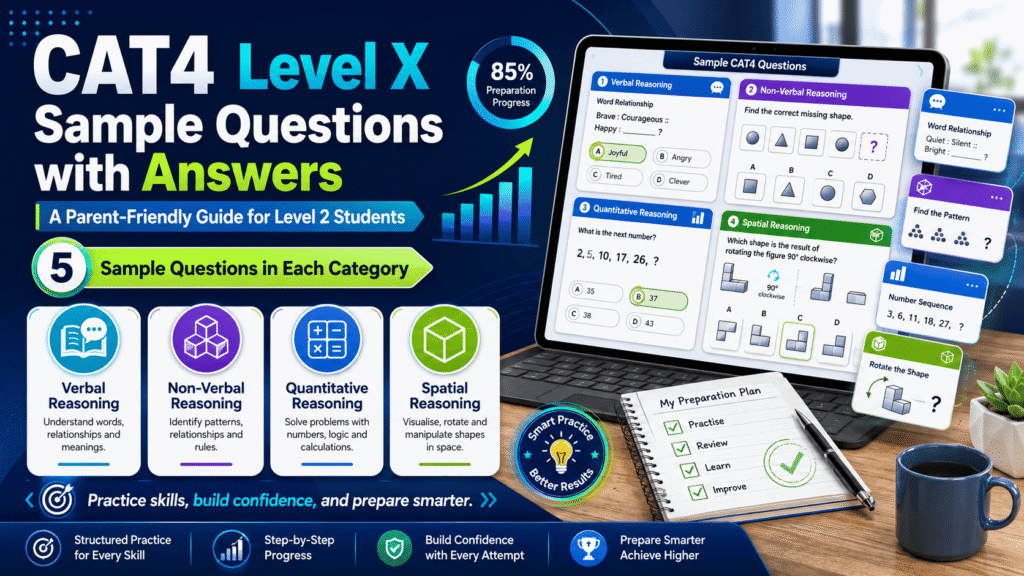
CAT4 Level X can feel new for many young learners because it is not the same as a normal classroom test. Instead of only checking spelling, reading, or maths facts, CAT4 focuses on reasoning skills. It looks at how students think, notice patterns, compare information, solve problems, and stay confident when facing unfamiliar questions.
For Level 2 students, especially young learners preparing for CAT4 Level X, practice questions are one of the best ways to build confidence. When students see different question types before the real assessment, they begin to understand what to expect. This helps reduce worry and improves accuracy.
This guide includes clear explanations and 5 sample questions for each key CAT4 Level X reasoning category: Verbal Reasoning, Non-Verbal Reasoning, Quantitative Reasoning, and Spatial Reasoning. Each sample question includes the correct answer and a simple explanation so parents and students can learn together.
1. What Are CAT4 Level X Sample Questions?
CAT4 Level X sample questions are practice questions that help young students understand the style of reasoning used in the test. These questions are designed to build thinking skills rather than test memorised facts.
They may include:
- Word relationships
- Shape patterns
- Number sequences
- Visual puzzles
- Spatial matching
- Odd one out tasks
- Missing item questions
- Simple logical reasoning
Sample questions are useful because they help students become familiar with the test format in a calm and supportive way.
1.1 Why Sample Questions Matter
Sample questions help children understand how CAT4-style questions work. A child may be good at schoolwork but still feel unsure when facing a reasoning question for the first time.
Practice helps students:
- Recognise common question styles
- Learn how to find patterns
- Compare answer choices
- Avoid rushed guesses
- Understand mistakes
- Build confidence step by step
The goal is not to memorise the answers. The goal is to understand the method.
1.2 How Parents Should Use These Questions
Parents should use these questions as learning tools, not pressure tools.
A helpful approach is:
- Read the question slowly
- Let the child try first
- Ask the child to explain their thinking
- Check the answer together
- Read the explanation
- Try a similar question later
If the child makes a mistake, stay positive. Mistakes show what needs more practice.
2. What Skills Do CAT4 Level X Questions Test?
CAT4 Level X questions focus on reasoning. This means students need to think carefully and use clues to solve problems.
The four main reasoning areas covered in this blog are:
- Verbal Reasoning
- Non-Verbal Reasoning
- Quantitative Reasoning
- Spatial Reasoning
Each area checks a different type of thinking.
2.1 Verbal Reasoning
Verbal reasoning focuses on words, meanings, and relationships between ideas.
Students may need to:
- Find a word that belongs in a group
- Spot a word relationship
- Choose a word with a similar meaning
- Understand simple word links
- Compare language ideas
This supports reading, vocabulary, comprehension, and classroom communication.
2.2 Non-Verbal Reasoning
Non-verbal reasoning focuses on pictures, shapes, and patterns.
Students may need to:
- Find the odd one out
- Complete a visual pattern
- Match shapes
- Notice changes in size or direction
- Choose the figure that follows a rule
This helps students build visual problem-solving skills.
2.3 Quantitative Reasoning
Quantitative reasoning focuses on number logic.
Students may need to:
- Complete number sequences
- Find missing numbers
- Compare quantities
- Understand number patterns
- Work out simple number rules
This supports mathematical thinking and problem-solving confidence.
2.4 Spatial Reasoning
Spatial reasoning focuses on how shapes move, rotate, fit together, or appear from different positions.
Students may need to:
- Recognise a turned shape
- Match a figure from another angle
- Imagine how a shape changes
- Identify a shape inside another shape
- Understand visual movement
This builds strong visualisation skills.
3. How to Answer CAT4 Level X Questions
Young students should not rush through CAT4 questions. The best approach is to slow down, look carefully, and find the rule.
CAT4 questions often look simple, but small details matter.
3.1 Use a Simple Step-by-Step Method
Students can use this method:
- Look carefully at the question
- Decide what type of question it is
- Find the pattern or relationship
- Check all answer choices
- Remove clearly wrong answers
- Choose the best answer
- Check once before moving on
This method helps improve accuracy.
3.2 Do Not Guess Too Quickly
Some students choose the first answer that looks correct. This can lead to mistakes.
Before choosing an answer, students should ask:
- What is the rule?
- What is changing?
- What is staying the same?
- Does this answer fit the whole pattern?
- Are there any better options?
Good reasoning means checking carefully.
4. Verbal Reasoning Sample Questions with Answers
Verbal reasoning questions help students think logically using words. These questions are useful for vocabulary, reading comprehension, and language confidence.
Below are 5 CAT4 Level X verbal reasoning sample questions with answers and explanations.
4.1 Verbal Reasoning Question 1
Question 1:
Which word belongs with these words?
Dog, cat, rabbit, _______
A. Chair
B. Horse
C. Pencil
D. Table
Correct Answer: B. Horse
Explanation: Dog, cat, rabbit, and horse are all animals. Chair, pencil, and table are not animals.
4.2 Verbal Reasoning Question 2
Question 2:
Which word means almost the same as “small”?
A. Tiny
B. Loud
C. Fast
D. Heavy
Correct Answer: A. Tiny
Explanation: Tiny means very small. Loud, fast, and heavy do not mean small.
4.3 Verbal Reasoning Question 3
Question 3:
Find the odd one out.
Apple, banana, orange, carrot
A. Apple
B. Banana
C. Orange
D. Carrot
Correct Answer: D. Carrot
Explanation: Apple, banana, and orange are fruits. Carrot is a vegetable, so it is the odd one out.
4.4 Verbal Reasoning Question 4
Question 4:
Complete the word relationship.
Bird is to fly as fish is to _______.
A. Run
B. Swim
C. Jump
D. Sleep
Correct Answer: B. Swim
Explanation: A bird moves by flying. A fish moves by swimming. The relationship is about how the animal moves.
4.5 Verbal Reasoning Question 5
Question 5:
Which word belongs in the same group?
Red, blue, green, _______
A. Circle
B. Yellow
C. Square
D. Book
Correct Answer: B. Yellow
Explanation: Red, blue, green, and yellow are colours. Circle and square are shapes, and book is an object.
5. Non-Verbal Reasoning Sample Questions with Answers
Non-verbal reasoning questions use shapes, symbols, and visual patterns. Students need to look carefully and notice what is changing.
Below are 5 CAT4 Level X non-verbal reasoning sample questions with answers and explanations.
5.1 Non-Verbal Reasoning Question 1
Question 1:
Choose the answer that shares the same connection characteristic as the three given images.
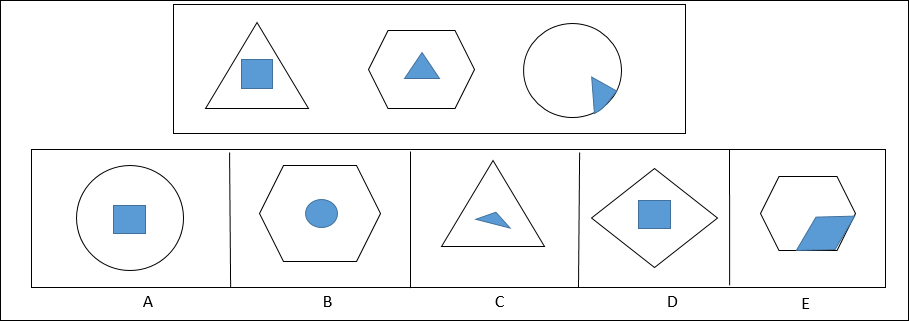
The correct answer is B
Explanation: In the three given images, a smaller blue shape is placed centered inside a larger outer shape. The first has a blue square in a triangle, the second a blue triangle in a hexagon, and the third a blue sector in a circle.Option B follows the same pattern with a blue circle centered inside a hexagon. The other options either place the blue shape off-center or don’t match the containment style.
5.2 Non-Verbal Reasoning Question 2
Question 2:
Choose the answer that shares the same connection characteristic as the three given images.
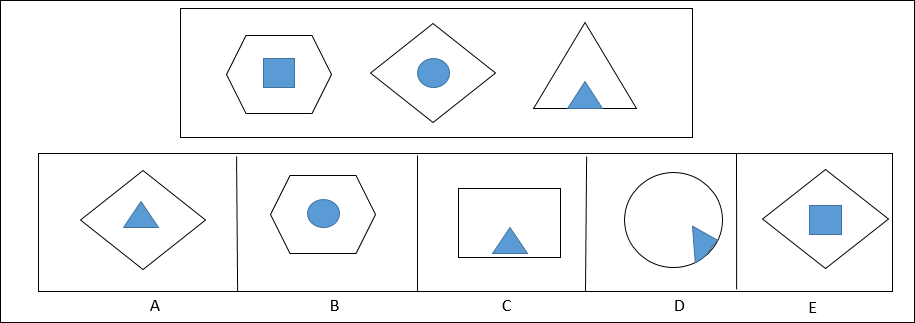
The correct answer is B
Explanation: The pattern in the given images has two types: the first two show a smaller blue shape centered inside the outer shape, and the third shows a blue shape touching the bottom edge. In option B, a blue circle is centered inside a hexagon, matching the centered containment pattern from the first image. The other options either place the blue shape at the bottom or use a different connection. So B is the correct match for the first pattern.
5.3 Non-Verbal Reasoning Question 3
Question 3:
Choose the answer that shares the same connection characteristic as the three given images.
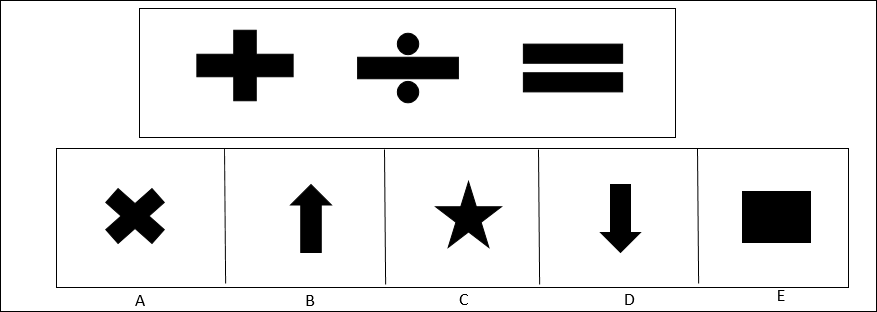
Explanation: The correct answer is A
The three shapes are all mathematical symbols. The first (on the left) is a plus symbol, the second (in the center) is a division symbol, and the third (on the right) is an equals symbol. The correct answer should be a mathematical symbol as well. Answer (A) is correct because it’s the only option that presents a mathematical symbol; in this case the times sign that is used for multiplication. Answers (B) – an arrow pointing upwards, (C) – a star, (D) – an arrow pointing downwards, and (E) – a square, are all symbols that are not mathematical.
5.4 Non-Verbal Reasoning Question 4
Question 4:
Observe how the first pair of pictures are related. Then choose the picture that completes the second pair using the same rule:
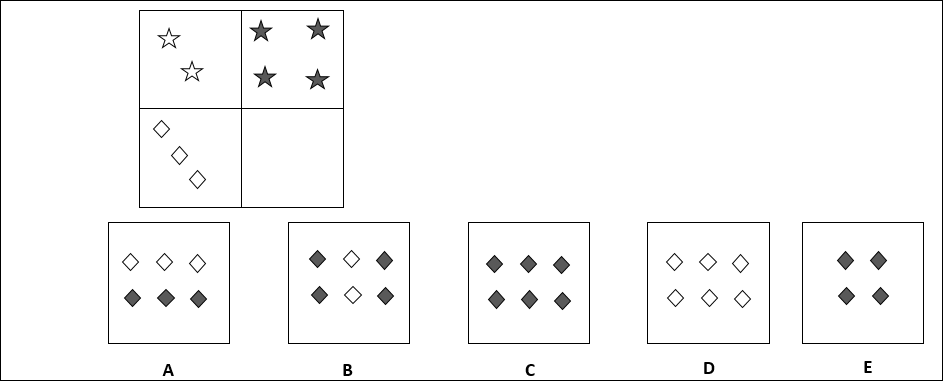
Correct Answer: C
Explanation: In the first pair, two white stars become double (four) and their colored changes to black, similarly in next pair three white diamond shape become doubled (six) and their color also changed to black. Therefore, Option C is the correct answer because it shows six black diamonds.
5.5 Non-Verbal Reasoning Question 5
Question 5:
Observe how the first pair of pictures are related. Then choose the picture that completes the second pair using the same rule:
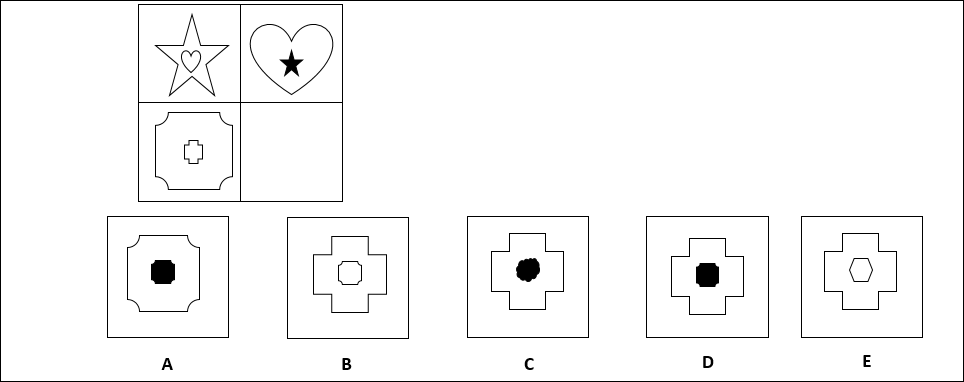
Correct Answer: D
Explanation: In the first pair, star has heart inside it which then inner heart become outer shape and star goes inside and become black. Therefore, Option D is the correct answer because it follows the same pattern.
6. Quantitative Reasoning Sample Questions with Answers
Quantitative reasoning questions focus on number patterns and number logic. Students need to find the rule before choosing the answer.
Below are 5 CAT4 Level X quantitative reasoning sample questions with answers and explanations.
6.1 Quantitative Reasoning Question 1
Question 1:
What number comes next?
2, 4, 6, 8, _______
A. 9
B. 10
C. 11
D. 12
Correct Answer: B. 10
Explanation: The numbers go up by 2 each time. After 8, the next number is 10.
6.2 Quantitative Reasoning Question 2
Question 2:
What number is missing?
5, 10, 15, _______ , 25
A. 16
B. 18
C. 20
D. 22
Correct Answer: C. 20
Explanation: The numbers go up by 5 each time. After 15, the missing number is 20.
6.3 Quantitative Reasoning Question 3
Question 3:
Which number is the odd one out?
3, 6, 9, 10, 12
A. 3
B. 6
C. 10
D. 12
Correct Answer: C. 10
Explanation: 3, 6, 9, and 12 are counting in 3s. 10 does not fit the pattern.
6.4 Quantitative Reasoning Question 4
Question 4:
Complete the number pattern.
1, 3, 5, 7, _______
A. 8
B. 9
C. 10
D. 11
Correct Answer: B. 9
Explanation: The numbers go up by 2 each time. The next number after 7 is 9.
6.5 Quantitative Reasoning Question 5
Question 5:
Which number comes next?
20, 18, 16, 14, _______
A. 13
B. 12
C. 11
D. 10
Correct Answer: B. 12
Explanation: The numbers go down by 2 each time. After 14, the next number is 12.
7. Spatial Reasoning Sample Questions with Answers
Spatial reasoning questions ask students to think about shapes, position, direction, and movement. These questions help students build visualisation skills.
Below are 5 CAT4 Level X spatial reasoning sample questions with answers and explanations.
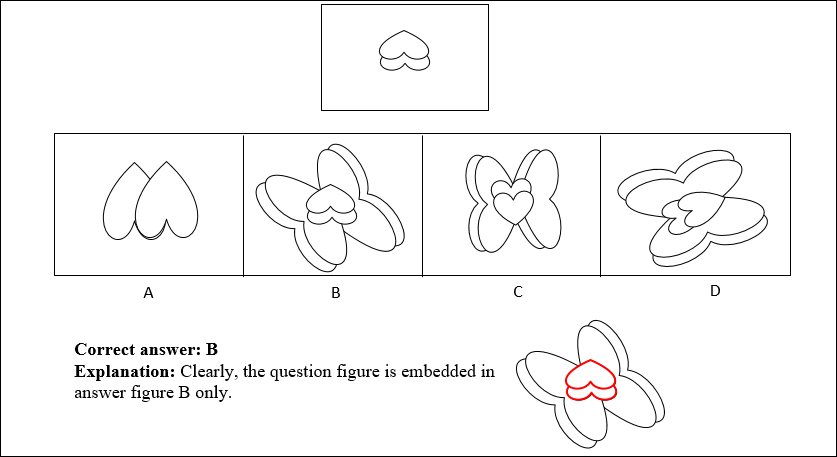
7.1 Spatial Reasoning Question 1
Question 1:
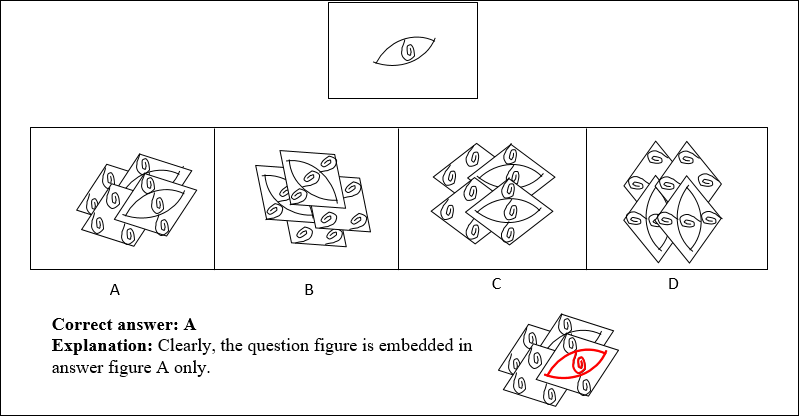
Find out that answer figure in which the question figure is embedded.
7.2 Spatial Reasoning Question 2
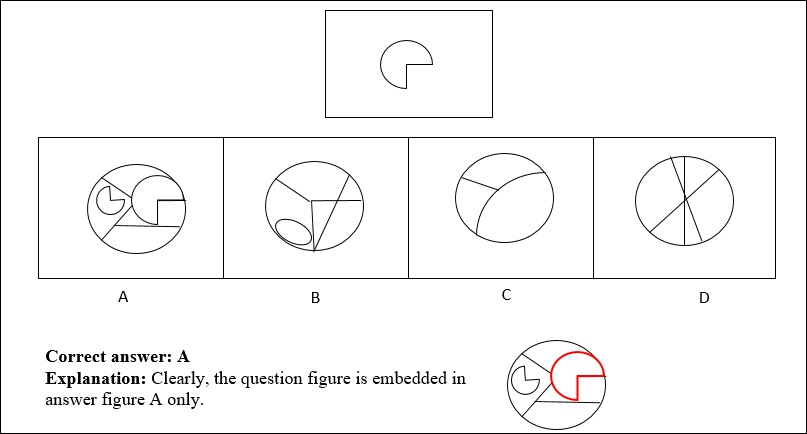
Question 2:
Find out that answer figure in which the question figure is embedded.
7.3 Spatial Reasoning Question 3
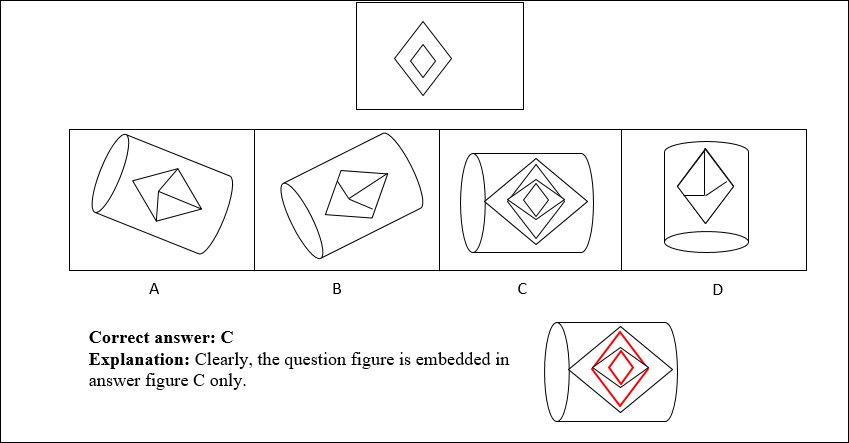
Question 3:
Find out that answer figure in which the question figure is embedded.
7.4 Spatial Reasoning Question 4
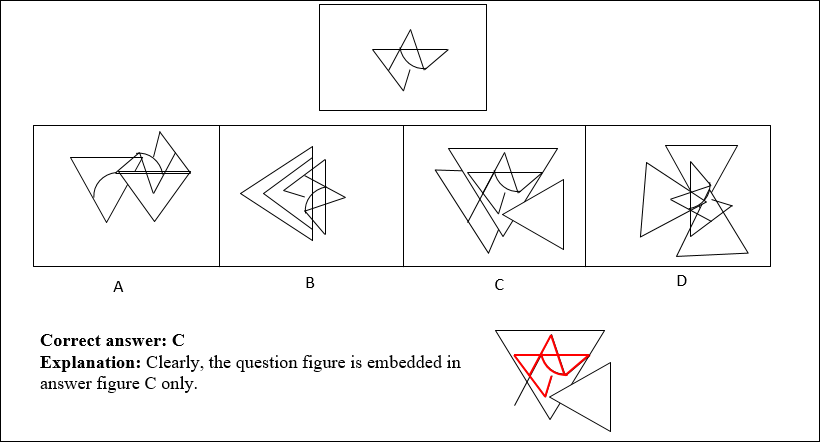
Question 4:
Find out that answer figure in which the question figure is embedded.
7.5 Spatial Reasoning Question 5
Question 5:
Find out that answer figure in which the question figure is embedded.
8. How to Review These CAT4 Level X Sample Questions
Practice questions are most useful when students review them properly. Parents should not only check whether the answer is right or wrong. They should help the child understand the thinking behind the answer.
8.1 Ask the Child to Explain Their Thinking
After each question, ask:
- Why did you choose that answer?
- What pattern did you notice?
- Which answer choices were wrong?
- What clue helped you?
- Could there be another answer?
- How can we solve a similar question next time?
This helps children become more aware of their own reasoning.
8.2 Focus on Mistake Patterns
If a child gets several questions wrong, look for a pattern.
For example:
- Are they rushing?
- Are they missing visual details?
- Are number patterns difficult?
- Are word meanings unclear?
- Are spatial questions confusing?
- Are they guessing before checking all options?
Once parents know the mistake pattern, preparation becomes more focused.
8.3 Practise Similar Questions Again
If a child struggles with one category, repeat similar questions.
For example:
- More word questions for verbal reasoning
- More shape patterns for non-verbal reasoning
- More number sequences for quantitative reasoning
- More rotation tasks for spatial reasoning
Targeted practice helps students improve faster.
9. How to Use Mock Tests After Sample Questions
Sample questions help students learn individual skills. Mock tests help students practise the full test experience.
Parents should introduce mock tests gradually after students understand the basic question types.
9.1 Start with Mini Mock Tests
For young students, mini mock tests are better than long practice sessions at the beginning.
A mini mock test may include:
- A few verbal reasoning questions
- A few non-verbal reasoning questions
- A few quantitative reasoning questions
- A few spatial reasoning questions
- A short review afterwards
This builds test confidence without overwhelming the child.
9.2 Review Mock Test Mistakes
After a mock test, review carefully.
Look at:
- Which questions were correct
- Which questions were wrong
- Which category was strongest
- Which category needs more practice
- Whether the child rushed
- Whether timing caused mistakes
- Whether the child stayed calm
The review is more important than the score.
9.3 Build Test Confidence Slowly
Mock tests should help students feel prepared, not frightened.
Parents should say:
“This is just practice. It helps us learn what to improve.”
This keeps the child calm and motivated.
10. Best Preparation Tips for CAT4 Level X
CAT4 Level X preparation should be simple, positive, and consistent. Young students learn best when practice feels manageable.
10.1 Keep Practice Short and Regular
Short practice sessions are usually better than long sessions.
A useful routine may include:
- 10 to 15 minutes of practice
- One reasoning category at a time
- A few carefully chosen questions
- Gentle review
- Positive feedback
This keeps children focused and confident.
10.2 Build All Four Reasoning Areas
Students should practise all four areas:
- Verbal reasoning
- Non-verbal reasoning
- Quantitative reasoning
- Spatial reasoning
Balanced practice helps children feel ready for different question types.
10.3 Use Encouraging Language
Parents should use positive language during practice.
Helpful phrases include:
- “You are learning the method.”
- “Mistakes help us improve.”
- “You spotted the pattern well.”
- “Let’s try another one together.”
- “You are becoming more confident.”
- “Take your time and look carefully.”
Confidence is an important part of CAT4 preparation.
11. Common Mistakes to Avoid
Many students make similar mistakes when practising CAT4 Level X questions. These mistakes are normal and can be improved.
11.1 Rushing Through Questions
Students may rush because they want to finish quickly. This can lead to careless errors.
Encourage children to:
- Slow down
- Look carefully
- Check all options
- Find the pattern
- Answer calmly
Accuracy should come before speed.
11.2 Guessing Without Finding the Rule
Some students guess before understanding the question.
Teach children to ask:
- What is the rule?
- What is changing?
- What stays the same?
- Which option fits best?
This improves logical thinking.
11.3 Ignoring Explanations
Answer keys are useful, but explanations are more important.
Students should understand why an answer is correct. This helps them solve similar questions in the future.
12. Final Thoughts
CAT4 Level X sample questions are a powerful way to help young students prepare with confidence. They introduce children to the types of reasoning tasks they may face and help them learn how to think carefully through each question.
This blog included 5 sample questions in each major category: Verbal Reasoning, Non-Verbal Reasoning, Quantitative Reasoning, and Spatial Reasoning. Each question included an answer and explanation so parents and students can practise together.
The best preparation is not about pressure or memorisation. It is about building reasoning skills step by step. Students should practise regularly, review mistakes, try mock tests gradually, and stay positive throughout the preparation journey.
With clear explanations, balanced practice questions, and parent support, Level X students can improve their confidence and approach CAT4-style questions with a calmer, stronger mindset.