
CAT4 Level Y preparation can feel challenging for parents and Year 3 students because the test is different from normal schoolwork. It does not simply check spelling lists, times tables, or topics learned in class. Instead, it focuses on how a child thinks, solves problems, recognises patterns, compares information, and uses reasoning skills.
For Year 3 students, CAT4 Level Y preparation should be calm, structured, and confidence-focused. The aim is not to create pressure. The aim is to help students understand the format, practise different reasoning question types, build accuracy, and feel more prepared before the assessment.
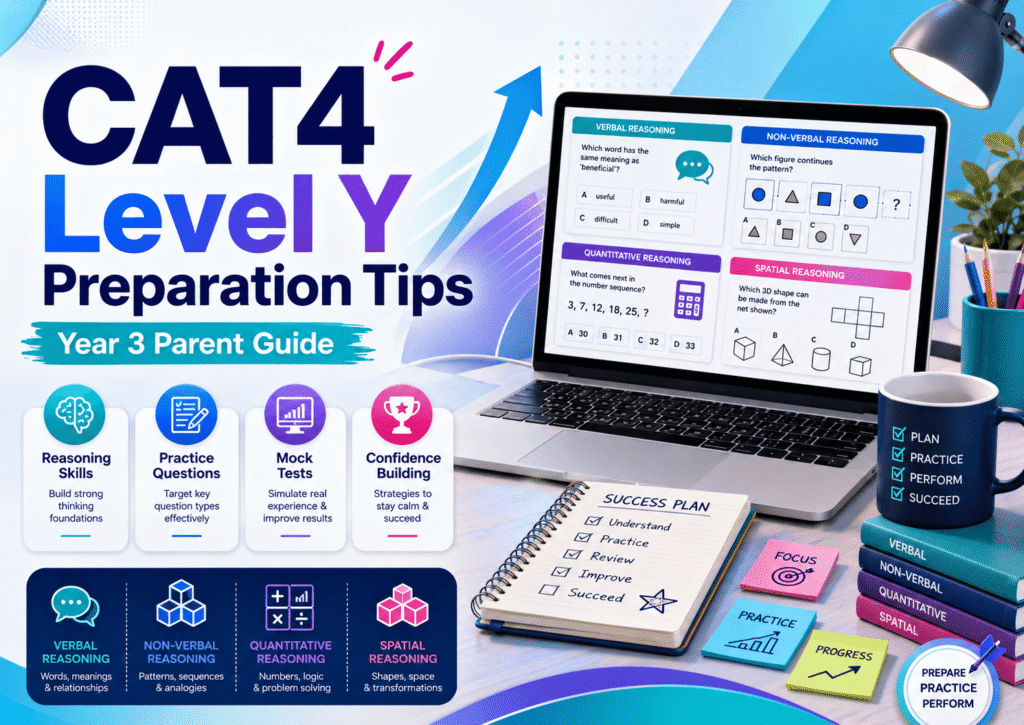
This guide shares practical CAT4 Level Y preparation tips for parents and students. It explains how to prepare for verbal reasoning, non-verbal reasoning, quantitative reasoning, and spatial reasoning. It also covers practice questions, mock tests, mistake review, study routines, and confidence-building strategies.
1. Understand What CAT4 Level Y Is Testing
The first step in CAT4 Level Y preparation is understanding what the test is designed to assess. CAT4 is a reasoning-based assessment, which means students need to think carefully and use logic rather than memorise facts only.
CAT4 Level Y may include questions based on:
- Words and meanings
- Shapes and pictures
- Number patterns
- Visual puzzles
- Spatial movement
- Logical relationships
- Pattern recognition
- Multiple-choice answers
When parents understand this, preparation becomes more focused and useful.
1.1 Why CAT4 Level Y Is Different from Normal Tests
A normal Year 3 test may check classroom learning. For example, it may test spelling, reading comprehension, addition, subtraction, or grammar.
CAT4 Level Y is different because students may face unfamiliar questions. They need to work out the rule by looking carefully at the information given.
This means preparation should focus on:
- Recognising question types
- Finding patterns
- Comparing answer choices
- Using logical thinking
- Avoiding rushed guesses
- Reviewing mistakes carefully
- Building confidence with unfamiliar tasks
1.2 Why Parents Should Explain CAT4 Simply
Young students should not feel frightened by the word “test.” Parents can explain CAT4 in a simple and positive way.
For example:
“CAT4 is a thinking test. It has questions with words, numbers, shapes, and patterns. You need to look carefully and find the rule.”
This helps children see the test as something they can learn to approach step by step.
2. Start CAT4 Level Y Preparation Early
One of the best CAT4 Level Y preparation tips is to start early. Early preparation gives Year 3 students time to become familiar with the test style without stress.
Last-minute practice can make children feel rushed and nervous.
2.1 Why Early Preparation Helps
When preparation starts early, students have time to:
- Learn one question type at a time
- Practise calmly
- Understand explanations
- Review mistakes properly
- Build confidence gradually
- Improve weaker areas
- Try mock tests when ready
This creates a stronger preparation routine.
2.2 Avoid Last-Minute Pressure
Last-minute preparation often leads to long practice sessions and too many new question types at once. This can make students tired, confused, or anxious.
Instead, parents should use short and regular sessions.
A good routine may include:
- 10 to 20 minutes of practice
- One reasoning skill focus
- A small number of questions
- Clear explanations
- Positive feedback
- Gentle review
Small steps over time are more effective than rushed preparation.
3. Learn the Four Main CAT4 Reasoning Areas
CAT4 Level Y preparation should cover all four major reasoning areas. Each area tests a different type of thinking.
The four main areas are:
- Verbal reasoning
- Non-verbal reasoning
- Quantitative reasoning
- Spatial reasoning
Balanced preparation helps students feel ready for the full test format.
3.1 Verbal Reasoning
Verbal reasoning focuses on words, meanings, and language relationships.
Students may need to:
- Find word similarities
- Choose a word that belongs in a group
- Identify the odd word out
- Complete word relationships
- Understand simple analogies
- Use vocabulary clues
This skill supports reading, comprehension, vocabulary, speaking, and writing.
3.2 Non-Verbal Reasoning
Non-verbal reasoning focuses on shapes, pictures, diagrams, and visual patterns.
Students may need to:
- Complete a shape pattern
- Find the odd shape out
- Match similar figures
- Choose a missing image
- Notice changes in size, direction, or position
- Identify visual rules
This helps students develop strong visual problem-solving skills.
3.3 Quantitative Reasoning
Quantitative reasoning focuses on number logic and number relationships.
Students may need to:
- Complete number sequences
- Find missing numbers
- Compare quantities
- Spot number rules
- Understand patterns
- Apply simple mathematical thinking
This supports maths confidence and logical problem-solving.
3.4 Spatial Reasoning
Spatial reasoning focuses on how shapes move, rotate, fit together, or appear from different angles.
Students may need to:
- Recognise rotated shapes
- Match figures from different positions
- Visualise movement
- Understand how parts combine
- Compare shape positions
- Identify turned or flipped figures
Spatial reasoning can feel difficult at first, but it improves with regular practice.
4. Practise One Question Type at a Time
Many parents make the mistake of giving children mixed practice too early. Mixed practice is useful later, but students should first understand each question type clearly.
Topic-by-topic practice builds confidence.
4.1 Start with Simple Question Types
Begin with easier question types such as:
- Odd one out
- Shape patterns
- Number sequences
- Word relationships
- Picture matching
- Missing item questions
Once the child understands one type, move to the next.
This helps the child feel successful and reduces confusion.
4.2 Move to Mixed Practice Later
After the child becomes comfortable with individual question types, mixed practice can be introduced.
Mixed practice helps students learn to switch between different reasoning skills. This is important because CAT4-style assessments may include different types of questions across sections.
Mixed practice improves:
- Flexibility
- Focus
- Accuracy
- Confidence
- Speed
- Test readiness
5. Build Verbal Reasoning Skills
Verbal reasoning is important for CAT4 Level Y because it checks how students think with words and meanings. Strong verbal reasoning can also support reading and classroom learning.
Parents can improve verbal reasoning through regular language practice.
5.1 Read and Discuss Short Texts
Reading is one of the best ways to support verbal reasoning.
Parents can use:
- Short stories
- Simple articles
- Picture books
- Poems
- Reading passages
- Everyday signs and labels
After reading, ask questions such as:
- What does this word mean?
- Which word means the same?
- Which word means the opposite?
- What happened first?
- Why did this happen?
- Can you explain this in your own words?
These questions help children think carefully about language.
5.2 Practise Word Relationships
Word relationship questions help children understand how words connect.
Examples include:
- Cat is to kitten as dog is to puppy.
- Hot is to cold as big is to small.
- Bird is to fly as fish is to swim.
Parents should ask children to explain the relationship.
The explanation is important because it shows real understanding.
5.3 Build Vocabulary Naturally
Vocabulary does not need to be learned through memorisation only. It can grow through conversation.
Parents can ask:
- What is another word for this?
- What is the opposite of this word?
- Can you describe this object?
- Can you use this word in a sentence?
- How are these two words connected?
A stronger vocabulary can make verbal reasoning easier.
6. Improve Non-Verbal Reasoning with Visual Practice
Non-verbal reasoning is about visual thinking. It includes shapes, diagrams, patterns, and pictures. Students must look carefully and notice what changes.
This section can be enjoyable for children when presented like puzzles.
6.1 Practise Shape Patterns
Shape patterns may involve changes in:
- Shape
- Size
- Colour
- Direction
- Position
- Number of parts
- Shading
- Order
Parents can ask:
“What changes each time?”
This simple question helps children focus on the rule.
6.2 Use Odd One Out Activities
Odd one out questions help children compare details.
Parents can use objects at home, such as toys, pencils, cups, blocks, or shapes.
Ask:
“Which one is different, and why?”
The “why” matters because it helps children explain their reasoning.
6.3 Teach Careful Visual Checking
Many non-verbal reasoning mistakes happen because students rush or miss a small detail.
Teach children to check:
- Is the shape the same?
- Has it turned?
- Is it bigger or smaller?
- Has the position changed?
- Are there more or fewer parts?
- Is the shading different?
Careful checking improves accuracy.
7. Strengthen Quantitative Reasoning
Quantitative reasoning focuses on numbers, but it is not only about calculation. It is about understanding number patterns and relationships.
Year 3 students should practise number logic in a calm and structured way.
7.1 Practise Number Sequences
Number sequences are a useful way to build quantitative reasoning.
Students should learn to ask:
“What is happening to the numbers?”
The rule may involve:
- Adding
- Subtracting
- Counting forwards
- Counting backwards
- Repeating a pattern
- Comparing gaps between numbers
For example, in the sequence 4, 8, 12, 16, the rule is adding 4 each time.
7.2 Use Everyday Number Activities
Parents can build number reasoning through daily life.
Useful activities include:
- Counting steps
- Sharing snacks equally
- Comparing groups of objects
- Counting in twos, fives, or tens
- Asking “how many more?”
- Sorting items by number
- Finding missing numbers
This makes number thinking feel natural.
7.3 Ask Students to Explain the Rule
Students should not only give the answer. They should explain how they found it.
For example:
“The numbers are going down by 2 each time.”
This shows that the child understands the pattern and can apply the same logic again.
8. Develop Spatial Reasoning Through Hands-On Practice
Spatial reasoning can be one of the trickier CAT4 Level Y areas because students need to imagine shapes moving, rotating, or fitting together.
Hands-on activities can make spatial reasoning easier.
8.1 Use Puzzles and Building Activities
Helpful activities include:
- Jigsaw puzzles
- Building blocks
- Pattern blocks
- Shape sorting
- Paper folding
- Matching shapes
- Simple construction tasks
These activities help children understand position, movement, and shape relationships.
8.2 Practise Rotated Shapes
Children should learn that a shape may still be the same shape even when it has turned.
Parents can ask:
- Has the shape rotated?
- Has it flipped?
- Is it still the same?
- Which option matches it?
- What changed about its position?
This builds visual confidence.
8.3 Use Drawing and Copying Tasks
Drawing can also support spatial reasoning.
Students can practise:
- Copying simple shapes
- Completing half of a picture
- Drawing patterns
- Matching turned figures
- Finishing grid designs
- Identifying shape changes
These tasks help children become more comfortable with visual thinking.
9. Use CAT4 Practice Questions Effectively
Practice questions are one of the most important parts of CAT4 Level Y preparation. However, they should be used correctly.
The aim is not to complete as many questions as possible. The aim is to understand the method.
9.1 Choose Age-Appropriate Practice Questions
Practice questions should match Year 3 ability. If questions are too difficult, the child may lose confidence. If they are too easy, the child may not improve enough.
Good CAT4 Level Y practice questions should be:
- Clear
- Skill-focused
- Age-appropriate
- Similar to reasoning test style
- Supported by explanations
- Balanced across reasoning areas
9.2 Review Every Mistake
Mistake review is one of the most powerful preparation tools.
After a wrong answer, ask:
- What did you notice first?
- What was the pattern?
- Which clue was missed?
- Why is the correct answer better?
- Why was the other answer wrong?
- How can we solve this next time?
This turns practice into real learning.
9.3 Repeat Difficult Question Types
If a child struggles with one question type, practise similar questions again.
For example:
- More word links for verbal reasoning
- More shape patterns for non-verbal reasoning
- More number sequences for quantitative reasoning
- More rotation tasks for spatial reasoning
Targeted practice improves weak areas faster.
10. Add Mock Tests Gradually
Mock tests help students experience test-style conditions before the real assessment. They help children practise focus, timing, and switching between question types.
However, mock tests should be introduced at the right time.
10.1 Start with Mini Mock Tests
Year 3 students should not begin with long mock tests immediately.
Start with:
- A small number of questions
- Short timed practice
- One or two reasoning areas
- Calm review afterwards
- Encouraging feedback
Mini mock tests help students build confidence step by step.
10.2 Use Mock Tests to Check Readiness
Mock tests can help parents see whether the child is ready for test-style practice.
They show whether the child can:
- Stay focused
- Understand instructions
- Manage time
- Switch between question types
- Work independently
- Avoid careless mistakes
- Stay calm
This information helps parents plan the next practice stage.
10.3 Review Mock Tests Carefully
The score is not the only important part of a mock test. The review matters more.
Parents should look at:
- Which questions were correct
- Which questions were wrong
- Which section was strongest
- Which section needs more practice
- Whether the child rushed
- Whether timing caused mistakes
- Whether the child understood the question type
This makes mock tests more useful.
11. Teach Simple CAT4 Test Strategies
Year 3 students need strategies that are easy to remember. Complicated methods can confuse them.
Simple strategies help children stay calm and think clearly.
11.1 Look Carefully Before Answering
Students should not choose the first answer that looks correct.
Teach them to:
- Read or view the question carefully
- Find the rule
- Check all options
- Remove wrong answers
- Choose the best answer
- Check once before moving on
This improves accuracy.
11.2 Use Elimination
If a student is unsure, they can remove answers that clearly do not fit.
For example, in a shape question, they can remove options with:
- The wrong shape
- The wrong direction
- The wrong number of parts
- The wrong size
- The wrong position
This gives the child a better chance of choosing correctly.
11.3 Stay Calm on Tricky Questions
Some questions may feel difficult. That is normal.
Teach children to think:
- What do I know?
- What is changing?
- Which answers are clearly wrong?
- Which answer fits best?
- Can I move on calmly if needed?
A calm student is more likely to think clearly.
12. Avoid Common CAT4 Level Y Preparation Mistakes
Good preparation is not only about what to do. It is also about what to avoid.
Some mistakes can reduce confidence and slow progress.
12.1 Do Not Practise for Too Long
Long sessions can make Year 3 students tired and frustrated.
Short, focused sessions work better.
A strong session should include:
- One skill focus
- A few questions
- Clear explanations
- Mistake review
- Positive feedback
12.2 Do Not Skip Weak Areas
Children may prefer the reasoning areas they enjoy. However, all four areas need attention.
If spatial reasoning feels difficult, practise it gently. If verbal reasoning is weaker, build vocabulary and word relationships slowly.
Balanced preparation is important.
12.3 Do Not Ignore Explanations
Answer keys alone are not enough.
Students need to understand why the answer is correct.
Explanations help students learn the method and apply it to similar questions later.
13. Build Confidence Throughout Preparation
Confidence is one of the most important parts of CAT4 Level Y preparation. A confident child is more likely to stay calm, focus better, and keep trying.
Parents should make preparation encouraging.
13.1 Praise Effort and Thinking
Instead of only praising correct answers, praise the thinking process.
Say:
- “You looked carefully.”
- “You found the pattern.”
- “You explained your answer well.”
- “You tried again after a mistake.”
- “You stayed focused.”
- “You are improving.”
This builds motivation.
13.2 Celebrate Small Wins
Small progress matters.
Celebrate when your child:
- Solves a tricky question
- Makes fewer careless mistakes
- Completes a mini mock test
- Improves in one reasoning area
- Explains an answer clearly
- Stays calm during practice
These small wins build confidence over time.
13.3 Avoid Negative Comparisons
Do not compare your child with classmates, siblings, or friends.
Every child learns at a different pace.
Focus on:
- Personal improvement
- Better focus
- Stronger reasoning
- Fewer mistakes
- More confidence
- Steady progress
14. Create a Balanced Weekly Preparation Routine
A clear weekly routine helps parents organise preparation without overwhelming the child.
The routine should include topic practice, review, and gentle mock test exposure.
14.1 Include All Four Reasoning Areas
A balanced plan should include:
- Verbal reasoning
- Non-verbal reasoning
- Quantitative reasoning
- Spatial reasoning
- Mixed practice
- Mistake review
- Mini mock tests
This helps students become confident across the full CAT4 Level Y format.
14.2 Keep the Routine Flexible
Some days will be busier than others. Some days the child may feel tired.
Parents should keep preparation flexible.
It is better to do a short, focused session than to force long practice when the child is not ready.
14.3 Focus More on Weak Areas
If one reasoning area is weaker, give it extra attention.
For example:
- Verbal reasoning: practise vocabulary and word relationships.
- Non-verbal reasoning: practise visual patterns.
- Quantitative reasoning: practise number sequences.
- Spatial reasoning: practise rotations and visual puzzles.
Focused support helps students improve more effectively.
15. Prepare Carefully in the Final Week
The final week before CAT4 Level Y should be calm and confidence-focused. It is not the time to overload the child with too many new questions.
15.1 Review Familiar Question Types
Use the final week to review:
- Word relationships
- Shape patterns
- Number sequences
- Spatial reasoning tasks
- Odd one out questions
- Common mistake areas
- Mini mock test results
Keep the practice light and positive.
15.2 Use Light Mock Test Practice
A short mock test can help the child stay familiar with the format.
Avoid too many mock tests in the final week. Too much testing can create pressure.
The goal is confidence, not stress.
15.3 Keep a Healthy Routine
Children perform better when they are rested and calm.
In the final week, focus on:
- Good sleep
- Short practice
- Breaks
- Encouragement
- Calm mornings
- Positive reassurance
A relaxed child is more likely to think clearly.
16. Test-Day Tips for Year 3 Students
On test day, parents should keep instructions simple. Too many reminders can make children nervous.
A calm message works best.
16.1 Simple Reminders Before the Test
Remind your child to:
- Read or look carefully
- Find the pattern
- Check all answer choices
- Think before choosing
- Stay calm
- Try their best
- Move on if a question feels difficult
These reminders are easy to remember.
16.2 Encourage Effort, Not Perfection
Tell your child:
“You do not need to be perfect. Just think carefully and try your best.”
This helps reduce pressure.
16.3 Stay Positive After the Test
After the test, avoid asking too many detailed questions immediately.
A supportive response is:
“Well done for trying your best.”
This helps the child feel valued and encouraged.
17. Final Thoughts
CAT4 Level Y preparation should be calm, balanced, and confidence-focused. Year 3 students do not need long, stressful study sessions. They need clear explanations, regular practice, useful feedback, and parent support.
The best CAT4 Level Y preparation tips include starting early, practising one question type at a time, building all four reasoning areas, reviewing mistakes, using mock tests gradually, and keeping confidence high.
Students should practise verbal reasoning, non-verbal reasoning, quantitative reasoning, and spatial reasoning so they become familiar with the full range of CAT4-style questions. Practice questions help students understand the method. Mock tests help students become comfortable with test-style conditions. Mistake review helps students improve.
With the right preparation, Year 3 students can build stronger reasoning skills, reduce anxiety, and approach CAT4 Level Y with greater confidence.