
CAT4 Level Y can feel new and challenging for many Year 3 students because it is different from normal classroom tests. Instead of only checking what a child has memorised, CAT4 focuses on reasoning skills. It looks at how students think, solve problems, recognise patterns, compare information, and stay calm when facing unfamiliar questions.
For parents, CAT4 Level Y sample questions are very useful because they show the type of thinking children may need during the assessment. When students practise with clear answers and explanations, they begin to understand how to approach each question step by step.
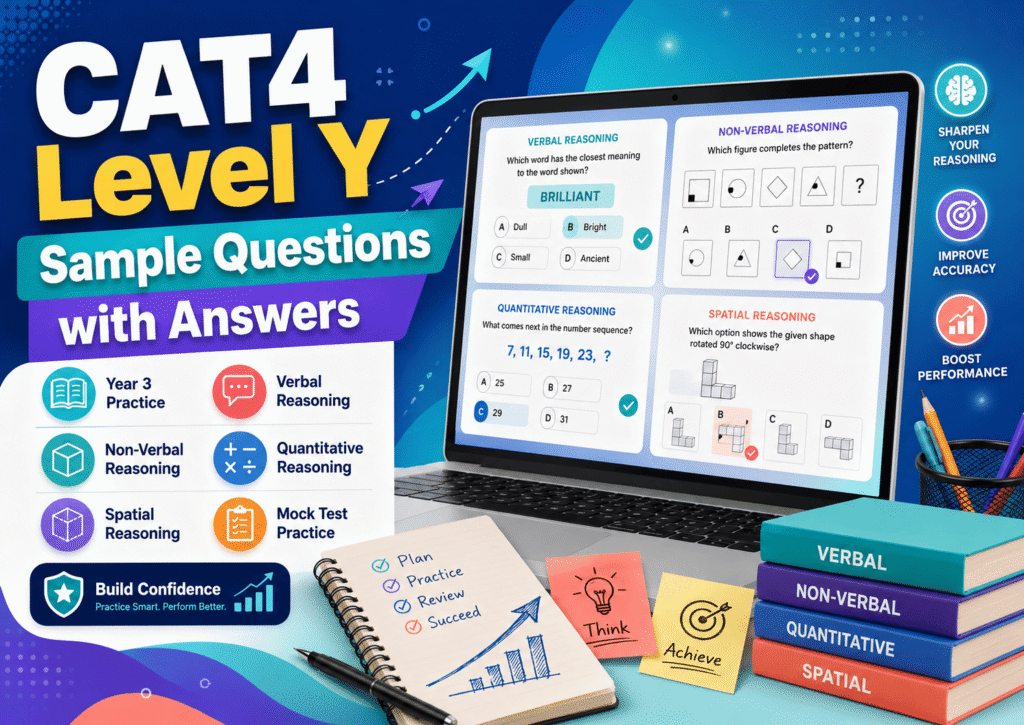
This guide includes CAT4 Level Y sample questions with answers for Year 3 students. It covers the four key reasoning areas: Verbal Reasoning, Non-Verbal Reasoning, Quantitative Reasoning, and Spatial Reasoning. Each category includes 5 sample questions with correct answers and simple explanations to support parent-led practice, mock test preparation, and student confidence.
1. What Are CAT4 Level Y Sample Questions?
CAT4 Level Y sample questions are practice questions designed to help Year 3 students become familiar with reasoning-style tasks. These questions do not simply ask children to remember facts. They encourage students to think carefully and find patterns, rules, or relationships.
Sample questions may include:
- Word relationships
- Odd one out tasks
- Shape patterns
- Number sequences
- Missing number questions
- Visual puzzles
- Rotated shapes
- Spatial matching
- Multiple-choice answers
The main goal is to help students understand the format before the real assessment.
1.1 Why Sample Questions Are Useful
Sample questions help students see how CAT4-style reasoning works. Many children feel unsure at first because the questions may not look like normal schoolwork.
With regular practice, students can learn to:
- Read or view each question carefully
- Identify the question type
- Find the hidden rule
- Compare answer choices
- Avoid guessing too quickly
- Check their answer
- Learn from mistakes
- Build confidence gradually
Practice helps make unfamiliar questions feel more manageable.
1.2 How Parents Should Use These Questions
Parents should use these sample questions as a learning tool, not as a pressure test. The best approach is calm, supportive, and step by step.
A helpful method is:
- Let the child try the question first.
- Ask them to explain their thinking.
- Check the correct answer together.
- Read the explanation.
- Discuss why the other options are not correct.
- Try a similar question later.
The explanation matters as much as the answer because it teaches the child the reasoning method.
2. What Skills Do CAT4 Level Y Questions Test?
CAT4 Level Y questions test different types of reasoning. Each reasoning area helps show how a child thinks and solves problems.
The four main areas are:
- Verbal Reasoning
- Non-Verbal Reasoning
- Quantitative Reasoning
- Spatial Reasoning
Each area uses a different skill, so students should practise all of them.
2.1 Verbal Reasoning Skills
Verbal reasoning focuses on words, meanings, and language relationships.
Students may need to:
- Find words with similar meanings
- Identify opposites
- Spot word categories
- Complete word relationships
- Find the odd word out
- Understand simple analogies
This supports vocabulary, reading comprehension, speaking, writing, and classroom understanding.
2.2 Non-Verbal Reasoning Skills
Non-verbal reasoning focuses on shapes, patterns, diagrams, and visual logic.
Students may need to:
- Complete a pattern
- Find the odd shape out
- Match similar figures
- Notice changes in size or direction
- Choose the missing picture
- Identify a visual rule
This helps students build visual problem-solving skills.
2.3 Quantitative Reasoning Skills
Quantitative reasoning focuses on number logic and number relationships.
Students may need to:
- Complete number sequences
- Find missing numbers
- Compare quantities
- Identify number patterns
- Understand simple number rules
- Choose the number that fits best
This supports maths reasoning and logical thinking.
2.4 Spatial Reasoning Skills
Spatial reasoning focuses on how shapes move, rotate, fit together, or appear from different angles.
Students may need to:
- Recognise a rotated shape
- Match shapes from different positions
- Visualise movement
- Understand how parts combine
- Compare directions
- Identify turned or flipped figures
This area can feel tricky, but it improves with practice.
3. How to Answer CAT4 Level Y Questions
Before attempting sample questions, students should understand a simple answering strategy. CAT4-style questions often require careful thinking, not rushing.
3.1 Use a Step-by-Step Method
Students can use this method for most CAT4 Level Y questions:
- Look carefully at the question.
- Decide what type of question it is.
- Find the pattern, rule, or relationship.
- Check all answer choices.
- Remove answers that do not fit.
- Choose the best answer.
- Check once before moving on.
This method helps students avoid careless mistakes.
3.2 Do Not Guess Too Quickly
Some students choose the first answer that looks right. This can lead to mistakes.
Before choosing, students should ask:
- What is the rule?
- What is changing?
- What stays the same?
- Which option fits the full pattern?
- Which answers are clearly wrong?
- Can I explain why my answer is correct?
If a student can explain the answer, they are more likely to understand the reasoning.
4. Verbal Reasoning Sample Questions with Answers
Verbal reasoning questions help students think logically using words. These questions support vocabulary, reading comprehension, and language confidence.
Below are 5 CAT4 Level Y verbal reasoning sample questions with answers and explanations.
4.1 Verbal Reasoning Question 1
Question 1:
Which word means almost the same as “brave”?
A. Afraid
B. Courageous
C. Tired
D. Quiet
Correct Answer: B. Courageous
Explanation: Brave means showing courage. Courageous has a similar meaning. Afraid means scared, tired means needing rest, and quiet means not loud.
4.2 Verbal Reasoning Question 2
Question 2:
Find the odd one out.
Violin, drum, flute, bicycle
A. Violin
B. Drum
C. Flute
D. Bicycle
Correct Answer: D. Bicycle
Explanation: Violin, drum, and flute are musical instruments. Bicycle is used for transport, so it does not belong in the group.
4.3 Verbal Reasoning Question 3
Question 3:
Complete the relationship.
Teacher is to school as doctor is to _______.
A. Garden
B. Hospital
C. Library
D. Kitchen
Correct Answer: B. Hospital
Explanation: A teacher works in a school. A doctor often works in a hospital. The relationship is about a person and their workplace.
4.4 Verbal Reasoning Question 4
Question 4:
Which word is the opposite of “wide”?
A. Narrow
B. Large
C. Long
D. Heavy
Correct Answer: A. Narrow
Explanation: Wide means broad or having a lot of space across. Narrow means the opposite, with little space across.
4.5 Verbal Reasoning Question 5
Question 5:
Which word belongs with this group?
Rose, tulip, daisy, _______
A. Carrot
B. Lily
C. Apple
D. Potato
Correct Answer: B. Lily
Explanation: Rose, tulip, daisy, and lily are flowers. Carrot, apple, and potato do not belong in the flower group.
5. Non-Verbal Reasoning Sample Questions with Answers
Non-verbal reasoning questions use shapes, patterns, and visual rules. Students need to look carefully at what changes and what stays the same.
Below are 5 CAT4 Level Y non-verbal reasoning sample questions with answers and explanations.
5.1 Non-Verbal Reasoning Question 1
Question 1:
Choose the answer that shares the same connection characteristic as the three given images.
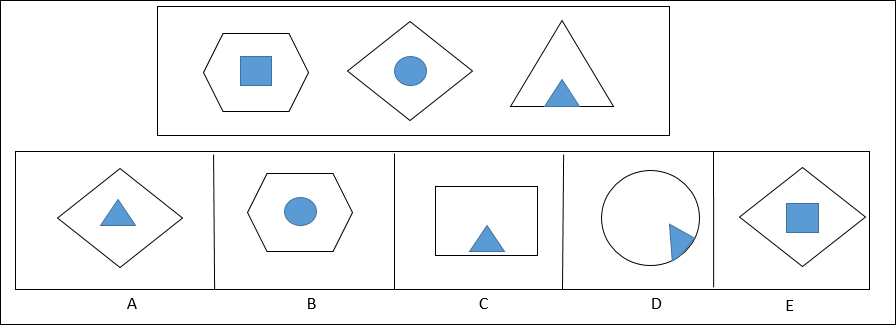
The correct answer is B
Explanation: The pattern in the given images has two types: the first two show a smaller blue shape centered inside the outer shape, and the third shows a blue shape touching the bottom edge. In option B, a blue circle is centered inside a hexagon, matching the centered containment pattern from the first image. The other options either place the blue shape at the bottom or use a different connection. So B is the correct match for the first pattern.
5.2 Non-Verbal Reasoning Question 2
Question 2:
Choose the answer that shares the same connection characteristic as the three given images.
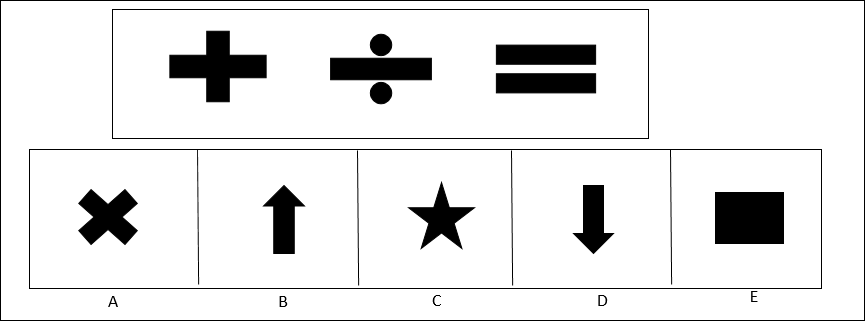
Explanation: The correct answer is A
The three shapes are all mathematical symbols. The first (on the left) is a plus symbol, the second (in the center) is a division symbol, and the third (on the right) is an equals symbol. The correct answer should be a mathematical symbol as well. Answer (A) is correct because it’s the only option that presents a mathematical symbol; in this case the times sign that is used for multiplication. Answers (B) – an arrow pointing upwards, (C) – a star, (D) – an arrow pointing downwards, and (E) – a square, are all symbols that are not mathematical. .
5.3 Non-Verbal Reasoning Question 3
Question 3:
Choose the answer that shares the same connection characteristic as the three given images.
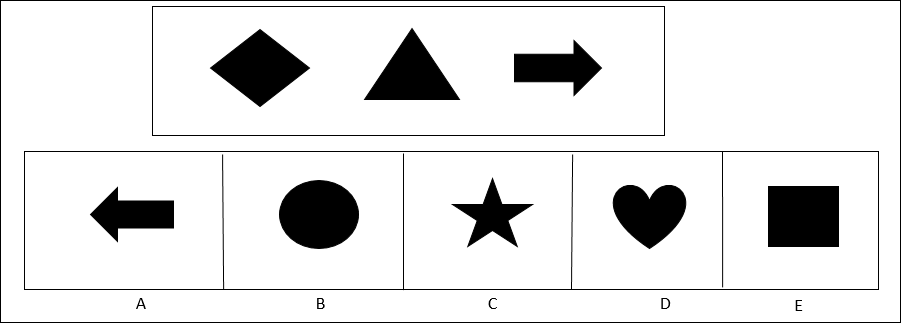
The correct answer is A
Explanation: The three given images – diamond, triangle, and right arrow – all share the characteristic of having straight edges and sharp, angular points. They are solid black shapes with defined vertices. Option A, the left arrow, matches this pattern because it also has straight edges, angular points, and is a directional arrow shape. The other options like circle, heart, and star have curves or smoother edges, so they don’t fit the same connection characteristic.
5.4 Non-Verbal Reasoning Question 4
Question 4:
Choose the answer that shares the same connection characteristic as the three given images.
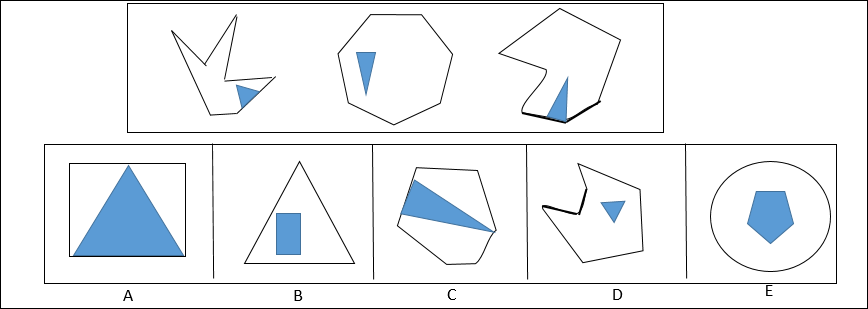
Explanation: The correct answer is D
Each of the figures in this question has seven sides and a triangle on the inside. Answer (D) is correct because it is the only answer that follows these rules. All of the other answer choices contain shapes with fewer than seven sides, and/or the inner shape is not a triangle.
5.5 Non-Verbal Reasoning Question 5
Question 5:
Choose the answer that shares the same connection characteristic as the three given images.
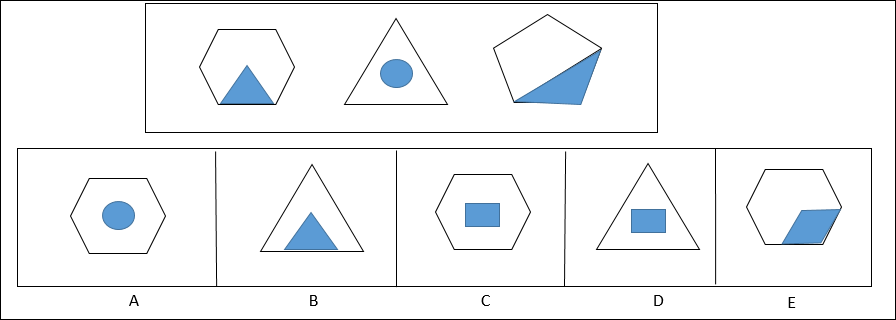
The correct answer is C
Explanation: The pattern is that in each given image, the inner blue shape shares one edge with the outer shape. Image 1: Triangle’s base lies on the hexagon’s bottom side. Image 2: Circle touches all three sides of the triangle. Image 3: Triangle’s side lies on the pentagon’s side. Only Option C has a rectangle inside the hexagon where the rectangle’s bottom edge matches the hexagon’s bottom edge, so it follows the same connection.
6. Quantitative Reasoning Sample Questions with Answers
Quantitative reasoning questions focus on number patterns and number logic. Students need to find the rule before choosing the answer.
Below are 5 CAT4 Level Y quantitative reasoning sample questions with answers and explanations.
6.1 Quantitative Reasoning Question 1
Question 1:
What number comes next?
3, 6, 9, 12, _______
A. 13
B. 14
C. 15
D. 16
Correct Answer: C. 15
Explanation: The numbers increase by 3 each time. After 12, the next number is 15.
6.2 Quantitative Reasoning Question 2
Question 2:
What number is missing?
4, 8, 12, _______ , 20
A. 14
B. 15
C. 16
D. 18
Correct Answer: C. 16
Explanation: The numbers go up by 4 each time. After 12, the missing number is 16.
6.3 Quantitative Reasoning Question 3
Question 3:
Which number is the odd one out?
5, 10, 15, 22, 20
A. 5
B. 10
C. 22
D. 20
Correct Answer: C. 22
Explanation: 5, 10, 15, and 20 are counting in 5s. 22 does not fit the pattern.
6.4 Quantitative Reasoning Question 4
Question 4:
What number comes next?
30, 27, 24, 21, _______
A. 20
B. 19
C. 18
D. 17
Correct Answer: C. 18
Explanation: The numbers decrease by 3 each time. After 21, the next number is 18.
6.5 Quantitative Reasoning Question 5
Question 5:
Complete the pattern.
2, 4, 8, 16, _______
A. 20
B. 24
C. 30
D. 32
Correct Answer: D. 32
Explanation: Each number is doubled. 2 doubled is 4, 4 doubled is 8, 8 doubled is 16, and 16 doubled is 32.
7. Spatial Reasoning Sample Questions with Answers
Spatial reasoning questions ask students to think about shape position, direction, rotation, and movement. These questions help build visualisation skills.
Below are 5 CAT4 Level Y spatial reasoning sample questions with answers and explanations.
7.1 Spatial Reasoning Question 1
Question 1:
Find out that answer figure in which the question figure is embedded.
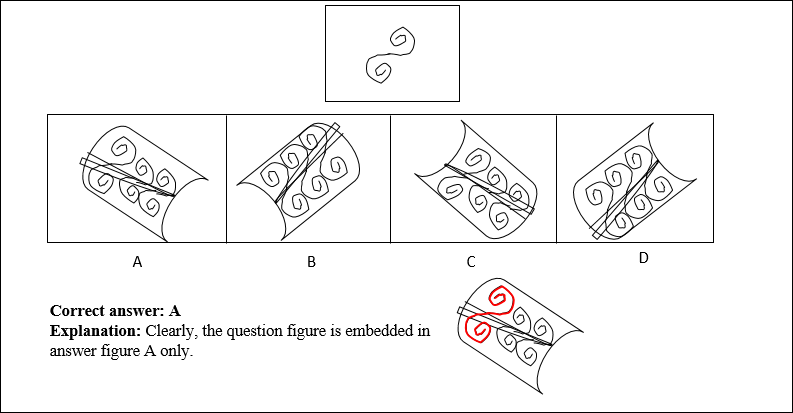
7.2 Spatial Reasoning Question 2
Question 2:
Find out that answer figure in which the question figure is embedded.
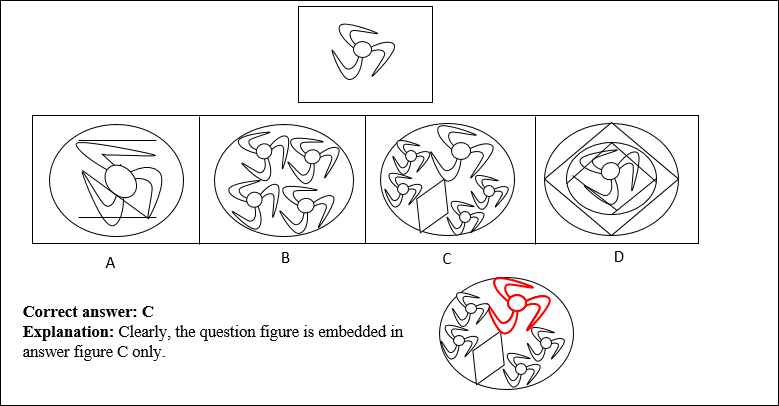
7.3 Spatial Reasoning Question 3
Question 3:
Find out that answer figure in which the question figure is embedded.
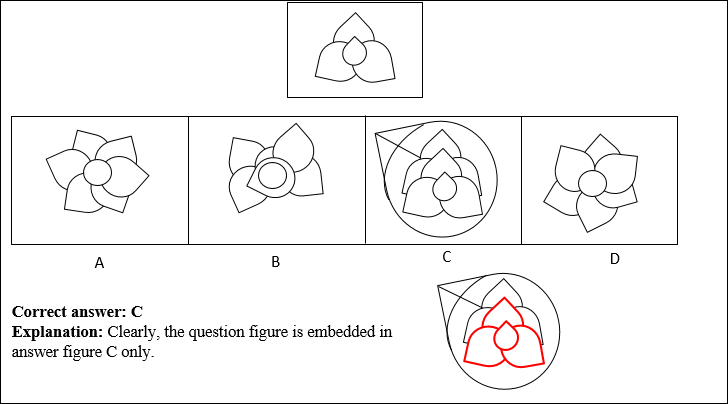
7.4 Spatial Reasoning Question 4
Question 4:
Find out that answer figure in which the question figure is embedded.
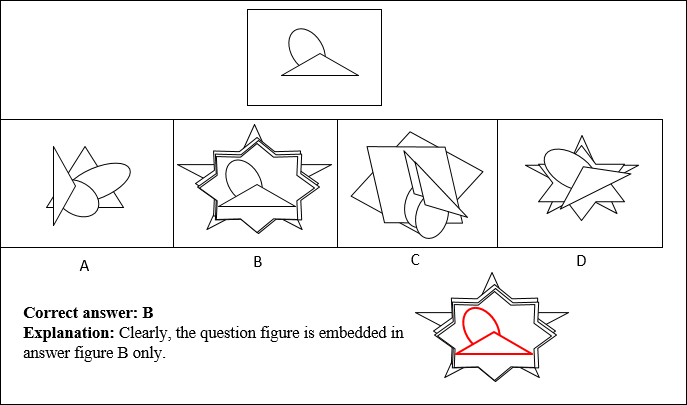
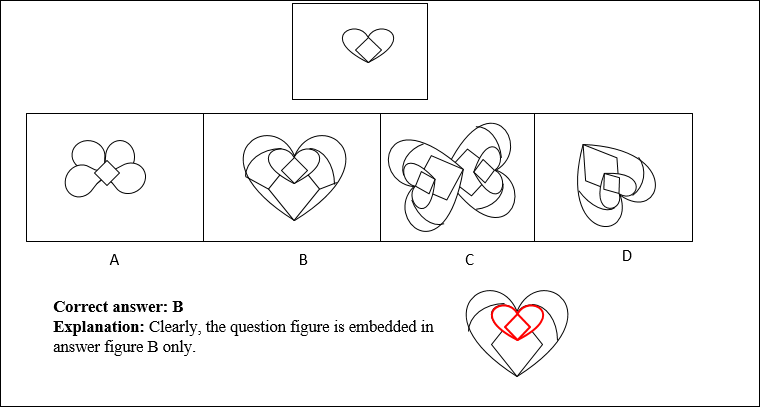
7.5 Spatial Reasoning Question 5
Question 5:
Find out that answer figure in which the question figure is embedded.
8. How to Review CAT4 Level Y Sample Questions
Sample questions are most useful when students review them properly. The aim is not just to check the answer. The aim is to understand the thinking behind the answer.
8.1 Ask Students to Explain Their Thinking
After each question, parents can ask:
- Why did you choose that answer?
- What pattern did you notice?
- Which options were wrong?
- What clue helped you?
- What changed in the pattern?
- How can you solve a similar question next time?
When students explain their thinking, they become more confident and careful.
8.2 Look for Repeated Mistakes
If a child keeps making the same kind of mistake, it usually shows an area that needs more practice.
For example:
- Word mistakes may mean verbal reasoning needs support.
- Shape mistakes may mean non-verbal reasoning needs practice.
- Number sequence mistakes may mean quantitative reasoning needs attention.
- Rotation mistakes may mean spatial reasoning needs more practice.
This helps parents target preparation more effectively.
8.3 Practise Similar Questions Again
If a child struggles with one category, repeat similar questions.
For example:
- More word relationship questions for verbal reasoning
- More pattern questions for non-verbal reasoning
- More number sequences for quantitative reasoning
- More rotation tasks for spatial reasoning
Targeted practice helps students improve more quickly.
9. How Mock Tests Support CAT4 Level Y Preparation
Sample questions help students learn individual skills. Mock tests help students practise the test-style experience.
Both are important.
9.1 Start with Mini Mock Tests
For Year 3 students, mini mock tests are usually better than long practice tests at the beginning.
A mini mock test may include:
- A few verbal reasoning questions
- A few non-verbal reasoning questions
- A few quantitative reasoning questions
- A few spatial reasoning questions
- A short review afterwards
This helps students build confidence slowly.
9.2 Review Mock Test Performance
After a mock test, parents should review:
- Which questions were correct
- Which questions were wrong
- Which category was strongest
- Which category needs more practice
- Whether the child rushed
- Whether timing caused stress
- Whether the child understood the question type
This makes mock tests more useful than simply checking a score.
9.3 Use Mock Tests to Build Confidence
Mock tests should not create fear. They should help students feel familiar with the format.
Parents can say:
“This is just practice. It helps us learn what to improve.”
This keeps preparation positive and confidence-focused.
10. Best CAT4 Level Y Preparation Tips
CAT4 Level Y preparation should be calm, consistent, and balanced. Students need practice across all reasoning areas.
10.1 Keep Practice Short and Regular
Short practice sessions are usually best for Year 3 students.
A good session may include:
- 10 to 20 minutes of practice
- One reasoning area
- A few carefully chosen questions
- Clear explanations
- Gentle mistake review
- Positive feedback
Short, regular practice is better than long, stressful sessions.
10.2 Practise All Four Reasoning Areas
Students should practise:
- Verbal reasoning
- Non-verbal reasoning
- Quantitative reasoning
- Spatial reasoning
Balanced practice helps children feel ready for different question types.
10.3 Review Answers with Explanations
Explanations help students understand the method.
A good explanation shows:
- What the rule was
- Why the correct answer fits
- Why the other answers do not fit
- What clue to look for next time
This builds real reasoning ability.
11. Common Mistakes to Avoid
Many students make similar mistakes when practising CAT4 Level Y questions. These mistakes are normal and can improve with practice.
11.1 Rushing Through Questions
Students may rush because they want to finish quickly. This can lead to careless errors.
Encourage children to:
- Slow down
- Look carefully
- Find the rule
- Check all options
- Choose calmly
Accuracy should come before speed.
11.2 Guessing Without Finding the Rule
Some students guess before understanding the question.
Teach them to ask:
- What is the pattern?
- What is changing?
- What stays the same?
- Which answer fits best?
This improves logical thinking.
11.3 Ignoring Mistake Review
Answer checking is not enough. Students need to understand why an answer was wrong.
Mistake review helps students avoid repeating the same errors.
12. Final Thoughts
CAT4 Level Y sample questions with answers are a helpful way to prepare Year 3 students for reasoning-style assessments. They allow children to practise different question types, understand answer explanations, and build confidence before attempting mock tests or longer practice sessions.
This blog included sample questions for the four main CAT4 Level Y reasoning areas: Verbal Reasoning, Non-Verbal Reasoning, Quantitative Reasoning, and Spatial Reasoning. Each question included a correct answer and a simple explanation to support learning.
The best preparation is not about pressure or memorisation. It is about understanding the method, practising regularly, reviewing mistakes, and building confidence step by step.
With clear explanations, balanced practice, and supportive parent guidance, Year 3 students can approach CAT4 Level Y questions with stronger reasoning skills and greater confidence.