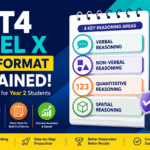


CAT4 Level B can feel very different from ordinary Year 5 school tests. Many students are used to answering questions based on topics they have already learned in class, but CAT4 focuses more on reasoning skills. It asks students to think carefully, recognise patterns, compare information, solve problems, and stay calm when questions feel unfamiliar.
Because of this, mistakes in CAT4 Level B preparation are common. A student may understand Maths but still struggle with number series. A confident reader may still find verbal analogies tricky. A child who enjoys puzzles may still miss small details in figure matrices or spatial reasoning questions.
The good news is that most CAT4 Level B mistakes can be improved with the right preparation. Practice questions, mock tests, clear explanations, mistake review, and positive parent support can help Year 5 students build stronger reasoning skills and greater confidence.
1. Why CAT4 Level B Mistakes Matter
Mistakes are not just wrong answers. They are useful clues that show what a student needs to practise next.
When parents understand why a mistake happened, CAT4 preparation becomes more focused and effective. Instead of giving students random practice questions, parents can target the exact reasoning area that needs support.
Common CAT4 Level B mistakes may show that a student is:
- Rushing through questions
- Guessing before finding the rule
- Missing small visual details
- Struggling with word relationships
- Confused by number patterns
- Avoiding spatial reasoning tasks
- Taking mock tests too early
- Not reviewing wrong answers properly
Mistakes should not be treated as failure. They should be used as a guide for improvement.
1.1 Mistakes Help Identify Weak Reasoning Areas
CAT4 Level B includes different reasoning areas, and each one needs a different skill.
For example:
- Verbal reasoning mistakes may show that vocabulary or word relationships need practice.
- Non-verbal reasoning mistakes may show that figure patterns need more attention.
- Quantitative reasoning mistakes may show that number logic needs strengthening.
- Spatial reasoning mistakes may show that rotation, folding, or visualisation needs support.
This makes preparation more targeted.
1.2 Mistakes Should Be Reviewed Calmly
Students learn better when mistakes are reviewed in a calm and positive way.
Parents can ask:
- What did you notice first?
- What was the rule?
- Which clue did you miss?
- Which answer looked close?
- Why is the correct answer better?
- How can we solve a similar question next time?
This helps students learn the method instead of feeling discouraged.
2. Mistake 1: Treating CAT4 Level B Like a Normal School Test
One of the most common CAT4 Level B mistakes is thinking the test is just like a normal school assessment.
A normal school test often checks what a student has learned in lessons. CAT4 is different because it focuses on reasoning ability and problem-solving.
Students may need to answer questions involving:
- Word relationships
- Number series
- Figure matrices
- Shape classification
- Spatial rotation
- Visual pattern recognition
- Multiple-choice reasoning
- Logical rule finding
This means normal revision alone may not be enough.
2.1 Why This Mistake Happens
Parents and students may focus only on school Maths and English worksheets. While schoolwork is important, CAT4-style questions require a different type of thinking.
A student may be strong in classroom learning but still need practice with:
- Verbal classification
- Verbal analogies
- Number analogies
- Number series
- Figure classification
- Figure matrices
- Figure analysis
- Figure recognition
These question styles require strategy and familiarity.
2.2 How to Avoid This Mistake
Use CAT4-style practice questions that focus on reasoning skills.
A balanced preparation routine should include:
- Verbal reasoning practice
- Non-verbal reasoning practice
- Quantitative reasoning practice
- Spatial reasoning practice
- Mixed question practice
- Mini mock tests
- Careful explanation review
The aim is not to memorise answers. The aim is to understand how to solve unfamiliar problems.
3. Mistake 2: Starting Preparation Too Late
Another common mistake is beginning CAT4 Level B preparation too close to the test date. Late preparation often creates pressure and makes students feel rushed.
Year 5 students need time to understand the format, practise different question types, and build confidence gradually.
3.1 Why Late Preparation Can Cause Stress
Late preparation can lead to:
- Long practice sessions
- Too many new question types at once
- Less time for mistake review
- Weak confidence
- More guessing
- More careless errors
- Less mock test experience
Students may feel overwhelmed if they are expected to learn everything quickly.
3.2 How to Avoid This Mistake
Start preparation early and keep it manageable.
A good routine may include:
- Short practice sessions several times a week
- One reasoning area at a time
- Regular review of mistakes
- Gradual mixed practice
- Mini mock tests when ready
- Positive encouragement after each session
Small, regular practice is usually more effective than last-minute pressure.
4. Mistake 3: Practising Too Many Question Types at Once
CAT4 Level B includes several reasoning question types. Practising all of them at once can confuse students, especially if they are new to the format.
Students need to understand each question type before moving into mixed practice.
4.1 Why This Mistake Affects Confidence
When students practise too many styles at once, they may not know what each question is asking.
They may struggle to decide whether they need to:
- Find a word category
- Complete an analogy
- Spot a figure pattern
- Solve a number rule
- Recognise a rotated shape
- Analyse a matrix
- Find a missing figure
This can lead to guessing and frustration.
4.2 How to Avoid This Mistake
Start with one skill at a time.
For example:
- Practise verbal classification first.
- Then move to verbal analogies.
- Then practise number series.
- Then add figure matrices.
- Then include spatial reasoning tasks.
Once the student understands each type, mixed practice becomes much more useful.
5. Mistake 4: Rushing Through Questions
Rushing is one of the biggest causes of wrong answers in CAT4 Level B. Some students choose the first option that looks correct without checking the full pattern.
In CAT4 questions, small details matter. The first answer that looks right is not always the best answer.
5.1 Why Students Rush
Students may rush because they:
- Want to finish quickly
- Feel nervous
- Think the question looks easy
- Worry about time
- Do not check every option
- Guess before thinking fully
Rushing can cause avoidable mistakes, especially in visual and number reasoning questions.
5.2 How to Avoid This Mistake
Teach students a simple checking routine:
- Read or look at the question carefully.
- Find the rule or relationship.
- Check every answer option.
- Remove clearly wrong options.
- Choose the best answer.
- Check once before moving on.
At the beginning of preparation, accuracy should come before speed. Speed can improve later through practice and mock tests.
6. Mistake 5: Guessing Without Finding the Rule
Many CAT4 Level B questions are built around a hidden rule. Students often make mistakes when they guess before finding that rule.
Guessing may sometimes be necessary if time is almost finished, but it should not be the first strategy.
6.1 Why Guessing Causes Repeated Errors
If a student guesses, they may not learn the method behind the question. This means they may repeat the same mistake later.
Guessing can affect:
- Verbal analogies
- Figure matrices
- Number series
- Number analogies
- Figure recognition
- Spatial reasoning tasks
Students need to learn how to search for the relationship first.
6.2 How to Avoid This Mistake
Before answering, students should ask:
- What is the rule?
- What is changing?
- What stays the same?
- Which option follows the same pattern?
- Which answers clearly do not fit?
- Can I explain why my answer is correct?
This helps students reason carefully instead of guessing quickly.
7. Mistake 6: Missing Small Visual Details
Non-verbal and spatial reasoning questions often depend on small visual details. A student may choose the wrong answer because they miss one change in direction, shading, position, or shape.
This is very common in CAT4 Level B preparation.
7.1 Visual Details Students Often Miss
Students may miss changes in:
- Shape
- Size
- Direction
- Position
- Number of parts
- Shading
- Rotation
- Symmetry
- Order
- Pattern repetition
Two answer choices may look similar, but only one follows the rule correctly.
7.2 How to Avoid This Mistake
Students should slow down and compare carefully.
Helpful checking questions include:
- Has the shape turned?
- Has the size changed?
- Has the position moved?
- Is one part missing?
- Is the shading different?
- Are there more or fewer shapes?
- Does the answer fit the whole pattern?
Careful observation is one of the most important CAT4 Level B skills.
8. Mistake 7: Weak Verbal Classification Strategy
Verbal classification questions ask students to understand how words belong together. Some students pick an answer because it sounds familiar, not because it fits the group.
This can lead to incorrect answers.
8.1 Why Verbal Classification Can Be Tricky
Students may struggle because words can be linked in different ways.
A group of words may be connected by:
- Category
- Function
- Meaning
- Type
- Use
- Location
- Relationship
- Opposite meaning
For example, “oak, pine, maple” are all trees. A correct answer must belong to the same category.
8.2 How to Avoid This Mistake
Teach students to ask:
- What do these words have in common?
- What category do they belong to?
- Does the answer fit the same category?
- Is there a word that only looks connected but is not?
- Can I explain the link clearly?
Students should practise grouping words and explaining why they belong together.
9. Mistake 8: Struggling with Verbal Analogies
Verbal analogies can be difficult because students need to understand the relationship between words and apply the same relationship to another pair.
A student may know the meaning of each word but still miss the relationship.
9.1 Common Verbal Analogy Problems
Students may struggle with relationships such as:
- Young animal to adult animal
- Object to use
- Person to workplace
- Part to whole
- Opposite meanings
- Similar meanings
- Creator to creation
- Tool to action
For example, “author is to book” works like “painter is to painting.” The relationship is creator to creation.
9.2 How to Avoid This Mistake
Students should ask:
- How are the first two words connected?
- Can I describe the relationship in my own words?
- Which answer creates the same relationship?
- Are any options close but not exact?
- Does the answer make logical sense?
Parents can support this skill through reading, vocabulary discussion, and simple analogy practice.
10. Mistake 9: Weak Number Series Strategy
Number series questions can be challenging because students need to find the pattern between numbers. Some students try one operation and stop too soon.
Quantitative reasoning is not just about calculation. It is about number logic.
10.1 Why Number Series Questions Cause Mistakes
Students may not know whether the numbers are:
- Increasing
- Decreasing
- Doubling
- Halving
- Adding the same number
- Subtracting the same number
- Changing by different amounts
- Following an alternating rule
This can make number questions feel confusing.
10.2 How to Avoid This Mistake
Students should ask:
“What is happening to the numbers?”
Then they should check:
- Are the numbers going up or down?
- What is the difference between each number?
- Is the difference the same each time?
- Is the pattern multiplying or dividing?
- Does the answer fit the whole sequence?
- Can I explain the rule clearly?
For example, in 6, 12, 18, 24, the rule is adding 6 each time.
11. Mistake 10: Not Understanding Number Analogies
Number analogies ask students to find a relationship in one pair or group of numbers and apply the same rule to another pair or group.
Some students treat them like ordinary calculations and miss the relationship.
11.1 Why Number Analogies Feel Difficult
Students may struggle because they need to compare two number relationships, not just solve one calculation.
They may need to identify whether the rule involves:
- Adding
- Subtracting
- Multiplying
- Dividing
- Doubling
- Halving
- Adding after multiplying
- Subtracting after multiplying
This requires flexible thinking.
11.2 How to Avoid This Mistake
Students should ask:
- What happens to the first number?
- Which operation is being used?
- Does the same rule work on the second number?
- Which answer follows the same relationship?
- Can I check the rule both ways?
Number analogy practice helps students become more confident with logical Maths thinking.
12. Mistake 11: Avoiding Figure Matrices
Figure matrices can look complicated because students need to compare shapes across rows and columns. Some students avoid them because they feel too visual or too detailed.
Avoiding them can create a major weakness in CAT4 Level B preparation.
12.1 Why Figure Matrices Are Challenging
Figure matrices may involve several changes at once, such as:
- Shape changing
- Direction changing
- Shading changing
- Position changing
- Number of parts changing
- Rotation
- Repetition
- Row and column rules
Students need to analyse the full pattern, not only one part.
12.2 How to Avoid This Mistake
Students should use a step-by-step method:
- Look across the row.
- Look down the column.
- Identify what changes.
- Identify what stays the same.
- Compare the answer options.
- Remove options that break the rule.
- Choose the option that completes both directions.
Regular figure matrix practice helps students build visual confidence.
13. Mistake 12: Struggling with Figure Analysis and Recognition
Spatial reasoning tasks can feel difficult because students need to imagine how shapes move, rotate, fold, or fit together.
Some students choose an answer that looks similar but does not match the full shape.
13.1 Common Spatial Reasoning Problems
Students may struggle to:
- Recognise rotated shapes
- Match figures from different angles
- Visualise folded shapes
- Identify hidden shapes
- Understand shape movement
- Track position changes
- Compare complex diagrams
This can make spatial reasoning feel harder than other areas.
13.2 How to Avoid This Mistake
Students can improve spatial reasoning through hands-on practice.
Useful activities include:
- Jigsaw puzzles
- Building blocks
- Paper folding
- Shape matching
- Drawing patterns
- Rotating objects
- Completing grid designs
- Matching turned figures
Parents can ask:
“Has the shape turned, flipped, folded, or moved?”
This helps students visualise changes more clearly.
14. Mistake 13: Ignoring Mistake Review
Some students complete practice questions, check the correct answers, and move on. This is a major mistake because real improvement happens during review.
Answer checking is not enough. Students need to understand why the answer is correct.
14.1 Why Review Matters
Mistake review helps students understand:
- What clue they missed
- What rule they should have used
- Why the correct answer fits
- Why the chosen answer was wrong
- How to solve similar questions next time
Without review, students may repeat the same errors.
14.2 How to Avoid This Mistake
After every practice session, review mistakes calmly.
Ask:
- What was the question asking?
- What rule did we miss?
- Which option was close but wrong?
- Why is the correct answer better?
- What should we look for next time?
This turns every mistake into a useful learning step.
15. Mistake 14: Taking Full Mock Tests Too Early
Mock tests are useful, but they should be introduced at the right time. Some students take full mock tests before they understand the question types.
This can reduce confidence and create unnecessary stress.
15.1 Why Early Mock Tests Can Be Unhelpful
A full mock test may feel overwhelming if students have not built the basic skills first.
It can lead to:
- Guessing
- Rushing
- Low confidence
- Frustration
- Poor focus
- Fear of practice
- Negative feelings about CAT4
Mock tests should build confidence, not fear.
15.2 How to Avoid This Mistake
Use this order:
- Learn the test format.
- Practise one reasoning area at a time.
- Review mistakes.
- Try mixed question sets.
- Start mini mock tests.
- Move to longer mock tests later.
This gives students a stronger foundation before timed practice.
16. Mistake 15: Focusing Only on Mock Test Scores
Some parents and students focus only on mock test scores. While scores can be useful, they do not show the full picture.
The review after a mock test is more important than the number alone.
16.1 What Parents Should Look For
After a mock test, parents should review:
- Which section was strongest
- Which section was weakest
- Whether the student rushed
- Whether timing was difficult
- Which question types caused confusion
- Whether mistakes were careless
- Whether confidence improved
This information is more useful than just checking the final score.
16.2 How to Use Mock Test Results
Mock test results should guide the next practice step.
For example:
- More verbal analogies if word relationships are weak
- More number series if quantitative reasoning is weak
- More figure matrices if non-verbal reasoning is weak
- More rotation tasks if spatial reasoning is weak
Mock tests should help students practise smarter.
17. Mistake 16: Practising for Too Long
Long practice sessions can make Year 5 students tired, frustrated, and less focused. More time does not always mean better preparation.
Short, focused practice is usually more effective.
17.1 Why Long Sessions Reduce Focus
Long sessions may cause students to:
- Lose concentration
- Rush answers
- Make careless mistakes
- Feel bored
- Become stressed
- Avoid difficult questions
- Stop enjoying practice
This can reduce confidence and progress.
17.2 How to Avoid This Mistake
Use shorter sessions with clear goals.
A strong practice session may include:
- One reasoning skill
- A small number of questions
- Clear explanations
- Mistake review
- Positive feedback
- A short break afterwards
Quality matters more than quantity.
18. Mistake 17: Practising Only Favourite Question Types
Some students practise only the question types they enjoy. This feels comfortable, but it can leave gaps in preparation.
CAT4 Level B requires balanced reasoning practice.
18.1 Why Balanced Practice Matters
Students should practise:
- Verbal reasoning
- Non-verbal reasoning
- Quantitative reasoning
- Spatial reasoning
A student may be strong in one area and weaker in another. Ignoring weaker areas can affect confidence and overall readiness.
18.2 How to Avoid This Mistake
Create a balanced weekly routine.
Include:
- One session for verbal reasoning
- One session for non-verbal reasoning
- One session for quantitative reasoning
- One session for spatial reasoning
- One mixed practice session
- One mistake review session
- Mini mock test practice when ready
This keeps preparation complete and organised.
19. Mistake 18: Putting Too Much Pressure on the Student
Pressure can make students anxious, which may lead to rushing, guessing, or avoiding difficult questions. CAT4 preparation should feel supportive, not stressful.
A calm student is more likely to think clearly.
19.1 How Pressure Affects Performance
Too much pressure may cause:
- Test anxiety
- Poor concentration
- Fear of mistakes
- Low motivation
- Rushed answers
- Negative feelings about practice
- Reduced confidence
Students perform better when they feel supported and capable.
19.2 How to Avoid This Mistake
Parents should use positive language.
Helpful phrases include:
- “You are learning the method.”
- “Mistakes help us improve.”
- “You spotted that pattern well.”
- “Let’s try another one together.”
- “You are getting more confident.”
- “Take your time and think carefully.”
Confidence grows through encouragement and steady progress.
20. How Parents Can Turn CAT4 Level B Mistakes into Progress
The best CAT4 preparation does not try to avoid mistakes completely. It uses mistakes wisely.
Mistakes show what students should practise next.
20.1 Keep Track of Repeated Mistakes
Parents can notice repeated mistake types, such as:
- Rushing mistakes
- Word relationship mistakes
- Number pattern mistakes
- Figure matrix mistakes
- Rotation mistakes
- Timing mistakes
- Guessing mistakes
This makes preparation more focused.
20.2 Practise Similar Questions Again
If a student struggles with one question type, repeat similar questions.
For example:
- More verbal analogies for word relationship mistakes
- More number series for sequence mistakes
- More figure classification for visual comparison mistakes
- More spatial puzzles for rotation mistakes
Targeted practice helps students improve faster.
20.3 Celebrate Improvement
Parents should celebrate small progress.
Praise when the student:
- Explains an answer clearly
- Spots a pattern correctly
- Makes fewer careless mistakes
- Stays calm during practice
- Improves a weak area
- Completes a mini mock test confidently
Small wins build motivation and confidence.
21. Final Thoughts
Common CAT4 Level B mistakes are normal, especially for Year 5 students who are still learning how to approach reasoning-style questions. Most mistakes happen because students rush, guess too early, miss small details, struggle with word or number relationships, avoid difficult question types, or fail to review wrong answers properly.
The best way to avoid these mistakes is through calm, focused, and balanced preparation. Students should practise verbal reasoning, non-verbal reasoning, quantitative reasoning, and spatial reasoning step by step. Parents should use practice questions, review mistakes, introduce mock tests gradually, and build confidence with positive encouragement.
CAT4 Level B preparation is not about pressure or perfection. It is about helping students think more carefully, solve problems more confidently, and become familiar with the test format.
With regular practice and the right support, Year 5 students can reduce common mistakes, improve reasoning skills, and approach CAT4 Level B with greater confidence.