
CAT4 Level C can feel very different from an ordinary Year 6 school assessment. Instead of mainly checking recently taught Maths or English content, it asks students to recognise patterns, understand relationships, compare information, apply logical rules, and solve unfamiliar problems.
Even academically confident students can make avoidable CAT4 mistakes when they are unfamiliar with the question formats. A strong reader may misunderstand a verbal analogy. A capable Maths student may apply the wrong number rule. A student who enjoys puzzles may still overlook a small rotation or shading change in a figure matrix.
CAT4 Level C is commonly associated with Year 6, and effective preparation should include regular reasoning practice, careful explanation review, mini tests, and mock tests introduced at the right stage.
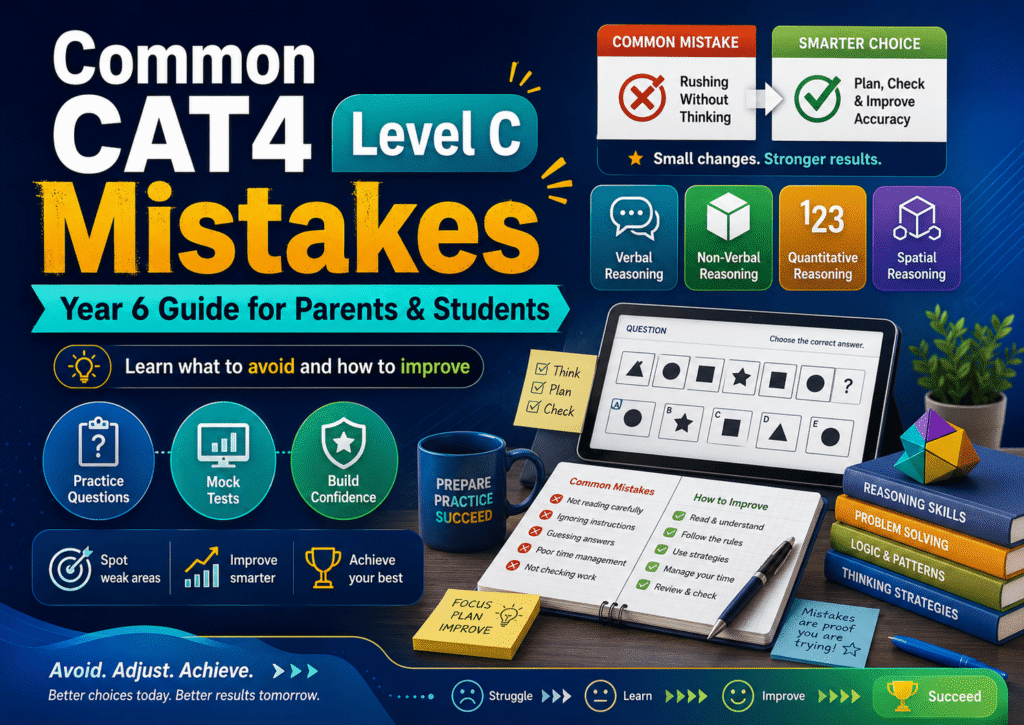
This guide explains the most common CAT4 Level C mistakes and shows parents and students how to avoid them. It focuses on verbal, non-verbal, quantitative, and spatial reasoning, alongside practice questions, mock tests, time management, mistake review, and student confidence.
1. Why Students Make Mistakes in CAT4 Level C
CAT4 Level C mistakes do not automatically mean that a Year 6 student lacks ability. Many errors happen because the assessment asks students to think in a way that may be different from their everyday classroom work.
Students may understand the individual words, numbers, or shapes in a question but still miss the relationship connecting them. They may also feel pressure to answer quickly, particularly when several options appear similar.
1.1 Unfamiliar Questions Can Affect Performance
CAT4-style questions may ask students to:
- Identify a hidden relationship
- Complete a visual pattern
- Apply a number rule
- Recognise a rotated figure
- Find the odd word or shape
- Compare multiple answer options
- Work accurately under time pressure
A student seeing these formats for the first time may spend too long understanding what to do. Familiarity with the question style can reduce this uncertainty.
1.2 Small Errors Can Hide Strong Reasoning Skills
A wrong answer may result from:
- Misreading one instruction
- Missing a small visual feature
- Applying the correct rule in the wrong direction
- Performing a calculation inaccurately
- Choosing an answer before checking every option
- Feeling nervous under timed conditions
Parents should look at why an error happened, not only whether the answer was right or wrong.
1.3 Mistakes Should Guide Future Practice
Each repeated error provides useful information.
For example:
- Word relationship errors suggest more verbal reasoning practice.
- Shape pattern errors suggest more non-verbal reasoning practice.
- Number sequence errors suggest more quantitative reasoning practice.
- Rotation and folding errors suggest more spatial reasoning practice.
- Careless mistakes suggest a need for stronger checking habits.
- Unfinished sections suggest that time management needs attention.
A productive CAT4 preparation plan turns these observations into focused next steps.
2. Mistake 1: Treating CAT4 Like a Normal School Test
One of the most common CAT4 Level C mistakes is preparing for it in exactly the same way as a classroom test.
Traditional revision may involve rereading notes, memorising facts, or practising recently taught calculations. These activities support general learning, but they do not fully prepare students for unfamiliar reasoning questions.
2.1 Why Ordinary Revision Is Not Enough
A school test may ask a student to recall a method they were taught. A CAT4-style question may instead present an unfamiliar arrangement of words, numbers, or figures and ask the student to work out the underlying rule.
Students need to practise how to:
- Identify relationships
- Test possible rules
- Compare options
- Eliminate incorrect choices
- Explain why one answer fits better than another
These are reasoning habits rather than memorised facts.
2.2 How to Avoid This Mistake
Preparation should include four balanced reasoning areas:
- Verbal reasoning
- Non-verbal reasoning
- Quantitative reasoning
- Spatial reasoning
Students should also become familiar with common question styles such as:
- Verbal Classification
- Verbal Analogies
- Figure Classification
- Figure Matrices
- Number Analogies
- Number Series
- Figure Analysis
- Figure Recognition
The goal is not to memorise practice answers. It is to recognise the method needed for a new question.
3. Mistake 2: Beginning Preparation Too Late
Last-minute preparation is another common mistake. Students may attempt to learn every question type within a few days, leading to rushed practice and unnecessary pressure.
CAT4 reasoning skills develop more effectively through shorter, regular sessions.
3.1 Problems Caused by Late Preparation
Starting too late can result in:
- Long and tiring practice sessions
- Too many question types introduced at once
- Limited time to correct misunderstandings
- Poor mistake review
- Low confidence
- Excessive mock testing
- Greater anxiety before the assessment
Students may appear to be doing a lot of work without fully understanding the methods.
3.2 Use a Gradual Preparation Sequence
A more effective sequence is:
- Understand the overall format.
- Learn one question type at a time.
- Complete untimed practice.
- Review answers and explanations.
- Repeat weak question types.
- Introduce mixed reasoning sets.
- Begin short timed exercises.
- Attempt mini mock tests.
- Move to full mock tests when ready.
This progression builds understanding before placing students under time pressure.
3.3 Keep Practice Consistent
Students generally benefit more from several focused sessions than from one long weekly session.
A useful session may include:
- A brief strategy reminder
- A small group of related questions
- Independent answering time
- Careful answer review
- One repeated question based on an error
- Positive feedback at the end
Consistency helps students retain strategies and recognise patterns more quickly.
4. Mistake 3: Practising Every Question Type at Once
Mixed practice is useful later in preparation, but it can be confusing at the beginning. If students switch constantly between analogies, matrices, sequences, and spatial tasks before understanding each format, they may not develop a reliable strategy for any of them.
4.1 Why Topic-by-Topic Practice Matters
Each CAT4 Level C question type requires a different approach.
For example:
- Verbal Classification requires category recognition.
- Verbal Analogies require relationship matching.
- Figure Matrices require row-and-column analysis.
- Number Series require sequence-rule identification.
- Figure Recognition requires visual tracking.
Students need time to understand these differences.
4.2 Build One Skill Before Mixing Questions
A student should first learn:
- What the question is asking
- What features to examine
- Which strategy to use
- How to check the answer
- What common traps to avoid
Once the student can explain the method confidently, mixed practice becomes more valuable.
4.3 Introduce Mixed Sets Gradually
Begin with two related question types, such as Verbal Classification and Verbal Analogies. Later, combine questions from all four reasoning areas.
This helps students practise switching strategies without becoming overwhelmed.
5. Mistake 4: Misreading Instructions
Some students begin solving before fully understanding the instruction. They may find a word that belongs in the group when the question asks for the word that does not belong, or select the next figure when the task asks for the missing figure in the middle.
5.1 Common Instruction Errors
Students may overlook words such as:
- Same
- Different
- Next
- Missing
- Opposite
- Most similar
- Does not belong
- Completes the pattern
One missed word can completely change the task.
5.2 Use a Pause-and-Identify Routine
Before answering, students should pause and identify:
- What information is given
- What they need to find
- Whether they are looking for a match or an exception
- Whether the answer must follow a sequence or relationship
- Whether the question uses words, numbers, or visual information
This brief pause can prevent many avoidable mistakes.
5.3 Restate the Question
During preparation, ask students to explain the instruction in their own words.
For example:
“I need to find the word that does not fit the category.”
This shows that the student understands the task before attempting it.
6. Mistake 5: Rushing to Choose the First Plausible Answer
Multiple-choice questions often include distractors that appear reasonable at first. Students who rush may select an option that matches one part of the pattern but not the complete rule.
6.1 Why the First Answer Can Be Misleading
An option may:
- Use the correct shape but the wrong shading
- Follow the first number step but not the complete sequence
- Have a related meaning but not the same relationship
- Show the correct rotation but also include a reflection
- Fit one matrix row but not the column
The best answer must satisfy the full rule.
6.2 Check Every Option
Students should not stop when they find one answer that looks possible.
They should:
- Examine all choices.
- Eliminate those that clearly fail.
- Compare the remaining options.
- Test each option against the complete rule.
- Select the strongest match.
This improves both accuracy and reasoning discipline.
6.3 Accuracy Before Speed
Early CAT4 preparation should prioritise correct thinking. Speed can be added gradually after students have developed reliable strategies.
Rushing an unfamiliar method only reinforces mistakes.
7. Mistake 6: Guessing Without Identifying the Rule
Reasoning questions are built around relationships and patterns. Guessing without finding the rule may occasionally produce a correct answer, but it does not build transferable skill.
7.1 Questions Students Should Ask
Before choosing an answer, students should ask:
- What is changing?
- What stays the same?
- Is there a repeated pattern?
- Does the rule work in every part?
- Which options can I eliminate?
- Can I explain my choice?
If a student cannot explain the rule, they may need to examine the question again.
7.2 Use Elimination When the Full Rule Is Unclear
Sometimes a student may not immediately identify the complete rule. Elimination can still improve the chance of selecting the correct answer.
Remove options that contain:
- The wrong number of parts
- An impossible number result
- An unrelated word
- The wrong direction
- Incorrect shading
- A shape not present in the pattern
The remaining choices are easier to compare.
7.3 Do Not Depend on Random Guessing During Practice
Practice sessions should be used to develop methods. If students guess, parents should still review the question and identify the rule afterwards.
The learning occurs during the explanation.
8. Mistake 7: Weak Verbal Classification Strategy
Verbal Classification questions require students to recognise a common category or connection between words. A student may choose a word simply because it is associated with one of the given words rather than belonging to the entire group.
8.1 Confusing Association with Classification
Consider the words:
Violin, trumpet, flute
The category is musical instruments. A word such as “concert” is associated with them but is not another instrument.
Students need to find an option that belongs to the same exact category.
8.2 Use the Common-Link Method
Students should:
- Read every given word.
- Identify what all the words share.
- State the category clearly.
- Test each option against that category.
- Reject words that are only loosely associated.
The connection must work for the complete group.
8.3 Build Vocabulary Through Categories
Useful vocabulary activities include grouping words by:
- Meaning
- Function
- Location
- Material
- Occupation
- Animal type
- Scientific category
- Object type
Ask students to explain the category rather than only naming the answer.
9. Mistake 8: Misunderstanding Verbal Analogies
Verbal Analogies test relationships between words. Students sometimes focus on the meanings of individual words without identifying how the first pair is connected.
9.1 Common Analogy Relationships
Relationships may include:
- Young animal to adult animal
- Worker to workplace
- Tool to function
- Part to whole
- Creator to creation
- Object to material
- Cause to effect
- Degree of meaning
- Opposites
- Similar meanings
The second pair must repeat the same relationship.
9.2 Describe the Relationship in a Sentence
For example:
Author is to novel as composer is to symphony.
The relationship can be described as:
“An author creates a novel, and a composer creates a symphony.”
Turning the relationship into a sentence helps prevent vague matching.
9.3 Avoid Reversing the Relationship
Order matters.
“Bird is to nest” is not the same relationship as “nest is to bird.” One moves from animal to home, while the other moves from home to animal.
Students should check that the direction of the second pair matches the first.
10. Mistake 9: Relying on Vocabulary Alone
A wide vocabulary supports verbal reasoning, but knowing word meanings is not enough. Students must also compare, classify, and connect words logically.
10.1 Why Vocabulary and Reasoning Are Different
A student may know that two words are related but still misunderstand the exact relationship.
For example, “doctor” and “medicine” are connected, but that does not automatically mean they form the same relationship as “teacher” and “school.”
Students need precise reasoning, not just general association.
10.2 Strengthen Vocabulary in Context
Parents can ask:
- What does this word mean?
- What is a synonym?
- What is an antonym?
- What category does it belong to?
- How would you use it in a sentence?
- How is it connected to the other word?
These questions deepen understanding.
10.3 Encourage Reading Across Different Topics
A varied reading routine exposes students to vocabulary from:
- Fiction
- History
- Science
- Geography
- Biography
- News-style texts
- Instructions and explanations
Students should discuss unfamiliar words rather than simply skip them.
11. Mistake 10: Looking at Only One Feature in Figure Classification
Figure Classification questions may involve several characteristics at once. Students often focus on shape while ignoring shading, direction, position, or number of elements.
11.1 Features to Check
Students should compare:
- Shape type
- Number of shapes
- Size
- Direction
- Position
- Shading
- Border style
- Rotation
- Symmetry
- Internal markings
The correct group may share more than one feature.
11.2 Compare All Figures Before Deciding
Students should not decide the rule after looking at only two figures. The proposed rule must apply to every figure in the group.
For example, three figures may all:
- Contain two shapes
- Have one shaded part
- Show the smaller shape inside the larger one
An answer must satisfy the complete combination.
11.3 Explain the Group Rule
Ask the student to say:
“All the figures have two shapes, and the inner shape is shaded.”
A clear explanation confirms that the classification is precise.
12. Mistake 11: Solving Figure Matrices in Only One Direction
Figure Matrices often contain relationships across both rows and columns. Some students find a rule that works horizontally and ignore whether it also works vertically.
12.1 Why One-Direction Analysis Fails
An answer may complete the row but break the column pattern. The missing figure usually needs to satisfy both.
Students should check:
- Horizontal changes
- Vertical changes
- Shape progression
- Shading progression
- Rotation
- Addition or removal of parts
- Combination of figures
12.2 Use a Row-and-Column Checklist
Students can follow this process:
- Examine the first row.
- Identify its rule.
- Examine the second row.
- Check whether the same rule applies.
- Examine the first column.
- Compare it with the second column.
- Predict the missing figure.
- Test each answer option.
This prevents incomplete analysis.
12.3 Watch for Combined Rules
Some matrices use one rule for shape and another for shading.
For example:
- The shape may rotate across each row.
- The shading may alternate down each column.
Students need to track both features separately.
13. Mistake 12: Confusing Rotation with Reflection
In visual reasoning, a rotated shape remains the same figure turned to a new angle. A reflected shape is reversed as though viewed in a mirror.
Students often confuse these transformations.
13.1 How to Identify Rotation
During rotation:
- The figure turns.
- The order of its parts remains consistent.
- Left and right do not swap in the same way as a mirror image.
- Internal markings move with the figure.
13.2 How to Identify Reflection
During reflection:
- The figure is reversed.
- A feature on the left may appear on the right.
- The arrangement becomes a mirror image.
- The shape may look similar but cannot be matched through turning alone.
13.3 Practise with Asymmetrical Figures
Symmetrical figures can make rotation and reflection difficult to distinguish. Use figures with:
- One dot on one side
- An arrow
- An uneven line
- Different corner markings
- A shaded section
These features make the transformation easier to track.
14. Mistake 13: Treating Number Series as Simple Arithmetic
Number Series questions do not always use one repeated operation. Some contain alternating steps, changing differences, or multi-stage rules.
Students who automatically add or subtract the same number may miss more complex sequences.
14.1 Common Number Series Rules
A sequence may involve:
- Adding the same amount
- Subtracting the same amount
- Multiplying
- Dividing
- Doubling
- Halving
- Alternating operations
- Increasing differences
- Two interwoven sequences
Students should test the rule across every step.
14.2 Examine the Differences
For a sequence such as:
3, 7, 13, 21, 31
The differences are:
- +4
- +6
- +8
- +10
The next difference would be +12.
Writing or noticing the gaps often reveals the rule.
14.3 Check the Whole Sequence
A rule that works for only the first two numbers is not enough. Students should confirm that it explains every transition.
They should also place the proposed answer into the sequence and check whether the pattern remains consistent.
15. Mistake 14: Applying a Number Analogy Rule in the Wrong Direction
Number Analogies require students to identify a relationship and reproduce it accurately. A common mistake is finding the right operation but applying it backwards.
15.1 Direction Matters in Number Relationships
If one number becomes another by multiplying and then adding, the student must follow the same order.
For example:
4 → 13
A possible rule is:
- Multiply by 3
- Add 1
Applying “add 1, then multiply by 3” gives a different result.
15.2 Write the Rule Clearly
Students should describe the transformation:
“Multiply by 3, then add 1.”
A clear verbal rule reduces operation-order errors.
15.3 Verify the Rule with Every Example
If the question provides more than one completed relationship, the same rule must work for each one.
Students should reject rules that explain only one pair.
16. Mistake 15: Performing Calculations Mentally Without Checking
CAT4 Quantitative Reasoning tests logic, but inaccurate arithmetic can still lead to a wrong answer after the correct rule has been found.
16.1 Separate Reasoning from Calculation
Students should treat the task as two stages:
- Identify the rule.
- Apply the rule accurately.
This makes it easier to determine whether an error came from reasoning or arithmetic.
16.2 Use Quick Verification
Students can check by:
- Repeating the calculation
- Estimating the expected size of the answer
- Applying the reverse operation
- Testing the answer within the sequence
- Comparing it with nearby answer choices
A brief check can catch many avoidable errors.
16.3 Be Careful with Multi-Step Rules
When a rule contains two operations, students should complete them in the correct order and avoid skipping a stage.
17. Mistake 16: Trying to Physically Rotate Spatial Figures Too Quickly
Some students attempt to rotate a complex figure mentally in one movement. This can be difficult, particularly when the figure contains several lines or internal markings.
17.1 Track One Feature at a Time
Choose a distinctive feature such as:
- A shaded corner
- A short line
- A dot
- An arrow
- A protruding section
Follow that feature through the rotation before comparing the complete figure.
17.2 Use Anchor Points
An anchor point is a feature that is easy to recognise. Students can ask:
- Where does the marked corner move?
- Which side now faces upward?
- Does the dot move clockwise or anticlockwise?
- Are the connected parts still in the same order?
This reduces visual confusion.
17.3 Practise Gradual Rotation
Begin with quarter-turns and half-turns before using more complex orientations. Hands-on objects, blocks, and paper shapes can help students understand movement before they attempt it mentally.
18. Mistake 17: Missing Information in Figure Analysis
Figure Analysis may involve folding, cutting, marking, or transforming a shape. Students sometimes focus only on the final fold and forget what happened during earlier stages.
18.1 Follow the Sequence in Order
Students should identify:
- The starting shape
- The first fold or transformation
- The second change
- The location of any hole, cut, or mark
- What happens when the shape is opened or reversed
Skipping one stage can produce an incorrect final image.
18.2 Consider Symmetry Created by Folding
A hole punched through folded paper may appear in several places when opened. Students need to consider how each fold duplicates or mirrors the mark.
18.3 Use Simple Paper Practice
During preparation, students can physically fold paper and add small pencil marks. This helps connect the abstract diagram with a real transformation.
19. Mistake 18: Finding a Similar Shape Instead of the Exact Figure
Figure Recognition questions may hide a target figure inside a larger, more complex design. Students often choose an area that looks similar but changes one line, angle, or connection.
19.1 The Complete Structure Must Match
Students should verify:
- The same number of lines
- The same angles
- The same connection points
- The same order of sections
- The same internal features
- Whether rotation is allowed
- Whether reflection changes the figure
An approximate match is not enough.
19.2 Trace the Figure Systematically
Students can begin from one distinctive corner and follow the lines in order.
They should avoid looking at the whole complex figure at once. Breaking the search into smaller steps makes recognition easier.
19.3 Ignore Extra Background Lines
The target figure may be surrounded by distracting lines. Students need to identify whether the required shape exists within the diagram, even if additional lines cross or extend beyond it.
20. Mistake 19: Ignoring Answer Explanations
Some students check whether an answer is correct and immediately move on. This misses the most valuable part of preparation.
A correct answer may have been guessed, while a wrong answer may have resulted from one small calculation error despite strong reasoning.
20.1 Review Correct Answers Too
Ask students:
- Did you know the rule?
- Can you explain it?
- Did you eliminate options or guess?
- Could you solve a similar question?
This confirms whether the skill is secure.
20.2 Review Wrong Answers Constructively
For each error, identify whether it came from:
- Misreading the instruction
- Missing a feature
- Using the wrong rule
- Applying the rule incorrectly
- Making an arithmetic error
- Rushing
- Running out of time
- Guessing
The correction should address the real cause.
20.3 Complete a Similar Follow-Up Question
After reviewing an error, give the student another question using the same skill. This confirms whether the explanation has been understood.
21. Mistake 20: Repeating Questions Without Targeted Review
Completing more questions does not automatically lead to improvement. Students can repeat the same mistake across several worksheets if no one helps them identify the cause.
21.1 Quality Matters More Than Quantity
A smaller set of carefully reviewed questions can be more valuable than a large set completed quickly.
Effective practice includes:
- Careful answering
- Clear reasoning
- Explanation review
- Error identification
- Repeated practice on weak skills
- Progress checking
21.2 Keep a Simple Mistake Record
Students can record:
- The question type
- The mistake made
- The correct rule
- The strategy to use next time
This does not need to be lengthy. One or two sentences are enough.
21.3 Look for Patterns Across Mistakes
A student may repeatedly:
- Ignore instructions
- Reverse analogy relationships
- Miss shading changes
- Miscalculate number rules
- Confuse rotation and reflection
- Rush the final questions
Recognising these patterns helps parents create a more focused plan.
22. Mistake 21: Taking Full Mock Tests Before Learning the Skills
Mock tests are valuable, but they should not replace topic teaching. A student who does not understand the question types may find a full mock test discouraging.
22.1 Why Early Full Tests Can Reduce Confidence
The student may:
- Guess frequently
- Leave many questions unfinished
- Misunderstand several formats
- Focus only on the low score
- Feel that CAT4 is too difficult
- Lose motivation to continue practising
The problem may be lack of familiarity rather than lack of ability.
22.2 Begin with Mini Tests
Mini tests can focus on:
- One reasoning area
- Two related question types
- A short mixed set
- A limited timed exercise
They introduce test conditions without overwhelming the student.
22.3 Move to Full Mock Tests When Ready
A student is more ready when they can:
- Recognise the main question types
- Explain basic strategies
- Work independently
- Review answers calmly
- Complete short timed sets
- Recover after a difficult question
Full mock tests are then more useful for measuring readiness.
23. Mistake 22: Looking Only at the Mock-Test Score
A score shows how many answers were correct, but it does not explain why mistakes happened. Parents who focus only on the final number may miss important progress.
23.1 Review Performance by Reasoning Area
Ask:
- Was Verbal Reasoning stronger than Spatial Reasoning?
- Did Number Series cause more difficulty than Number Analogies?
- Were Figure Matrices completed accurately but slowly?
- Did the student rush the final section?
- Were mistakes concentrated in one question type?
This information provides a clearer preparation direction.
23.2 Look for Improvement Beyond the Score
Useful signs of progress include:
- Better strategy explanations
- Fewer careless mistakes
- More accurate elimination
- Improved concentration
- Faster pattern recognition
- Calmer timed practice
- Greater willingness to attempt difficult questions
These changes may appear before a major score increase.
23.3 Use Mock Tests Diagnostically
After each mock test:
- Identify strengths.
- Select one or two priority areas.
- Complete targeted practice.
- Review the relevant strategies.
- Attempt another mini test.
- Return to a full mock test later.
This cycle supports meaningful improvement.
24. Mistake 23: Introducing Timing Before Accuracy
Students who are timed too early may develop rushed habits. They may learn to choose quickly instead of reasoning carefully.
24.1 Build the Method First
Early practice should allow students to:
- Understand the instruction
- Find the pattern
- Test options
- Explain the answer
- Review errors
Only after the method becomes reliable should timing become a stronger focus.
24.2 Add Timing Gradually
Begin with:
- A generous time allowance
- Short question sets
- One reasoning type
- A focus on calm completion
- Review after each timed exercise
Reduce time gradually as confidence improves.
24.3 Track Accuracy and Completion
Finishing quickly is not useful if accuracy falls sharply. The aim is a balanced improvement in:
- Correct answers
- Completion rate
- Strategy use
- Concentration
- Confidence
25. Mistake 24: Spending Too Long on One Difficult Question
Some students become determined to solve one challenging question and lose time that could have been used on several easier questions.
25.1 Recognise When to Move On
Students should move on when:
- They have reread the question several times.
- No clear rule is emerging.
- They have already eliminated what they can.
- The question is causing panic.
- They are using too much of the available time.
Leaving one difficult question should not affect the rest of the assessment.
25.2 Make the Best Informed Choice
Before moving on, students can:
- Remove clearly wrong options.
- Look for one final clue.
- Select the most reasonable remaining answer.
- Continue calmly.
This is more effective than random guessing or prolonged frustration.
25.3 Practise Recovery
Students should learn to reset after a difficult question.
A simple internal reminder can be:
“That question was hard, but the next one may be easier.”
This protects confidence and concentration.
26. Mistake 25: Practising for Too Long
Long practice sessions can reduce focus and increase careless mistakes. Year 6 students may appear to be working but stop processing questions carefully.
26.1 Signs That a Session Is Too Long
The student may:
- Rush suddenly
- Guess more often
- Stop explaining answers
- Become frustrated
- Repeat simple errors
- Avoid checking
- Lose interest
Continuing beyond this point may reinforce poor habits.
26.2 Use Focused Sessions
A productive session may contain:
- One clear learning goal
- A manageable number of questions
- Immediate review
- A short follow-up task
- Positive feedback
The session should finish while the student can still concentrate.
26.3 Vary the Activity
Preparation can include:
- Practice questions
- Verbal games
- Number puzzles
- Paper folding
- Shape construction
- Error review
- Mini tests
Variety keeps reasoning practice engaging.
27. Mistake 26: Practising Only Strong Areas
Students often prefer question types they find easy. Success feels encouraging, but avoiding weaker areas creates an unbalanced preparation plan.
27.1 Use Strengths as a Starting Point
A strong area can be used as a short warm-up. This helps the student begin confidently.
Then move to a weaker skill while concentration is still high.
27.2 Give Weak Areas More Focus
For example:
- Weak Verbal Reasoning: build vocabulary and analogy skills.
- Weak Non-Verbal Reasoning: practise classification and matrices.
- Weak Quantitative Reasoning: practise number relationships and sequences.
- Weak Spatial Reasoning: use rotation, folding, and recognition activities.
Targeted practice should remain manageable rather than overwhelming.
27.3 Keep Every Area Active
Even strong areas need occasional practice. A balanced routine helps students retain all four reasoning skills.
28. Mistake 27: Creating Too Much Pressure
Excessive pressure can make students rush, overthink, or fear mistakes. CAT4 preparation should help students feel more capable, not more anxious.
28.1 Pressure Can Affect Reasoning
An anxious student may:
- Misread instructions
- Forget a familiar strategy
- Change correct answers unnecessarily
- Spend too long checking
- Give up after one difficult question
- Focus on the result instead of the method
Calm thinking supports better reasoning.
28.2 Use Positive Preparation Language
Parents can say:
- “Let’s work out the rule together.”
- “Mistakes show us what to practise.”
- “You checked that carefully.”
- “Your explanation is improving.”
- “Take one question at a time.”
- “You do not need to be perfect.”
These statements support a growth-focused mindset.
28.3 Praise the Process
Praise students for:
- Reading carefully
- Identifying a rule
- Eliminating options
- Explaining an answer
- Correcting a mistake
- Remaining calm
- Showing persistence
This builds confidence that is not dependent on one score.
29. How Parents Can Create a Balanced CAT4 Level C Routine
A clear routine makes preparation easier to manage and reduces last-minute stress.
29.1 Include All Four Reasoning Areas
A balanced routine should include:
- Verbal Reasoning
- Non-Verbal Reasoning
- Quantitative Reasoning
- Spatial Reasoning
- Mixed practice
- Mistake review
- Mini mock tests
The amount of time given to each area can be adjusted according to the student’s needs.
29.2 Use a Simple Weekly Pattern
A practical routine might involve:
- One verbal session
- One non-verbal session
- One quantitative session
- One spatial session
- One mixed review
- One mini test when appropriate
- At least one full rest day
The exact schedule should fit the student’s school workload and energy.
29.3 Review Progress Regularly
Parents should ask:
- Which question types are improving?
- Which mistakes are repeating?
- Is the student explaining methods more clearly?
- Has timed accuracy improved?
- Is confidence increasing?
- What should the next focus be?
Preparation should change as the student develops.
30. Final-Week Mistakes to Avoid
The final week should strengthen confidence and familiarity. It should not introduce panic or excessive new content.
30.1 Avoid Too Many New Question Types
Students should mainly review familiar skills and priority weaknesses. Introducing several advanced formats at the last minute may create confusion.
30.2 Avoid Repeated Full Mock Tests
Too many full tests can create fatigue. Use:
- Short mixed sets
- Strategy reminders
- Light mistake review
- One carefully selected mock test if needed
- Rest between demanding sessions
30.3 Avoid Negative Conversations
Do not focus on:
- Comparing scores with other students
- Predicting failure
- Repeatedly discussing difficult questions
- Demanding perfection
- Adding extra pressure
The final week should feel organised and reassuring.
31. Test-Day Mistakes to Avoid
Preparation also includes knowing what not to do on assessment day.
31.1 Do Not Rush the First Questions
Nervous students may begin too quickly. Encourage them to settle into the test, read carefully, and use their normal strategy.
31.2 Do Not Panic After a Difficult Question
One challenging question does not mean the whole assessment will be difficult. Students should move forward calmly.
31.3 Do Not Change Answers Without a Reason
Students sometimes replace a correct answer because of nervousness. An answer should be changed only when the student notices a specific error or identifies a stronger rule.
31.4 Do Not Carry One Mistake into the Next Question
Each question is a fresh task. Students should avoid thinking about previous answers while attempting the next one.
32. A Simple CAT4 Level C Checking Strategy
Students can use a short checking method across the main reasoning areas.
32.1 Read
Understand exactly what the question is asking.
32.2 Identify
Decide whether the task involves a category, analogy, sequence, matrix, rotation, folding process, or hidden figure.
32.3 Find the Rule
Look for what changes and what remains the same.
32.4 Compare
Check every answer option against the complete rule.
32.5 Eliminate
Remove options that clearly fail.
32.6 Select and Check
Choose the strongest answer and perform one brief final check.
This routine helps reduce impulsive answers.
33. Final CAT4 Level C Mistake-Prevention Checklist
Before moving into full mock-test practice, students should be able to:
- Recognise the main question types
- Read instructions carefully
- Explain common verbal relationships
- Compare all features in visual questions
- Check matrix rows and columns
- Identify number-series rules
- Apply number-analogy operations in order
- Distinguish rotation from reflection
- Track folding and spatial changes
- Eliminate incorrect options
- Review mistakes calmly
- Work through short timed sets
- Move on from difficult questions
- Maintain confidence under pressure
Students do not need to master everything immediately. The checklist is a guide for steady progress.
34. Final Thoughts
Common CAT4 Level C mistakes are a normal part of preparation. They do not define a Year 6 student’s intelligence or future performance. In most cases, errors reveal a specific strategy, question type, or confidence skill that needs more practice.
The most effective preparation is focused and balanced. Students should learn each reasoning format separately, complete carefully selected practice questions, review explanations, record repeated mistakes, and move into mock tests gradually.
Parents can make a major difference by keeping preparation calm. Positive feedback, short practice sessions, realistic goals, and thoughtful mistake review help students develop stronger reasoning habits without unnecessary pressure.
CAT4 Level C preparation is not about memorising answers or achieving instant perfection. It is about learning how to analyse information, identify relationships, solve unfamiliar problems, and remain confident when a question feels challenging.
With regular practice and supportive guidance, Year 6 students can reduce avoidable CAT4 Level C mistakes, improve their accuracy, and approach the assessment with greater confidence.